
The Coming War Over AI Will Define The 2026 Midterms
A three-way fracas could determine the future of a potentially game-changing technology.
Dec 31, 2025 | Updated Dec 31, 2025
Dueling super PACs are threatening to spend hundreds of millions of dollars to advance their respective visions of AI, while a grassroots backlash against data centers across the country is fueling a populist pushback against the technology. The cross-cutting forces could quickly make arguments about how AI will impact jobs, energy prices, privacy and children’s safety a focal point for primaries across the country.
“Mark Zuckerberg had a 10-year time in the sun before everyone realized that there were harms associated with social media,” said Alex Bores, a Democratic New York assemblyman and congressional candidate whose work on a state-level law regulating the technology has made him the first declared target of a pro-AI super PAC. “With AI, it’s happening a lot quicker. And so there’s many, many elected officials who are hearing from our neighbors about the need to give Americans a voice in the development of AI.”
Three distinct camps are emerging to argue over the technology, with members of each group existing in both parties: There are industry forces with an essentially accelerationist view of the technology, arguing that any attempt to restrict it risks the United States losing an all-important battle with China. These groups are closely allied with the White House, which has embraced a pro-industry vision of light regulation, and have spun up a super PAC with plans to spend $100 million.
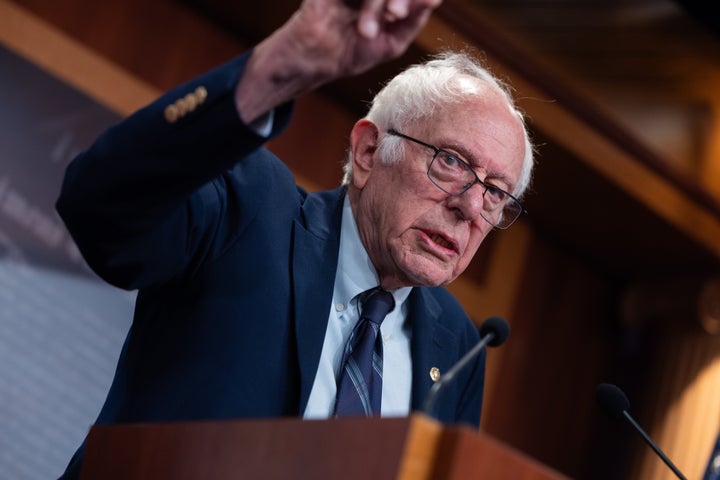
There’s also a populist backlash, with Sen. Bernie Sanders (I-Vt.) recently laying down a marker by proposing a total moratorium on the construction of the data centers powering the AI boom.
“This process is moving very, very quickly, and we need to slow it down,” Sanders said in a social media video announcing his proposal, noting the technology could lead to mass job loss and increased isolation among young people. “We need all of our people involved in determining the future of AI, and not just a handful of multibillionaires.”
Sanders’ proposal is highly unlikely to become law anytime soon, but it could become a rallying cry for progressives and other candidates willing to take a hard-line, populist stance against both AI itself and the construction of data centers, which have faced fierce backlash at the local level. Candidates adopting it, however, risk angering the aforementioned well-funded super PACs.
A third group, of which Bores is a member, is enthusiastic about the technology but argues that regulation is needed to help Americans adapt to it and limit the potentially catastrophic risks associated with its deployment. AI companies and researchers aligned with this view have launched their own nonprofit groups and super PACs, and are expected to spend $50 million on the midterms.
Advertisement
Polling has broadly made it clear Americans have a positive view of AI, but want more oversight of the technology: The Searchlight Institute, a Democratic think tank, released polling earlier this month showing roughly two-thirds of Americans want the government to regulate AI for safety and privacy reasons, even if regulations will slow down American AI development when compared to China.
But an outright ban on the technology was not very popular: By a 62% to 18% margin, Americans preferred regulating AI to banning further research. But when faced with either a ban or unregulated development of the technology, voters were nearly split: 30% favored a ban, to 34% who favored continued development.
Silicon Valley’s Warriors
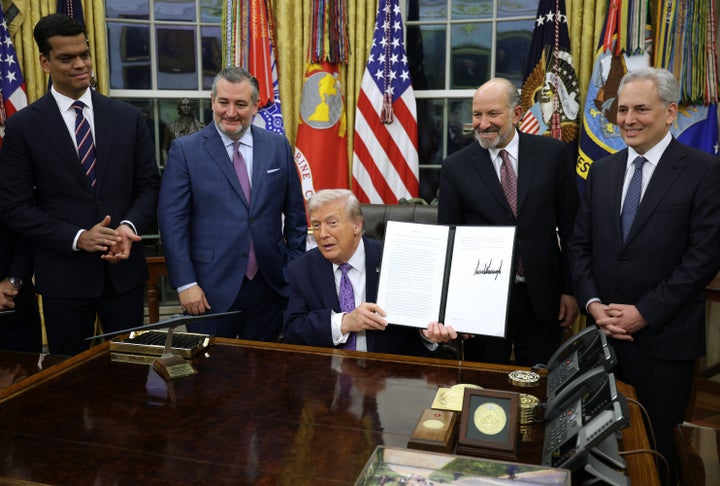
President Donald Trump, center, signs an executive order aiming to block most state-level regulation of artificial intelligence. His top AI advisor, David Sacks, is on the far right. Alex Wong via Getty Images
David Sacks, a venture capitalist and podcast host who serves as the White House’s AI czar, is perhaps the public face of the accelerationist flank. An ally of Elon Musk and Peter Thiel, he has successfully convinced Trump to adopt a pro-industry posture and was the primary author of a legally questionable executive order barring most state-level regulation of AI.
The tech industry has argued that complying with different regulations in each state would be an unacceptable handicap when the industry is in a Cold War-esque race with China to develop the most powerful AI technology possible.
“We have to be unified. China is unified,” Trump said when signing the order this month. “They have one vote, that’s President Xi. He says do it, and that’s the end of that.”
Leading The Future, a pro-industry super PAC planning to spend $100 million on the midterms, is putting financial might behind this worldview. Backed by leaders of both OpenAI and the venture capital firm Andreessen Horowitz, the group is explicitly modeled after crypto-industry-backed groups, which spent tens of millions of dollars on campaigns to force both parties to pay attention to their goals in 2022 and 2024.
Multiple operatives in both parties privately acknowledge that Leading The Future’s expected war chest is enough to make it one of three major forces, the others are the cryptocurrency industry and pro-Israel groups, every campaign has to account for in a competitive primary.
“Right now, [AI] simply isn’t a big enough issue to voters to risk getting on their radar,” one Democrat managing a campaign in a competitive House primary said, requesting anonymity to speak frankly. “That could change if anger about this stuff grows and grows.”
Besides attacking Bores, the group has also endorsed Chris Gober, a lawyer running for an open seat in Texas, a gerrymandered district stretching from the outskirts of Houston to Austin. The group’s ad backing Gober, a Republican election lawyer who represented both Musk and Sen. Ted Cruz (R-Texas) in high-profile cases, does not directly mention AI.
Leading The Future did not respond to HuffPost’s request for comment.
Most Republican candidates are expected to largely fall in line with Trump’s relatively laissez-faire position, though some populist right-wing forces ― including former Trump adviser Steve Bannon and the Institute for Family Studies, a conservative think tank ― are urging the GOP to take a far more skeptical look at the technology.

Opposition to data center construction has spread across the country, inspiring grassroots rebellions everywhere from Arizona to Wisconsin. Wild Horizon via Getty Images
Nathan Sage, a mechanic and Marine veteran running for the Democratic Senate nomination in Iowa with Sanders’ support, was among those to quickly embrace the call for a moratorium. In an interview, Sage said concerns about AI-related job loss and “youth talking to AI instead of people” were rampant during a 99-county tour of the state he completed earlier this year.
“When it comes to AI, it’s the wild wild west,” he said of the unregulated nature of the industry. “It seems like another ploy for billionaires and multi-billionaires to gain more money while taking away from the working class, and nothing really gained by the working class.”
Sage’s position is not without precedent. Democrats flipped a GOP-held state legislative seat in Virginia in November in large part due to anger over the proliferation of data centers in Northern Virginia. Concerns about how much water and electricity data centers use have played major roles in fights from Arizona to Maine, despite industry efforts to show the concerns are overblown.
But the position is not without political risk. Sage, who is competing with state Sen. Zach Wahls and state Rep. Josh Turek in the primary for the chance to battle GOP Rep. Ashley Hinson, could easily see himself on the receiving end of an advertising blitz.
The Populists’ Risk
Opposition to data center construction has spread across the country, inspiring grassroots rebellions everywhere from Arizona to Wisconsin. Wild Horizon via Getty Images
Nathan Sage, a mechanic and Marine veteran running for the Democratic Senate nomination in Iowa with Sanders’ support, was among those to quickly embrace the call for a moratorium. In an interview, Sage said concerns about AI-related job loss and “youth talking to AI instead of people” were rampant during a 99-county tour of the state he completed earlier this year.
“When it comes to AI, it’s the wild wild west,” he said of the unregulated nature of the industry. “It seems like another ploy for billionaires and multi-billionaires to gain more money while taking away from the working class, and nothing really gained by the working class.”
Sage’s position is not without precedent. Democrats flipped a GOP-held state legislative seat in Virginia in November in large part due to anger over the proliferation of data centers in Northern Virginia. Concerns about how much water and electricity data centers use have played major roles in fights from Arizona to Maine, despite industry efforts to show the concerns are overblown.
But the position is not without political risk. Sage, who is competing with state Sen. Zach Wahls and state Rep. Josh Turek in the primary for the chance to battle GOP Rep. Ashley Hinson, could easily see himself on the receiving end of an advertising blitz.
“I’m going to do what Iowans want,” Sage said, adding: “People are going to come into this room and pour money into this race on any side they want to, but I need to do what’s right.”
National progressive operatives similarly downplayed the political risk of angering the well-heeled tech industry, noting that many Sanders-style candidates are likely to face heavily funded negative advertising campaigns regardless.
But it’s not just the tech industry that could view opposition to data centers as a red flag. With data center construction surging while the rest of the economy is largely stagnant, construction unions have become heavily reliant on data center work to provide their members with jobs.
“These projects support our members’ lives, and those who do this work every day experience the story differently from what’s gaining traction online,” the executive director of the Wisconsin Building Trades Council wrote in an op-ed in the Milwaukee Journal-Sentinel last month amid multiple fights over data centers in the state. “The digital future our world is moving toward is tied to this infrastructure, and it can be a powerful catalyst for community growth when done right.”
Sage argued that unions were being short-sighted in supporting projects with heavy long-term costs. “You’re getting a couple hundred jobs in data center creation and you’re replacing it with pollution in our water, high energy costs and less jobs across the market,” he said.
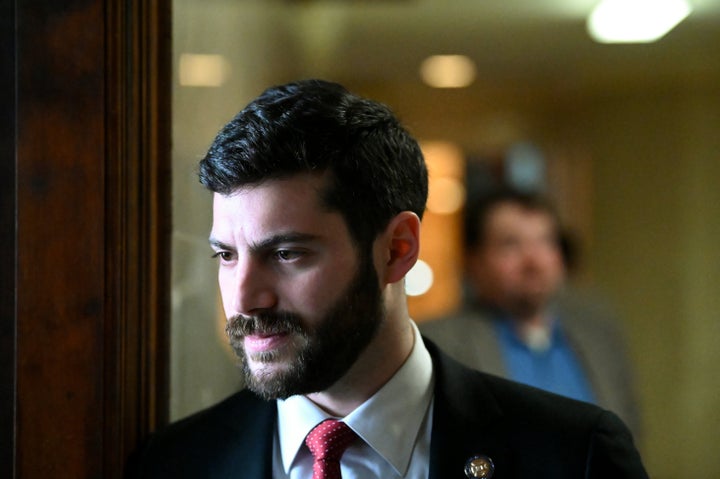
New York Assemblyman Alex Bores’ sponsorship of a law creating safety standards for AI models has made him a top target of a pro-AI industry super PAC. Albany Times Union/Hearst Newspapers via Getty Images
Bores, who is running in an extremely crowded primary to replace retiring Rep. Jerry Nadler in New York’s 12th District, has become the focal point of the midterm AI wars early on. The 35-year-old data scientist, who only joined the state legislature in 2023, is one of the lead sponsors of the RAISE Act, which created safety standards for the highest-tech AI models and fines for companies that failed to comply.
Even before Hochul signed it into law shortly before Christmas, Leading The Future was spending on digital ads targeting Bores through a separate PAC it funds. The ads label Bores “wrong on AI” and suggest he will cost the state jobs. Bores is welcoming the fight.
“They view me as their biggest obstacle to their quest for unbridled power over the American worker, over the education system and our kids, over our climate and our energy bills, and they’re right about that,” he said, noting the amount Leading The Future plans to spend against him has already increased from $1 million to $10 million. “I mean, they are seeing that they are deeply, deeply unpopular.”
But Bores is no Luddite: He points to the possibility AI could help find cures for his mother’s multiple sclerosis and says his “bullishness” about the technology is what’s driving him to push for legislation dealing with everything from how to protect kids using the technology to how to deal with the projected massive disruptions to the labor market.
The assemblyman also has AI industry supporters of his own ― some of whom helped raise money for Hochul while she was considering the RAISE Act ― and he could soon see support from Public First. Many of these backers are associated with the effective altruism movement, a philosophical approach that often focuses on existential threats like those posed by a superpowered AI.
The AI industry’s ads attacking Bores allude to this split, linking supporters of regulation to a particularly infamous adherent of effective altruism. “He’s backed by groups founded by convicted felon Sam Bankman-Fried,” an announcer intones. “Is that really who should be shaping AI safety for our kids?”
Bores brushed aside the attempt to link him to the convicted crypto scammer. “They’re desperate,” he said of Leading The Future, arguing the intra-industry split is more about researchers battling with executives and noting the RAISE Act had the backing of two winners of the Turing Award, the highest prize in computer science.
“The people who are building the technology, who understand the technology, want there to be reasonable regulations,” he said. “The bosses at the top that are primarily focused on profit don’t want there to be any regulation.”
With the desire for regulation only growing across the political spectrum, Bores argued, AI proponents need to understand that only a moderate position can fend off populist anger.
“If the industry’s voice ends up being dominated by this extreme minority from Leading the Future, then proposals like banning all data centers will gain more traction,” he said. “Instead, [industry should be] coming to the table and really engaging in how we can make sure that this technology benefits the many instead of the few.”
National progressive operatives similarly downplayed the political risk of angering the well-heeled tech industry, noting that many Sanders-style candidates are likely to face heavily funded negative advertising campaigns regardless.
But it’s not just the tech industry that could view opposition to data centers as a red flag. With data center construction surging while the rest of the economy is largely stagnant, construction unions have become heavily reliant on data center work to provide their members with jobs.
“These projects support our members’ lives, and those who do this work every day experience the story differently from what’s gaining traction online,” the executive director of the Wisconsin Building Trades Council wrote in an op-ed in the Milwaukee Journal-Sentinel last month amid multiple fights over data centers in the state. “The digital future our world is moving toward is tied to this infrastructure, and it can be a powerful catalyst for community growth when done right.”
Sage argued that unions were being short-sighted in supporting projects with heavy long-term costs. “You’re getting a couple hundred jobs in data center creation and you’re replacing it with pollution in our water, high energy costs and less jobs across the market,” he said.
The Intra-Industry War
New York Assemblyman Alex Bores’ sponsorship of a law creating safety standards for AI models has made him a top target of a pro-AI industry super PAC. Albany Times Union/Hearst Newspapers via Getty Images
Bores, who is running in an extremely crowded primary to replace retiring Rep. Jerry Nadler in New York’s 12th District, has become the focal point of the midterm AI wars early on. The 35-year-old data scientist, who only joined the state legislature in 2023, is one of the lead sponsors of the RAISE Act, which created safety standards for the highest-tech AI models and fines for companies that failed to comply.
Even before Hochul signed it into law shortly before Christmas, Leading The Future was spending on digital ads targeting Bores through a separate PAC it funds. The ads label Bores “wrong on AI” and suggest he will cost the state jobs. Bores is welcoming the fight.
“They view me as their biggest obstacle to their quest for unbridled power over the American worker, over the education system and our kids, over our climate and our energy bills, and they’re right about that,” he said, noting the amount Leading The Future plans to spend against him has already increased from $1 million to $10 million. “I mean, they are seeing that they are deeply, deeply unpopular.”
But Bores is no Luddite: He points to the possibility AI could help find cures for his mother’s multiple sclerosis and says his “bullishness” about the technology is what’s driving him to push for legislation dealing with everything from how to protect kids using the technology to how to deal with the projected massive disruptions to the labor market.
The assemblyman also has AI industry supporters of his own ― some of whom helped raise money for Hochul while she was considering the RAISE Act ― and he could soon see support from Public First. Many of these backers are associated with the effective altruism movement, a philosophical approach that often focuses on existential threats like those posed by a superpowered AI.
The AI industry’s ads attacking Bores allude to this split, linking supporters of regulation to a particularly infamous adherent of effective altruism. “He’s backed by groups founded by convicted felon Sam Bankman-Fried,” an announcer intones. “Is that really who should be shaping AI safety for our kids?”
Bores brushed aside the attempt to link him to the convicted crypto scammer. “They’re desperate,” he said of Leading The Future, arguing the intra-industry split is more about researchers battling with executives and noting the RAISE Act had the backing of two winners of the Turing Award, the highest prize in computer science.
“The people who are building the technology, who understand the technology, want there to be reasonable regulations,” he said. “The bosses at the top that are primarily focused on profit don’t want there to be any regulation.”
With the desire for regulation only growing across the political spectrum, Bores argued, AI proponents need to understand that only a moderate position can fend off populist anger.
“If the industry’s voice ends up being dominated by this extreme minority from Leading the Future, then proposals like banning all data centers will gain more traction,” he said. “Instead, [industry should be] coming to the table and really engaging in how we can make sure that this technology benefits the many instead of the few.”


No comments:
Post a Comment