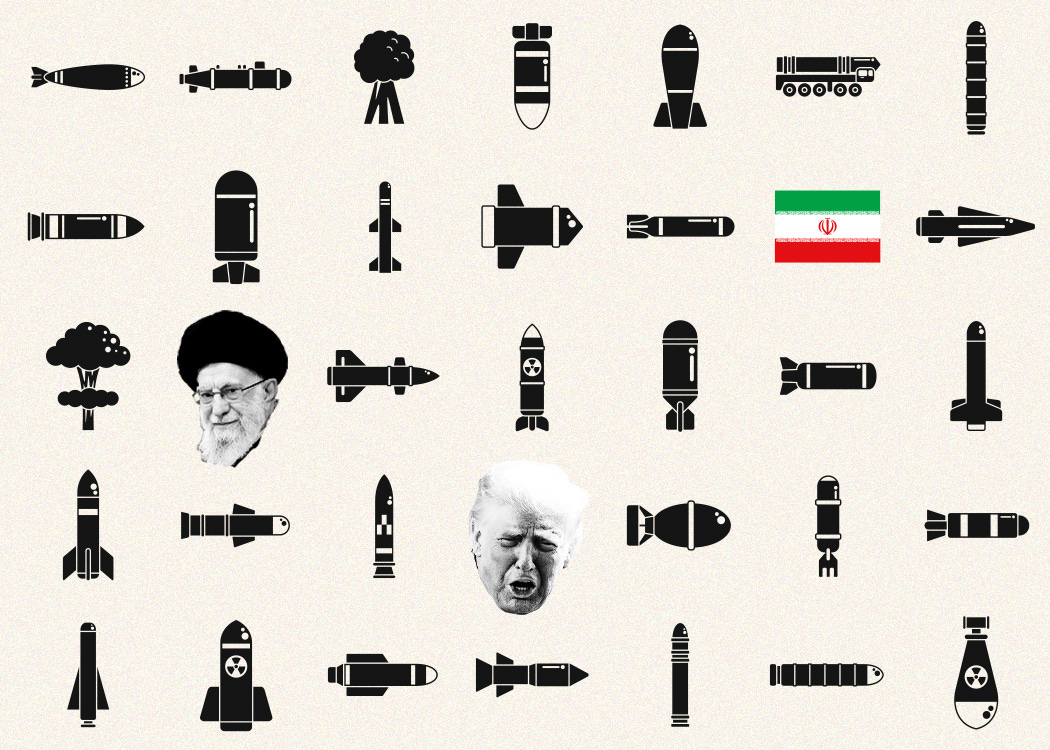

It comes down to a straightforward question: What’s the plan to translate military force into political change?
Feb 28, 2026
(Composite by Hannah Yoest,
THIS MORNING’S STRIKES IN IRAN looked like what Americans expect when their military is given specific orders and the time to plan: coordinated, intense, and precise. The targets were not random. They were the nervous system and connective tissue of the Iranian regime: leadership headquarters, intelligence nodes, air defense sites, command-and-control networks, internal security organs. They were the kinds of systems you hit when your objective is not merely punishment but paralysis. The kind you hit when more strikes are coming.
And more could be coming. Early reporting suggests the targets were selected to fracture regime coherence rather than simply destroy infrastructure. That signals an intent to pressure the regime’s internal control mechanisms, not just its military hardware.
The level of coordination required to do all this reflects the professionalism of the U.S. and Israeli militaries. It also reflects years of intelligence preparation, training, and contingency planning.
But make no mistake, this tactical excellence should not be mistaken for strategic clarity. The first night of a war is always the easiest night to make look clean. What follows is what ultimately determines whether this action truly strengthens American security. Degrading a regime’s capabilities is a military task; but replacing a regime, or trying to reshape its behavior through punishment from above, or compelling its people to rise up—those are strategic gambles that seem to rest on hope more than on a clearly articulated plan.
It is true that air campaigns can destroy things. What they cannot do, by themselves, is build political outcomes.
The news seems to come faster and more chaotic every day. Let’s make sense of it together. Join Bulwark+ for members-only newsletters, podcasts, and live events.
AS A YOUNG MAJOR in the late 1980s, before I first experienced combat in Iraq, I participated in war games at Fort Leavenworth. As emerging planners at the School of Advanced Military Strategy, my colleagues and I were forced to grapple with a scenario involving Iran. Even then—decades before today’s technology and regional dynamics—the exercise exposed the sheer complexity of the problem we faced after an opening air strike.
Those war games taught us a lesson that the war in Iraq later reinforced: Removing capabilities is not the same as managing the political fallout. Iraq was smaller, less geographically forbidding, and ultimately subjected to occupation. Yet even in those more favorable circumstances, regime removal did not yield immediate stability; in fact, it caused years of chaos and dysfunction.
Iran presents a far more complex challenge. It’s a nation of nearly 90 million people, three-and-a-half times the size of Iraq, with geography that punishes logistics, a politically and ethnically diverse population, and a political culture shaped by revolution, nationalism, and a narrative of resistance to foreign intervention. The regime has spent nearly half a century calling the United States the “Great Satan,” embedding that identity into institutions, education, and the internal security apparatus. Expecting or facilitating internal political collapse without leadership, organization, or protected political space is not a strategy for regime change—it’s a recipe for chaos.
In that year of study at Fort Leavenworth, we were also taught how to translate a political strategy into an operational plan to be executed by the military. The Trump administration’s recently released National Security Strategy and National Defense Strategy devote surprisingly little attention to Iran as a primary theater for major U.S. military action. Both documents emphasize dominance of the Western Hemisphere and deterrence in the Indo-Pacific. Iran appears largely in the context of regional instability and proxy threats—not as the focal point of a regime change campaign.
This disconnect matters. Strategy documents are meant to align national priorities with resources and to help decision-makers up and down the chain of command and around the world manage risk. When major military action unfolds outside those stated priorities, it signals strategic drift. Allies question our consistency. Adversaries question our focus. And planners are forced to reallocate resources from declared priorities to emergent crises, weakening deterrence elsewhere. Planners and executors assess all those factors when conducting a campaign.
BUT THE MOST TROUBLING aspect of the current campaign is the apparent gap between strategy and action. The ends, ways, and means of strategic planning don’t line up.
What is the end state for the Trump administration? Presidential rhetoric suggests a range of objectives: degrading Iran’s military capability, deterring regional attacks, weakening the regime, and encouraging internal upheaval. These are complicated goals. Each requires different methods, timelines, and political commitments.
What are the ways to make these objectives happen? Air strikes can degrade infrastructure and intimidate. But they cannot produce a popular uprising, generate legitimate leadership, unify a fractured opposition, or construct a stable political order.
There is a persistent belief in Washington that enough explosions will cause the Iranian people to rise up against their government. History suggests otherwise. Authoritarian regimes facing external attack often consolidate internal control, even when their leaders are eliminated. The Iranian state has layered redundancy into repression. The IRGC, Basij militias, and intelligence services frame external strikes as proof of foreign hostility. A population dissatisfied with its government can still rally against what it perceives as a foreign aggressor.
What are the means to pursue these objectives? The operation appears to rely heavily on military power while underweighting diplomatic legitimacy, alliance cohesion, and long-term political planning. Those elements—not Tomahawks—sustain strategic success.
Hope is not a method. A regime-change strategy without a phased-action plan is not a strategy at all. It’s an aspiration untethered from reality, and it will quickly lose support, either from the rest of the government or our citizens or both.
That is why the lack of visible coordination with Congress is equally concerning. Oversight is not merely a constitutional formality. Congressional engagement signals seriousness, durability, and legitimacy—to allies, adversaries, and the American public. It also represents the support of the American citizenry as voiced through their legislative representatives.
When Congress is sidelined, adversaries see an opportunity: Perhaps the United States lacks the political cohesion to sustain a prolonged effort in Iran. Allies hedge, uncertain whether they are being drawn into a conflict without shared deliberation. Markets react to perceived instability. And if casualties occur—as the president has acknowledged they might—public unity becomes a strategic asset that cannot be sustained or improvised.
There is also the perception—fair or not—that U.S. actions have been heavily influenced by Israeli strategic interests. Israel faces an existential threat from Iran’s missile forces and proxy networks. Its calculus is immediate and geographic. The United States, by contrast, must weigh global commitments, alliance structures, international reputation, and the risk of escalation across multiple theaters.
When U.S. policy appears driven by another state’s security priorities, even an ally’s, it complicates coalition-building. European partners may question whether they are being drawn into a regional conflict that does not align with their threat assessments. Gulf states may cooperate tactically while resisting deeper political alignment. In the long term, perceived policy capture—however inaccurate—erodes confidence in American strategic independence.
Our foes are also watching. Every intercepted missile, every repositioned carrier, every emergency resupply, every contested air corridor becomes data. In an era of real-time surveillance and analysis, the United States is never fighting only the opponent in front of it. Others are studying our methods, our munitions consumption, and most critically our political coherence and endurance.
Wars rarely begin with either side hoping to expand them. They spread and intensify through miscalculation, alliance obligations, and the internal logic of escalation. A first strike can be flawless and still lead to strategic failure if it’s not anchored to a realistic end state, sustained legitimacy, and a coalition willing to bear the costs.
The easiest question in war is, “Can we hit it?” The question that determines outcomes is, “What happens after we hit it? What happens the next day? What happens the year after?”
Right now, the United States has demonstrated it can strike with precision. What remains uncertain is whether we have a strategy that can sustain the consequences of doing so.


No comments:
Post a Comment