
BBC Central America and Cuba correspondent
There are only a handful of names that have had a lasting impact in the history of Mexican organised crime.
His killing has been heralded as a victory in both Mexico and the United States.
The Mexican authorities and the US reported that US intelligence was involved in bringing down the kingpin, lending the operation a sense of cross-border cooperation that could benefit both governments.
For the Mexican military, a cartel leader has been removed from the equation, thereby weakening – at least in theory, and maybe for a time – the criminal group he ran.
The response from El Mencho's men has been swift.
Mexico's most wanted drug lord 'El Mencho' killed in military operation
How does fentanyl get into the US?

Roadblocks have been erected and violence has spilt over into the streets in as many as eight different states, from Guerrero on the Pacific coast to Tamaulipas in the north-east. Even the capital Mexico City and the surrounding Mexico State have seen incidents.
Some of the worst violence has been in Jalisco itself, with masked gunmen setting fire to stores in the state capital, Guadalajara – one of the venues for this summer's Fifa World Cup. In the beach resort of Puerto Vallarta, tourists and locals alike are sheltering in place until the wave of violence passes.
It's a show of loyalty from El Mencho's foot-soldiers and a show of fury at the authorities for eliminating their leader. But whether the roadblocks and burning cars are for anything more than just show – whether the violence deescalates or ramps up – will become clear over next few days. The reaction by law enforcement will be critical in that regard.
It is a long-held truth about such transnational criminal groups that, even with a cartel head as influential as Nemesio Oseguera Cervantes, there are inevitably three or four well-placed lieutenants on hand to replace him.
Undoubtedly, though, El Mencho was key to the group's ascendancy.
When he moved to the United States as an undocumented immigrant in the 1980s, he had already had his first brushes with criminality in cultivating the marijuana fields of his native state. Various arrests in the US followed, as he dug deeper into narcotics crime in California, before eventually being sentenced to several years in prison in the US.
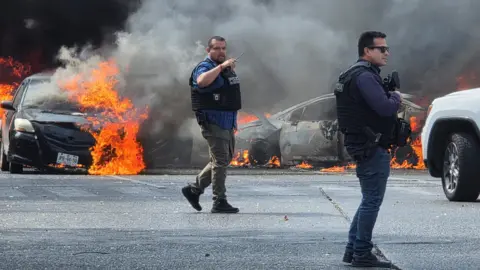 Reuters - Cars burn in Zapopan, near Guadalajara, after El Mencho's death on Sunday
Nemesio Oseguera was deported back to Mexico aged 30 and began to fully immerse himself in cartel activity. He worked for the Milenio Cartel, based out of his native Michoacán, and grew in stature and reputation as a calculating and cruel boss.
He was ideally placed when the cartel fractured and, from its remnants, the CJNG sprang up with El Mencho at its head.

This is the CJNG militants in full force - CNN
There are only a handful of names that have had a lasting impact in the history of Mexican organised crime.
3 hours ago
Nemesio Oseguera Cervantes – more commonly known as 'El Mencho' – is one of them. Hailing from humble rural roots in the western state of Michoacán, his rise to the top of one of the most feared and dangerous cartels in modern Mexico, the Jalisco New Generation Cartel (CJNG), was meteoric. And it was achieved through aggression, ambition, brutality and ruthlessness.
His killing has been heralded as a victory in both Mexico and the United States.
The Mexican authorities and the US reported that US intelligence was involved in bringing down the kingpin, lending the operation a sense of cross-border cooperation that could benefit both governments.
For the Mexican military, a cartel leader has been removed from the equation, thereby weakening – at least in theory, and maybe for a time – the criminal group he ran.
The response from El Mencho's men has been swift.
Mexico's most wanted drug lord 'El Mencho' killed in military operation
How does fentanyl get into the US?
Roadblocks have been erected and violence has spilt over into the streets in as many as eight different states, from Guerrero on the Pacific coast to Tamaulipas in the north-east. Even the capital Mexico City and the surrounding Mexico State have seen incidents.
Some of the worst violence has been in Jalisco itself, with masked gunmen setting fire to stores in the state capital, Guadalajara – one of the venues for this summer's Fifa World Cup. In the beach resort of Puerto Vallarta, tourists and locals alike are sheltering in place until the wave of violence passes.
It's a show of loyalty from El Mencho's foot-soldiers and a show of fury at the authorities for eliminating their leader. But whether the roadblocks and burning cars are for anything more than just show – whether the violence deescalates or ramps up – will become clear over next few days. The reaction by law enforcement will be critical in that regard.
It is a long-held truth about such transnational criminal groups that, even with a cartel head as influential as Nemesio Oseguera Cervantes, there are inevitably three or four well-placed lieutenants on hand to replace him.
Undoubtedly, though, El Mencho was key to the group's ascendancy.
When he moved to the United States as an undocumented immigrant in the 1980s, he had already had his first brushes with criminality in cultivating the marijuana fields of his native state. Various arrests in the US followed, as he dug deeper into narcotics crime in California, before eventually being sentenced to several years in prison in the US.
Reuters - Cars burn in Zapopan, near Guadalajara, after El Mencho's death on SundayNemesio Oseguera was deported back to Mexico aged 30 and began to fully immerse himself in cartel activity. He worked for the Milenio Cartel, based out of his native Michoacán, and grew in stature and reputation as a calculating and cruel boss.
He was ideally placed when the cartel fractured and, from its remnants, the CJNG sprang up with El Mencho at its head.
This is the CJNG militants in full force - CNN
Through a combination of territorial expansion and the nimbleness to pivot the cartel's activity into new and lucrative illegal activities, he turned the group into what it has become today – arguably the predominant criminal force in Mexico.
His leadership and his cartel benefited from the collapse of the Sinaloa Cartel after the extradition of its leader, Joaquín 'El Chapo' Guzmán, to the United States. Subsequent battles between warring factions in Sinaloa have ultimately torn the group apart.

Mexican National Guard, Credit CNN
The New Generation Cartel was on hand to hoover up an important portion of the fentanyl trade after the fall of El Chapo's sons. One of them, Joaquín Guzmán López, handed himself in to the US authorities and brought down his group's biggest rival, Ismael 'El Mayo' Zambada, with him.
El Mencho was a clear beneficiary of the vacuum and the dramatic sequence of events in Sinaloa. But as is so often the case in Mexican drug crime, it was not a crown he wore for long.
The government of President Claudia Sheinbaum will portray the removal of one of the most wanted men in Mexico as a victory and it will be echoed in Washington. It shows progress on the main issue on which President Donald Trump has demanded action from Mexico, after immigration: fentanyl trafficking.
Given the element of US intelligence apparently involved, it also underlines the Sheinbaum administration's willingness to work together with Washington in pursuit of the same goals. She would hope it will be enough to stave off any further talk of the need for unilateral US military action on Mexican soil in the form of drone strikes or boots on the ground – something which some in the Republican Party and in the Trump Administration have openly called for.
El Mencho was a clear beneficiary of the vacuum and the dramatic sequence of events in Sinaloa. But as is so often the case in Mexican drug crime, it was not a crown he wore for long.
The government of President Claudia Sheinbaum will portray the removal of one of the most wanted men in Mexico as a victory and it will be echoed in Washington. It shows progress on the main issue on which President Donald Trump has demanded action from Mexico, after immigration: fentanyl trafficking.
Given the element of US intelligence apparently involved, it also underlines the Sheinbaum administration's willingness to work together with Washington in pursuit of the same goals. She would hope it will be enough to stave off any further talk of the need for unilateral US military action on Mexican soil in the form of drone strikes or boots on the ground – something which some in the Republican Party and in the Trump Administration have openly called for.
Such discussions are still to come. For the time being, Mexicans are still processing that El Mencho is dead, and in his absence watching cartel members set fires in the streets in cities across the nation.
Violence erupts in Mexico after drug lord El Mencho killed

52 minutes ago
A wave of violence has broken out in Mexico after the country's most wanted drug baron was killed in a security operation to arrest him involving US intelligence.
Nemesio Oseguera Cervantes, known as "El Mencho", was the leader of the feared Jalisco New Generation (CJNG) drug cartel and died after being seriously injured in clashes between his supporters and the army on Sunday.
Four CJNG members were killed during the operation in the town of Tapalpa, in the central-western Jalisco state, and three army personnel were also injured, the Mexican defence ministry said.
Retaliation for the drug lord's death has seen violence spread to at least a dozen states, with CJNG blocking roads with burning vehicles.
Throughout Sunday, there were reports of gunmen on the streets in Jalisco and elsewhere.

Eyewitnesses filmed plumes of smoke rising over several cities including Guadalajara - one of the host cities of the forthcoming FIFA World Cup.
Jalisco's Governor Pablo Lemus Navarro declared a code red in the state, pausing all public transport and cancelling mass events and in-person classes.
Tourists who spoke to Reuters described the resort town of Puerto Vallarta, Jalisco, as a "war zone".
Some 250 roadblocks were in place across the country during the unrest, with 65 in Jalisco, the BBC's US news partner CBS reported. In its latest update, the Mexican Security Cabinet said four blockades remained active in Jalisco.
The cabinet says 25 people have been arrested, 11 for their alleged participation in violent acts and 14 more for alleged looting and pillaging.
Shops were on fire and about 20 bank branches were attacked in the violence, it added.

Shutterstock / Plumes of smoke rose along the waterfront in Puerto Vallarta
Mexican President Claudia Sheinbaum said there was "absolute coordination" between state and federal officials in response to the violence, urging people to stay "calm and informed".
Sheinbaum added that "in most parts of the country, activities are proceeding normally".
Several airlines have cancelled flights to Jalisco, including Air Canada, United Airlines and American Airlines.
The US has warned its citizens to shelter in place in five states: Jalisco, Tamaulipas, areas of Michoacán, Guerrero, and Nuevo Leon.
The UK government said "serious security incidents" had been reported in Jalisco, adding "you should exercise extreme caution" and follow the advice of local authorities.
Late on Sunday night, US Press Secretary Karoline Leavitt said El Mencho was a "top target for the Mexican and United States government as one of the top traffickers of fentanyl into our homeland."
She said three cartel members had been killed, another three wounded, and two arrested in the operation, for which the US had provided intelligence.
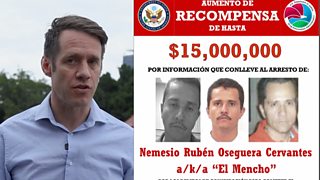
 The US had offered a $15m (£11.1m) bounty for information on El Mencho's whereabouts
El Mencho, a 59-year-old former police officer, ran a vast criminal organisation responsible for trafficking huge quantities of cocaine, methamphetamine and fentanyl into the US.
The US State Department had offered a $15m (£11.1m) reward for information leading to El Mencho's capture.
In a statement, the Mexican defence ministry said the operation was "planned and executed" by the country's special forces.
Mike Vigil, former Chief of International Operations for the US Drug Enforcement Administration, described the operation as "one of the most significant actions undertaken in the history of drug trafficking". He was speaking to CBS, the BBC's US news partner.


No comments:
Post a Comment