

Thomas Kohlmann
Whatever the outcome of the war between the US and Iran, the global energy markets won't return to normal for a very long time. Many observers believe that soaring fuel prices will give a decisive boost to renewable energies.
Behind the scenes of the current power struggle in the Persian Gulf, the world's two largest economies are competing over what the global energy architecture of the future will look like — and who will dominate it. Under President Donald Trump, the US is fully committed to ramping up oil and gas production, while China has been transforming itself over the past decade, from the world's largest emitter of CO2 to global leader of the electrical energy revolution.

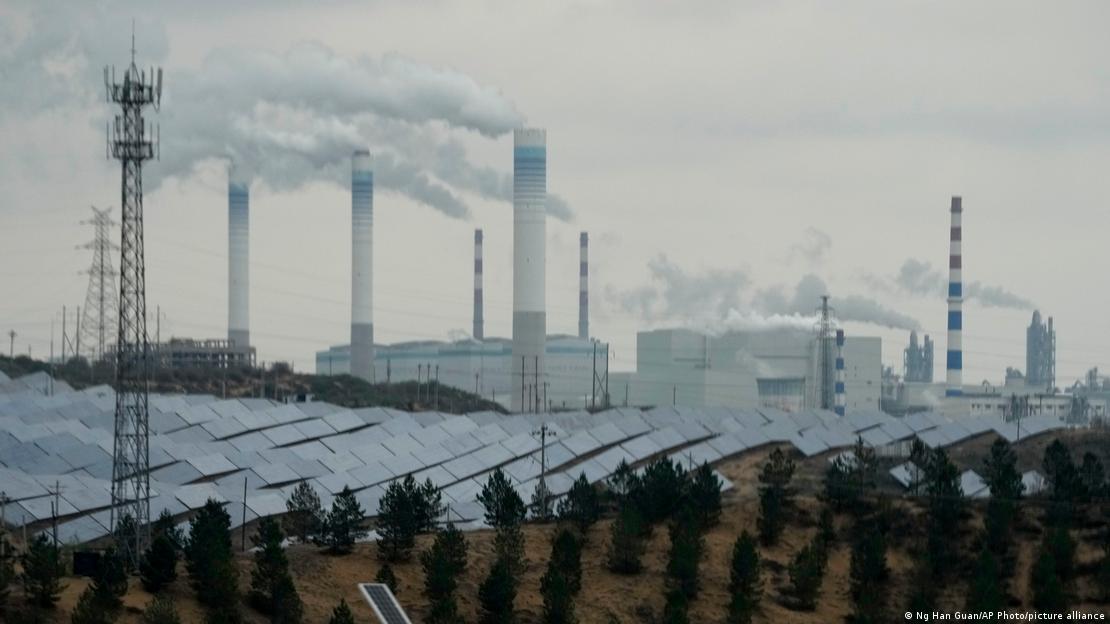
America wants the age of fossil fuels to go on as long as possible, while the Chinese are gradually implementing a strategy of global leadership by way of solar panels, storage batteries and electric cars "made in China."
Oil and gas as leverage for US foreign and economic policy
"In the US, the energy dominance agenda, which relies heavily on fossil energy markets, is clearly trying to politically leverage the US's energy wealth in the fossil sector," energy expert Andreas Goldthau, director of the Willy Brandt School of Public Policy at the University of Erfurt, told DW. "This goes so far as to try to bring other resource-rich countries like Venezuela under its control, or else to direct their resources, production, and exports."


"On the other hand, we have China, which is strongly focused on decarbonization, the clean tech sector and reducing imports of oil and gas. This is not just a matter of climate policy. On the contrary — it's a matter of economic security," Goldthau explains.
The Chinese, he says, have clearly recognized that they depend on others to maintain their economic model and they are doing everything they can to change this. "The Chinese are the largest investors in renewable energies and clean tech. And now they are leaders in the technologies we need to master the energy transition," says Goldthau.
From smart energy grids to solar or wind power, nothing can be made anymore without Chinese products and components, including rare earths. "They've made significant progress here, also with electrolyzers [for producing green hydrogen] and battery storage," Goldthau says. "The list is long. And they're doing this to establish resilience on the one hand, but also, of course, to achieve a certain level of self-sufficiency and sovereignty."
According to analyses by the International Energy Agency (IEA) and the McKinsey management consultancy, between 60% and 70% of all electric cars worldwide are manufactured in China. And because economic growth in China is slowing, huge oversupply is being created which is increasingly being exported to Europe.
No EVs without China?

Success of the 'made in China' program
China also holds all the cards in the key technologies of energy transition. It now controls about 80% of the global supply chain for photovoltaics. In some subsectors, such as the production of silicon wafers, its market share is over 95%. According to the IEA's Global EV Outlook, in the first half of 2025 China installed more solar capacity than the rest of the world combined.
China's share of global wind turbine production has also increased massively in recent years. According to figures from the World Wind Energy Association and data from Bloomberg New Energy Finance, China will account for around 72% of the global market for new wind turbines in 2025. Eight of the 10 leading manufacturers worldwide are now Chinese companies, such as Goldwind or Envision.


China's green technology exports more than quadrupled between 2020 and 2025. The energy think tank Ember calculated that in 2025 the clean energy sector contributed more than one third of China's total GDP growth.
US fossil energy dominance vs. China's electrified state
Meanwhile, the US under Trump is slamming the brakes on renewable energies while greatly accelerating the expansion of fossil fuels. During his election campaign, Trump's rallying cry to his supporters was "drill, baby, drill." Drill to the max is also the credo of Trump's energy secretary, Chris Wright, the founder and former CEO of Liberty Energy, the second-largest fracking company in north America.
"It's no secret that, under Trump, the US is pursuing a policy of 'energy dominance'," says Henning Gloystein, an energy expert at the London office of the New York-based consulting firm Eurasia Group. "This policy is being followed quite openly. Energy secretary Chris Wright has been talking about it for years. And this dominance is to be established by ramping up domestic oil and gas production and exports. They also want to gain control over foreign assets, as in Venezuela, for example, and as it may yet do in Iran."
US fracking revolution
According to US Energy Secretary Wright, in just 20 years the United States has gone from being the world's biggest importer of oil and gas to the biggest global gas exporter, and one of the dominant exporters of oil. This was made possible by the so-called "shale revolution": the fracking boom in the United States which has massively increased local production of natural gas and oil.
"Today, the United States produces more oil than Saudi Arabia and Russia combined and more natural gas than Russia, Iran and China combined, securing its role as the undisputed global energy leader," the White House states confidently on its website.
Lower tariffs for purchasers of US fossil fuels
Does this mean that, for Trump, oil is primarily a geopolitical power factor that must be owned and controlled? "Absolutely," says Gloystein of the Eurasia Group. He points to how the US is negotiating with its trade partners: "Last year, the US said: In exchange for relatively low tariffs, Europe must buy more American oil and gas." He comments that Washington is using the same tactic with other trade partners, like Japan, Thailand or India, and seeking to nail down supply contracts for as long as possible.
Gloystein explains US energy policy under Trump as follows: "If a German company asks for liquefied natural gas from the US, the new supplier says: 'OK, we can deliver two to three million tons of LNG to Germany starting in 2028, and it'll be a 20-year contract.' And with that they've integrated gas into Germany's energy systems for another 20 years. The Americans are very actively doing this."
US as guarantor for gas and oil
"The US is the biggest source of growth in global oil production," says Fatih Birol. The head of the International Energy Agency in Paris warns against focusing solely on fossil energy sources. "We mustn't forget: Energy security in the 21st century means not just the availability of oil and gas, but also the diversification of supply chains for clean technologies."
And this is where China clearly has the edge. The shale revolution has helped the US achieve energy independence and increased geopolitical weight. China aims to do the same with its global leadership in green technologies. But it is still a long way from achieving its goal: Around 60% of China's total energy requirement is still met by coal.
The energy experts Gloystein and Goldthau believe the trend globally is clearly toward renewable energy and not only since the Iran war, the blockade of the Strait of Hormuz, and the exorbitant oil and gas prices. But which will ultimately prevail: The fossil energy dominance of the United States, or the electrified state promoted by Beijing?
"If I had to bet on something right now," says Goldthau, "I would say the electrified state, which is not just trying to steer supply to domestic energy sources, and thus for the most part renewables, but is also, above all, developing the technologies needed by others."
This article has been translated from German.


No comments:
Post a Comment