

April 11, 2026 2:05 PM - Updated: April 11, 2026 7:26 PM This post has been updated with additional information on the transit.
Two Navy guided-missile destroyers entered the Strait of Hormuz on Saturday, the first American warships to transit the strait since the U.S.-Israel offensive in Iran began on Feb. 28.
USS Frank E. Petersen (DDG-121) and USS Michael Murphy (DDG-112) operated in the Persian Gulf after transiting the strait as part of the U.S. plan to “ensure the strait is fully clear of sea mines,” according to a Saturday U.S. Central Command news release. Frank E. Petersen is part of the Abraham Lincoln Carrier Strike Group, while Michael Murphy is an independently-deployed destroyer, according to USNI News’ Fleet and Marine Tracker. The pair of ships transited back through the strait to the Gulf of Oman, according to ship spotters.
Additional U.S. forces, to include underwater drones, according to the release.
The two ships transited the gulf to begin “setting conditions for clearing mines,” reads the release.
“Today, we began the process of establishing a new passage and we will share this safe pathway with the maritime industry soon to encourage the free flow of commerce,” CENTCOM Commander Adm. Brad Cooper said in the release.
Iran announced on Thursday that there were mines in the strait, the first Tehran confirmation, and laid out two paths that ships can use to avoid them, USNI News previously reported. One of the paths included the Tehran tollbooth, which required ships to sail by Iran’s Larak Island while also contacting the Islamic Revolutionary Guards Corps to provide documentation and, in some cases, payment.
In a post on Truth Social, President Donald Trump previewed the mine-clearing effort.
“We’re now starting the process of clearing out the Strait of Hormuz as a favor to Countries all over the World, including China, Japan, South Korea, France, Germany, and many others,” he wrote.
How the U.S.will clear the strait remains an open question. Over the last year, the Navy has made major changes to mine countermeasures in the Middle East. Last year, three Littoral Combat Ships replaced four Avenger-class Mine Countermeasure ships. USS Canberra (LCS-30), the first Independence-class Littoral Combat Ship with the first purpose-built MCM package, deployed in May to U.S. 5th Fleet with USS Santa Barbara (LCS-32) and USS Tulsa (LCS-16) arriving later last year.
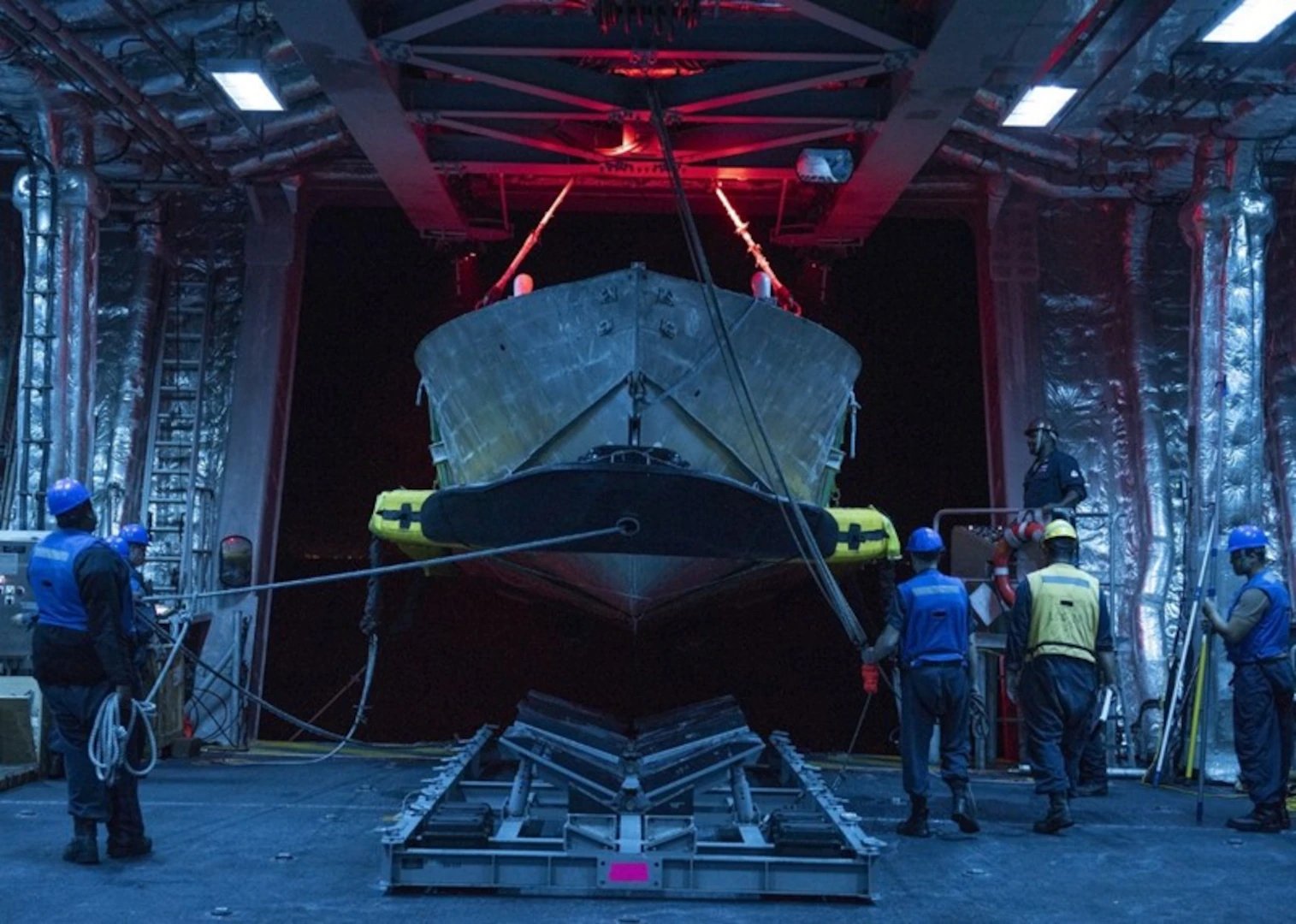 MCM UUV in the mission bay of an Independence-class Littoral Combat Ship. US Navy Photo
Unlike the legacy Avengers, the MCM package relies on a combination of unmanned and helicopter-borne systems to clear sea mines while remaining out of danger areas.
All three LCS departed the Persian Gulf ahead of the U.S. strikes. Santa Barbara and Tulsa were spotted in Singapore while Canberra was operating near Diego Garcia, USNI News understands.
This week, two Japan-based Avenger-class minesweepers were dispatched toward U.S. Central Command. USS Pioneer (MCM-9) and USS Chief (MCM-14) came into port in Singapore after transiting the South China Sea. A U.S. 5th Fleet spokesperson declined to comment on the destination of Pioneer and Chief when asked by USNI News earlier this week.
The four Avenger-class MCM ships in 5th Fleet were decommissioned in Bahrain late last year and arrived in Philadelphia by a heavy-lift ship in March to be scrapped.
In addition to LCS MCM packages and the Avengers, the Navy’s Explosive Ordnance Disposal community has 16 expeditionary MCM companies that use a combination of divers and unmanned systems that can operate on vessels of opportunity for mine-clearing operations. Those companies have deployed extensively in the Middle East, USNI News has reported.
If the ceasefire holds between Iran and U.S., mines become one of the only threats to ships, Dominick Donald, an advisor to the Joint War Committee, which represents war risk underwriters in the Lloyd’s insurance market, told USNI News. If the ceasefire fails or ends, then ships will have to face threats of Iranian projectiles as well.
There have not been any confirmed instances of a ship being hit by a mine since the conflict began. USNI News have tracked 29 vessels that have been hit by or in the area of Iranian projectiles.
 Iran’s National Security Commission chart of the government approved traffic seperations on April 9, 2026.
Transits through the strait have continued to trickle despite the two-week ceasefire between the U.S. and Iran. Shipping analysis Lloyd’s List Intelligence tracked six transits on Wednesday and eight on Thursday. On Tuesday, the day of President Donald Trump’s 8 p.m. deadline to open the strait, there were 15.
Between March 30 to April 5, there were 76 transits, the busiest week for the strait since the conflict began. Transits are still less than 10 percent of the typical daily flow, according to Lloyd’s List Intelligence.
There are an estimated 500 to 700 vessels over 10,000 dwt stuck in the Persian Gulf. That number is higher when ships under 10,000 dwt are added, Bridget Diakun, a senior editor with Lloyd’s List said during a Thursday webinar.
The Strait of Hormuz is a point of contention in ongoing negotiations between the U.S. and Iran. International maritime law treats the Strait of Hormuz as an international passage open to all, while Iran argues it is made up of Iranian and Omani territorial waters.


No comments:
Post a Comment