
World-first process uses junk DNA to shift sex determination
Bar-Ilan University researchers use CRISPR tool to alter Enh13 switch controlling Sox9 gene, causing XX mice to develop as males; study may help explain other genetic mutations
By Diana Bletter
9 April 2026
In a world first, scientists at Bar-Ilan University say they have discovered that a single-letter switch in a region of the genome once dismissed as “junk DNA” can reverse the biological sex of a mouse.
“If you change just one letter in the DNA in a place that doesn’t create proteins, and does not encode for anything, you can prevent the ability to create an ovary, and instead you will get development of testes,” said principal investigator Dr. Nitzan Gonen from the Mina and Everard Goodman Faculty of Life Sciences and Institute of Nanotechnology and Advanced Materials, in a recent video call with The Times of Israel. “This is why it’s super exciting.”
Using CRISPR technology, a gene-editing tool, the scientists changed “just one DNA letter out of about 2.8 billion,” Gonen said. “I was completely surprised to find that XX mice, which genetically should have been female, developed instead as males with full testes and male genitalia.”
The scientist said that 98 percent of our DNA, which is known as “dark matter” because it does not code for proteins, may hold the key to understanding mutations.
“Non-coding DNA can have a profound effect on development and disease,” Gonen said.
The peer-reviewed research, headed up by doctoral student and lead author Elisheva Abberbock and other researchers from Bar-Ilan University, along with Dr. Ariel Afek of the Weizmann Institute and Dr. Francis Poulat of the University of Montpellier, was published on Thursday in Nature Communications.
Biological sex, gender, and sexual orientation
Gonen laid the groundwork of her research by saying that when people talk about sex, “many people have the tendency to confuse biological sex with gender and with sexual orientation, but those are actually three different pillars or layers.”
Sex determination is a process that is “fully biological,” and it “all happens during embryonic development, giving rise to males or females.”
“We understand much of it, but not all of it,” she said.
The next issue is gender, she said, which may have a biological trait, “but we don’t have really good tools to study that with mice.”
Gonen laid the groundwork of her research by saying that when people talk about sex, “many people have the tendency to confuse biological sex with gender and with sexual orientation, but those are actually three different pillars or layers.”
Sex determination is a process that is “fully biological,” and it “all happens during embryonic development, giving rise to males or females.”
“We understand much of it, but not all of it,” she said.
The next issue is gender, she said, which may have a biological trait, “but we don’t have really good tools to study that with mice.”

Dr. Nitzan Gonen of the Mina and Everard Goodman Faculty of Life Sciences and Institute of Nanotechnology and Advanced Materials at Bar-Ilan University. (Courtesy)
“No mouse will come and tell me, ‘Look, I’m a female, but I feel like I’m a male,'” she said. “Those are things that are really hard to study, but we know they are there.”
She said that one in 100 children and adults around the world, including Israel, will feel like they don’t match their biological sex.
Finally, the last pillar is sexual orientation.
“Most males are attracted to females and females are attracted to males, but you can have females attracted to females and males attracted to males. We know that this also exists in the animal kingdom, but it’s harder to study. Mice won’t say who they’re very attracted to.”
Gonen’s lab focuses on biological sex, which is something that “we can study in the lab with animal models and have a better understanding, and it’s fully dependent on the genes,” she said.
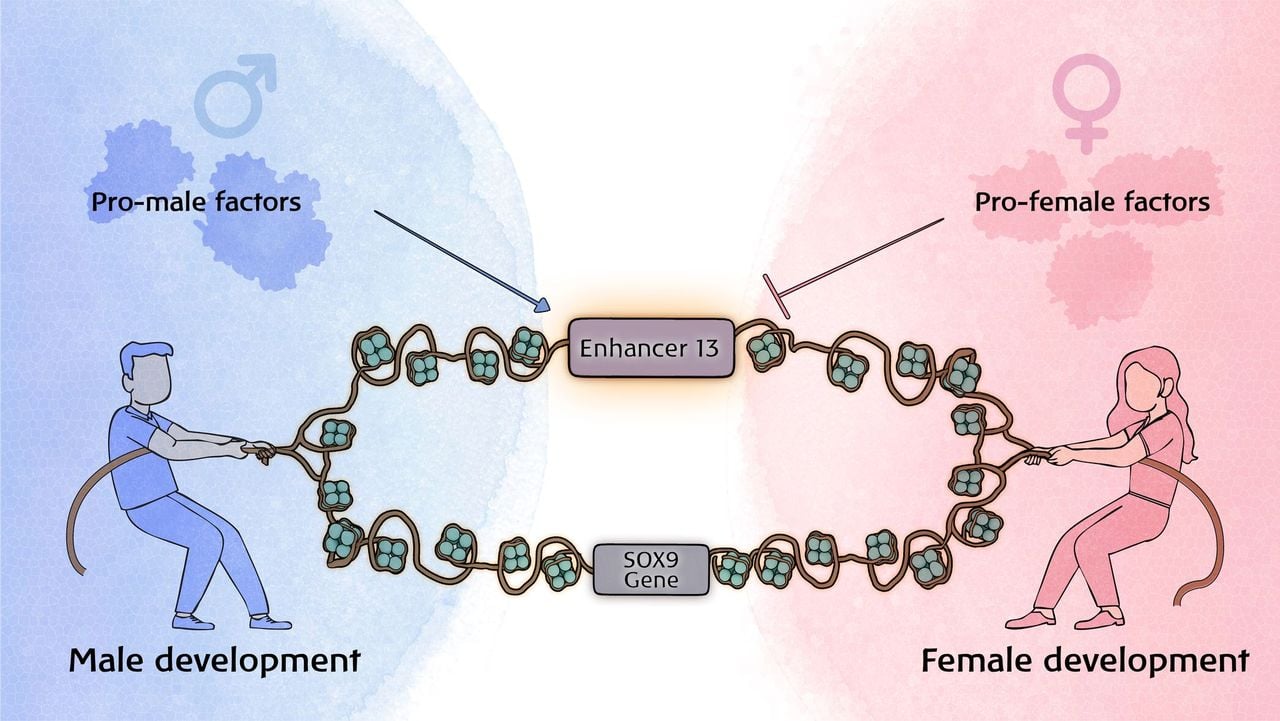
The figure depicts the Enh13 regulatory region alongside the Sox9 gene as a “battle site” between the sexes. Pro-female factors act to repress Sox9 via binding to Enh13, while pro-male factors activate it. The balance between these opposing forces ultimately determines whether male or female development occurs. (Courtesy/NetaVarsano)
Where the battle of the sexes begins
Gonen’s latest study focused on a genetic switch called Enh13, where “the battle of the sexes happens,” she said.
Enh13 is the element that controls an essential gene, Sox9, which must be turned on for testis development.
In a normal embryo, the Sox9 gene must be kept turned off to develop ovaries and become female.
The scientists used CRISPR genome editing to introduce microscopic “typos” into this switch.
Gonen’s latest study focused on a genetic switch called Enh13, where “the battle of the sexes happens,” she said.
Enh13 is the element that controls an essential gene, Sox9, which must be turned on for testis development.
In a normal embryo, the Sox9 gene must be kept turned off to develop ovaries and become female.
The scientists used CRISPR genome editing to introduce microscopic “typos” into this switch.
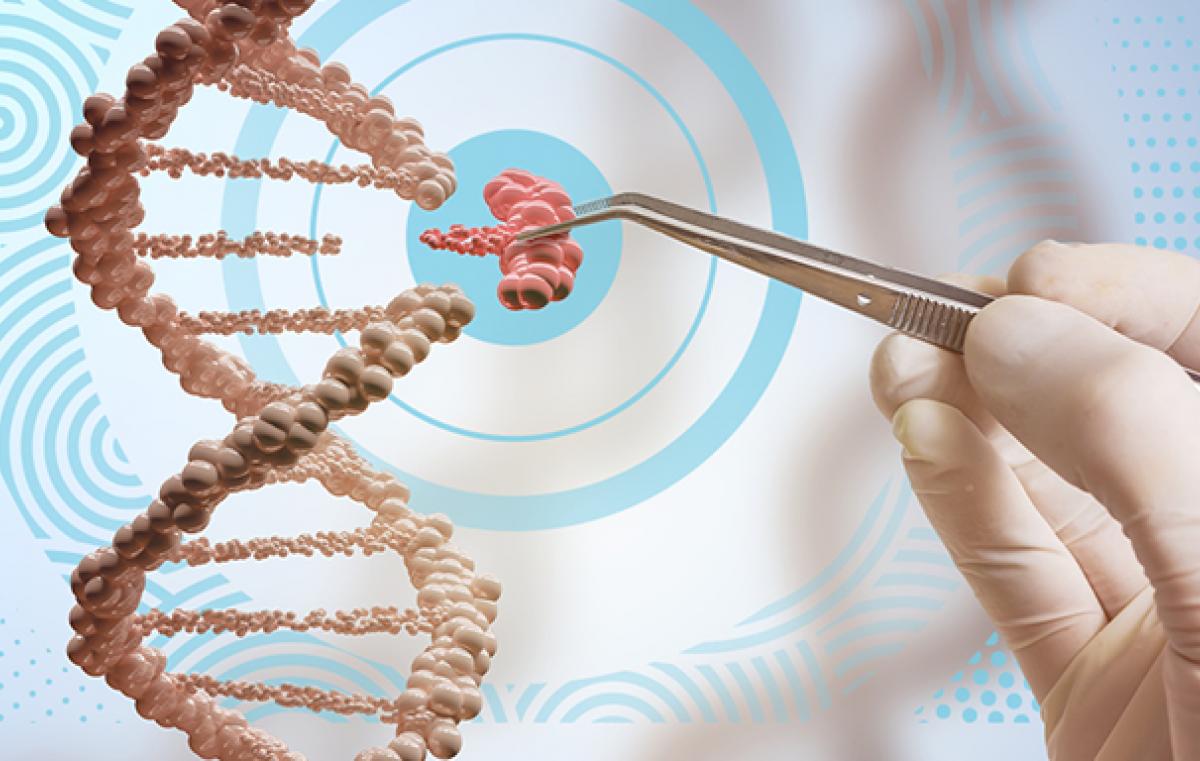 CRISPR technology allows researchers to edit genomes by altering DNA sequences to correct diseases. (Courtesy/Bar Ilan University)
“The result was elegant,” said Gonen. “In XX mice, the Sox9 gene was accidentally activated, leading to the development of full testes and male genitalia.”
“This discovery suggests that Enh13 must also be actively repressed to allow for female development,” she explained.
The current research builds on a study Gonen published in 2024, which showed that different small mutations in this same region could have the opposite effect, causing genetically male, XY mice, to develop as females.
Differences of Sex Development (DSD) in children
Gonen said that the research could help the approximately one in 4,000 children born with Differences of Sex Development (DSD), a condition where reproductive anatomy does not fit typical definitions of male or female.
This was once called “Disorders of Sex Development,” a term that is now considered inaccurate or inappropriate.
Gonen said that the research could help the approximately one in 4,000 children born with Differences of Sex Development (DSD), a condition where reproductive anatomy does not fit typical definitions of male or female.
This was once called “Disorders of Sex Development,” a term that is now considered inaccurate or inappropriate.
 An illustrative photo of an abdominal ultrasound during early pregnancy. (AlexRaths via iStock by Getty Images)
“If a mother is doing an ultrasound, for example, and the clinician sees a boy, but the chromosomal testing says you have a girl, then you understand that something is wrong,” Gonen said. “Or, if at puberty, your daughter’s friends are getting their period and she is not getting it, we will identify that she is biologically an XY and was supposed to be a boy.”
Gonen recounted that a woman came to her office saying that her son, “who was very tall and beautiful,” was trying to have children, but he and his partner were not successful.
“We found that he is an XX male,” she said. “I had to gently explain to her that someone who is born with XX chromosomes will never be able to have biological children because they lack the Y chromosome, which carries the essential genes for sperm production.”
“Understanding what is wrong gives people some peace of mind,” Gonen said. “Basically, people who have DSD are infertile.”
She said that is why she is convinced that down the road, people would not use this discovery to change the chromosomes of a fetus.
“You wouldn’t want to generate someone like that who is infertile,” Gonen said.
 Associate Professor Katie Ayers, Deputy Director of the Genomic Medicine Theme, and Co-Group Leader of Reproductive Development, at Murdoch Children’s Research Institute in Melbourne, Australia. (Courtesy)
“Less than 50% of children born with a difference in sex development will receive a definitive genetic diagnosis, meaning they receive sub-optimal clinical care,” Associate Professor Katie Ayers, deputy director of the Genomic Medicine Theme, and co-group leader of reproductive development at Murdoch Children’s Research Institute in Melbourne, Australia, told The Times of Israel.
Ayers was not involved in the research.
“This work demonstrates that even very small changes in enhancers for testicular or ovarian development can cause disrupted gonad development,” she said. “Investigation of these regions in DSD patients may lead to additional diagnoses and better clinical care.”
Gonen said that the discovery of how Enh13 functions is “just the tip of the iceberg.”
“There are probably hundreds more enhancers that sit somewhere scattered in the genome,” she said. “The variation or mutations in those regions could explain other unsolved cases of DSD, but also, more broadly, other genetic diseases that we don’t know how to explain, and we are starting to slowly understand.”


No comments:
Post a Comment