

CNN News
Updated 3:25 AM EDT, Sat June 6, 2026
• Conflict in Lebanon: More than 20 people were killed on Friday in Israeli strikes inside Lebanon, reported Lebanese state media. Meanwhile, Iran’s foreign minister Abbas Araghchi pushed back on Lebanese President Joseph Aoun’s remarks in a CNN interview, in which he said Tehran was using his country as a bargaining chip.
• Peace talks: A top Iranian official told CNN that a potential peace deal hinges on the Trump administration agreeing to release $24 billion in frozen Iranian assets, and warned of the potential for a wider war.
36 min ago

Smoke and destroyed homes seen in southern Lebanon on Friday Reuters
Israel’s military offensive against Hezbollah, a heavily armed Iranian-backed proxy, in Lebanon has killed more than 3,500 Lebanese people and displaced nearly a fifth of the population. Israeli forces have occupied dozens of villages in southern Lebanon to clear Hezbollah’s forces.
Assessed Israeli advances in Lebanon

1 hr 7 min ago

Lebanese soldiers at a road in front of destroyed houses in Dibbine village, southeast Lebanon, on Friday, June 5, 2026,. Hussein Malla/AP
The US and Iran exchanged strikes early Saturday local time, days after issuing contradictory messages about the status of ceasefire discussions.
Meanwhile in Lebanon, fighting between Israeli forces and Iran-backed Hezbollah has intensified despite a ceasefire agreed by the Israeli and Lebanese governments.
Strait of Hormuz: The US intercepted a wave of missiles and drones launched by Iran toward the Strait of Hormuz and the Gulf region. American forces also struck coastal surveillance radar sites in Iran after shooting down four attack drones, said US Central Command. Iran had fired several shots as a “warning” near the Strait of Hormuz, which “may have been related” to the repositioning of US naval vessels in the area, reported the semi-official Mehr news agency.
Gulf states: Sirens were activated early Saturday morning in Kuwait and Bahrain. Kuwait’s army said it was responding to missile and drone threats, while Bahrain told residents to take shelter.
Lebanon: More than 20 people were killed in strikes in the south of the country on Friday, according to a CNN tally of deaths reported in the state-run National News Agency.
Top diplomat hits back: Iran’s foreign minister pushed back on remarks Lebanese President Joseph Aoun made in a CNN interview that Tehran is using Lebanon as a bargaining chip in its war with the US and Israel. Abbas Araghchi said: “Save Lebanon from your real foe, Mr. President,” in an apparent reference to Israel.
War timeline: US President Donald Trump said that he’s “moving very fast” with the Iran war, despite his initial stated timeline of four to six weeks. “I’m into three months, you know. Vietnam lasted 19 years. I’m into my third month,” he told NBC News.
Nuclear lab visit: Trump’s special envoys Steve Witkoff and Jared Kushner met with a team of experts at a national laboratory in Tennessee on Thursday, a US official said, as the US works toward nuclear negotiations with Iran. Scott Roecker, the vice president for the Nuclear Threat Initiative’s Nuclear Materials Security Program, explained that the lab has a history of removing highly enriched uranium.
CNN’s Laura Sharman, Eyad Kourdi, Kareem El Damanhoury, Aleena Fayaz, Mitchell McCluskey, Kit Maher, Jennifer Hansler and Zachary Cohen contributed reporting.
Warning against return to war: Rezaei warned that Iran will “drag the war” beyond the Persian Gulf if the United States resumes the conflict, potentially expanding military operations from the Strait of Hormuz to the Indian Ocean, the Bab al-Mandab Strait, the Red Sea and the Mediterranean Sea. “We will give another dimension to the war by attacking these other American bases that we have been attacking so far.”
On a potential meeting between Trump and Khamenei: He did not answer a question about Khamenei’s health and role in the country’s decision-making, but rejected prospects of him meeting Trump. “This will not happen, right now we are in the first stage of negotiations and Mr. Trump has brought the negotiations to a standstill. This will not happen.”
Editor’s note: CNN operates in Iran only with the permission of the government but maintains full editorial control of its reports.
Here's the latest
• Exchange of fire: US forces intercepted missiles and drones launched by Iran toward the Strait of Hormuz and the Gulf region as sirens were activated in Kuwait and Bahrain. The US military also struck coastal sites in Iran. Tehran had fired shots as a “warning measure” that “may have been related” to US naval vessels in the area, according to Iranian media.• Conflict in Lebanon: More than 20 people were killed on Friday in Israeli strikes inside Lebanon, reported Lebanese state media. Meanwhile, Iran’s foreign minister Abbas Araghchi pushed back on Lebanese President Joseph Aoun’s remarks in a CNN interview, in which he said Tehran was using his country as a bargaining chip.
• Peace talks: A top Iranian official told CNN that a potential peace deal hinges on the Trump administration agreeing to release $24 billion in frozen Iranian assets, and warned of the potential for a wider war.
36 min ago
A look at Israel's offensive in Lebanon
By Becky Pinnington and Aditi SangalSmoke and destroyed homes seen in southern Lebanon on Friday Reuters
Israel’s military offensive against Hezbollah, a heavily armed Iranian-backed proxy, in Lebanon has killed more than 3,500 Lebanese people and displaced nearly a fifth of the population. Israeli forces have occupied dozens of villages in southern Lebanon to clear Hezbollah’s forces.
Take a look at the state of the offensive in Lebanese territory:
Israel's advance into southern Lebanon
Since the conflict between Israel and Hezbollah reignited in March, the Israeli military has established what it calls a buffer zone by advancing around six miles into southern Lebanon.Assessed Israeli advances in Lebanon

1 hr 7 min ago
Catch up: US and Iran trade fire, strikes in Gulf region, fighting in Lebanon intensifies
By Xiaoqian Lin
Lebanese soldiers at a road in front of destroyed houses in Dibbine village, southeast Lebanon, on Friday, June 5, 2026,. Hussein Malla/AP
The US and Iran exchanged strikes early Saturday local time, days after issuing contradictory messages about the status of ceasefire discussions.
Meanwhile in Lebanon, fighting between Israeli forces and Iran-backed Hezbollah has intensified despite a ceasefire agreed by the Israeli and Lebanese governments.
What has happened in the region:
Strait of Hormuz: The US intercepted a wave of missiles and drones launched by Iran toward the Strait of Hormuz and the Gulf region. American forces also struck coastal surveillance radar sites in Iran after shooting down four attack drones, said US Central Command. Iran had fired several shots as a “warning” near the Strait of Hormuz, which “may have been related” to the repositioning of US naval vessels in the area, reported the semi-official Mehr news agency.
Gulf states: Sirens were activated early Saturday morning in Kuwait and Bahrain. Kuwait’s army said it was responding to missile and drone threats, while Bahrain told residents to take shelter.
Lebanon: More than 20 people were killed in strikes in the south of the country on Friday, according to a CNN tally of deaths reported in the state-run National News Agency.
Other headlines:
Top diplomat hits back: Iran’s foreign minister pushed back on remarks Lebanese President Joseph Aoun made in a CNN interview that Tehran is using Lebanon as a bargaining chip in its war with the US and Israel. Abbas Araghchi said: “Save Lebanon from your real foe, Mr. President,” in an apparent reference to Israel.
War timeline: US President Donald Trump said that he’s “moving very fast” with the Iran war, despite his initial stated timeline of four to six weeks. “I’m into three months, you know. Vietnam lasted 19 years. I’m into my third month,” he told NBC News.
Nuclear lab visit: Trump’s special envoys Steve Witkoff and Jared Kushner met with a team of experts at a national laboratory in Tennessee on Thursday, a US official said, as the US works toward nuclear negotiations with Iran. Scott Roecker, the vice president for the Nuclear Threat Initiative’s Nuclear Materials Security Program, explained that the lab has a history of removing highly enriched uranium.
CNN’s Laura Sharman, Eyad Kourdi, Kareem El Damanhoury, Aleena Fayaz, Mitchell McCluskey, Kit Maher, Jennifer Hansler and Zachary Cohen contributed reporting.
1 hr 14 min ago
Iran’s top diplomat has pushed back on remarks Lebanese President Joseph Aoun made in a CNN interview that Tehran is using Lebanon as a bargaining chip in its war with the US and Israel.
Aoun delivered a searing rebuke to Iran in an exclusive interview with CNN’s Christiane Amanpour on Friday, saying Tehran’s actions were against the wishes of the Lebanese people.

Lebanon’s President slams IRGC, calls on Hezbollah to pursue dialogue in CNN exclusive
Responding to the clip of the CNN interview, Iran’s Foreign Minister Abbas Araghchi said: “Had Lebanon been a bargaining chip for Iran, we’d have a deal long ago.”
“Save Lebanon from your real foe, Mr. President,” he added, in an apparent reference to Israel –– which has been conducting an intense military operation targeting the militant group Hezbollah in Lebanon since early March.
In the CNN interview, Aoun also said that he is committed to doing “whatever it takes” to save his country from conflict, and that the Lebanese people are “fed up” with war between Israel and Hezbollah, a heavily armed Iranian-backed proxy that has built strong domestic support by portraying itself as the defender of southern Lebanon and the Palestinian people.
CNN’s Mostafa Salem contributed to this report.
Iran's top diplomat rejects Lebanese leader's claim Tehran is using Lebanon as a bargaining chip
By Laura Sharman and Kareem El DamanhouryIran’s top diplomat has pushed back on remarks Lebanese President Joseph Aoun made in a CNN interview that Tehran is using Lebanon as a bargaining chip in its war with the US and Israel.
Aoun delivered a searing rebuke to Iran in an exclusive interview with CNN’s Christiane Amanpour on Friday, saying Tehran’s actions were against the wishes of the Lebanese people.
Lebanon’s President slams IRGC, calls on Hezbollah to pursue dialogue in CNN exclusive
Responding to the clip of the CNN interview, Iran’s Foreign Minister Abbas Araghchi said: “Had Lebanon been a bargaining chip for Iran, we’d have a deal long ago.”
“Save Lebanon from your real foe, Mr. President,” he added, in an apparent reference to Israel –– which has been conducting an intense military operation targeting the militant group Hezbollah in Lebanon since early March.
In the CNN interview, Aoun also said that he is committed to doing “whatever it takes” to save his country from conflict, and that the Lebanese people are “fed up” with war between Israel and Hezbollah, a heavily armed Iranian-backed proxy that has built strong domestic support by portraying itself as the defender of southern Lebanon and the Palestinian people.
CNN’s Mostafa Salem contributed to this report.
1 hr 15 min ago
US Forces struck Iranian coastal defense sites in in Goruk and on Qeshm Island on June 5. US Central Command
The US intercepted a wave of ballistic missiles and drones launched by Iran toward the Strait of Hormuz and the Gulf region, according to US Central Command.
“Iran fired seven ballistic missiles toward Kuwait and Bahrain hours after U.S. Central Command (CENTCOM) shot down four Iranian one-way attack drones that were launched toward the Strait of Hormuz,” CENTCOM said Saturday local time in a statement.
Six of the missiles were intercepted and a seventh did not reach its target, according to initial assessments. No US personnel was harmed, it said.
“Iranian claims of damaging U.S. 5th fleet headquarters in Bahrain are false,” CENTCOM added. Iran’s Islamic Revolutionary Guard Corps had said it struck “enemy bases in the region.”
CENTCOM said the Iranian attack drones had “posed an immediate threat to regional maritime traffic.”
The US forces struck Iranian surveillance radar sites in Goruk and on Qeshm Island “to defend against further maritime attacks,” it said.
Iran’s semi-official Mehr news agency reported on Saturday that Iran had fired several shots as a “warning” near the Strait of Hormuz which “may have been related” to the repositioning of US naval vessels in the area.
CENTCOM: US intercepts Iranian missiles and drones launched toward Hormuz and Gulf region
By Laura SharmanUS Forces struck Iranian coastal defense sites in in Goruk and on Qeshm Island on June 5. US Central Command
The US intercepted a wave of ballistic missiles and drones launched by Iran toward the Strait of Hormuz and the Gulf region, according to US Central Command.
“Iran fired seven ballistic missiles toward Kuwait and Bahrain hours after U.S. Central Command (CENTCOM) shot down four Iranian one-way attack drones that were launched toward the Strait of Hormuz,” CENTCOM said Saturday local time in a statement.
Six of the missiles were intercepted and a seventh did not reach its target, according to initial assessments. No US personnel was harmed, it said.
“Iranian claims of damaging U.S. 5th fleet headquarters in Bahrain are false,” CENTCOM added. Iran’s Islamic Revolutionary Guard Corps had said it struck “enemy bases in the region.”
CENTCOM said the Iranian attack drones had “posed an immediate threat to regional maritime traffic.”
The US forces struck Iranian surveillance radar sites in Goruk and on Qeshm Island “to defend against further maritime attacks,” it said.
Iran’s semi-official Mehr news agency reported on Saturday that Iran had fired several shots as a “warning” near the Strait of Hormuz which “may have been related” to the repositioning of US naval vessels in the area.
1 hr 22 min ago
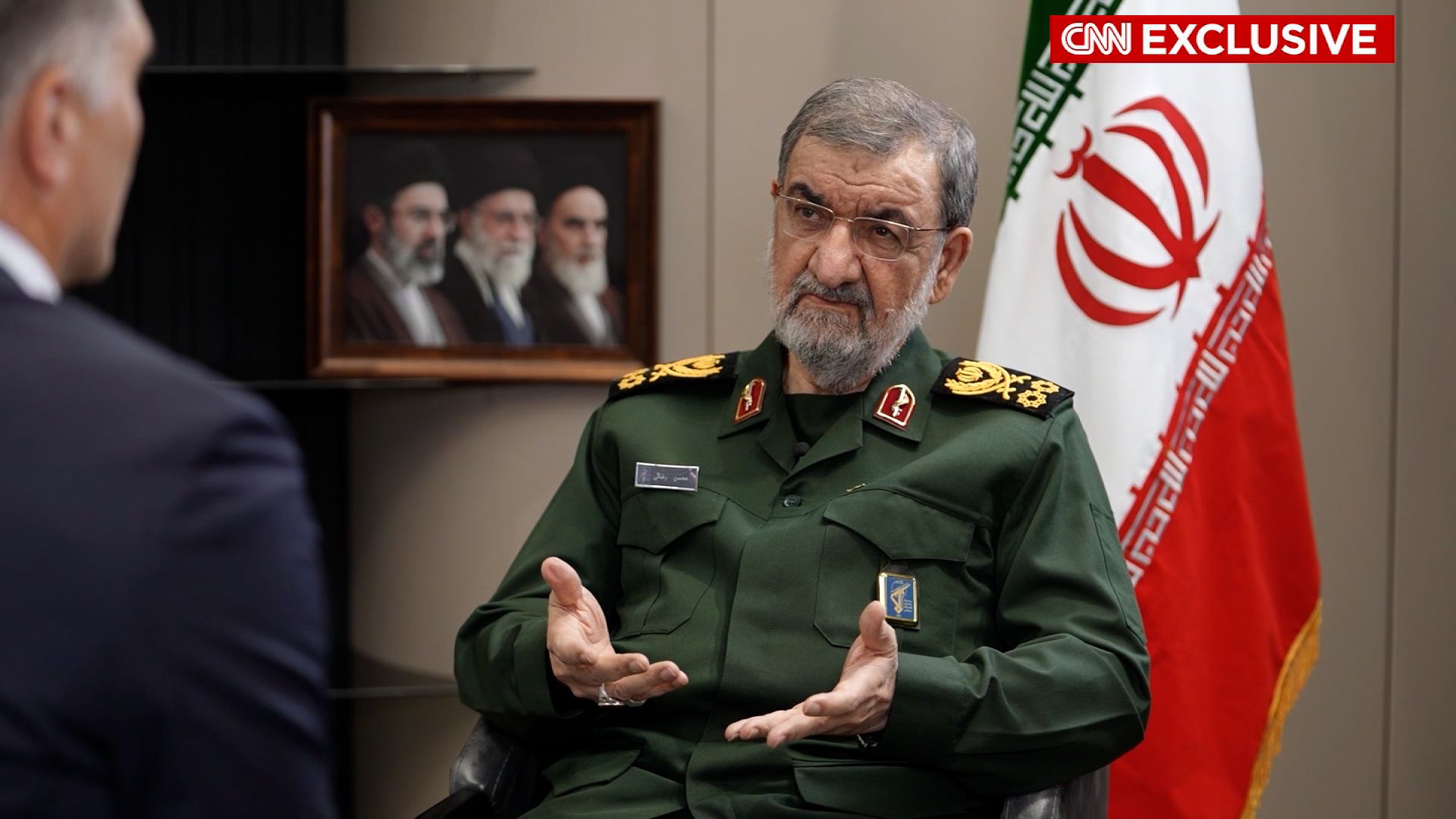
Top Iranian official: Trump and Iran's supreme leader will not meet
A potential peace deal between the United States and Iran hinges on the Trump administration agreeing to release $24 billion in frozen Iranian assets, a top Iranian official told CNN on Friday, warning that the US would “enter into a dark corridor” should it resume fighting.
“The negotiations are at a deadlock and (US President Donald) Trump must break this deadlock,” Mohsen Rezaei, military adviser to Supreme Leader Ayatollah Mojtaba Khamenei, told CNN in an exclusive interview in Tehran. “The ball is in Trump’s court.”
Iran has reportedly demanded the release of $12 billion in frozen funds as soon as an interim agreement is signed with the US, and another $12 billion at a later stage. US officials are concerned that any unfreezing of funds at this stage could remove a key leverage point over the regime.
In the rare interview with CNN, Rezaei shed light on the thinking inside Iran’s strategic decision-making circles about the country’s postwar vision, the fate of the Strait of Hormuz and how Iran may act if it is attacked again. Here’s what he said:
Releasing frozen Iranian assets: He framed the demand as a trust-building measure, saying the Trump administration’s potential release of the funds would be “a new horizon for the future” of Iran and America: “If he (Trump) wants to reach an agreement with Iran, this $24 billion is a test of trust that Iran wants to have with Trump – this is a test that America must pass and the path will be opened.”
Top Iranian official says peace negotiations are deadlocked over $24 billion
By Frederik Pleitgen and Claudia Otto in TehranTop Iranian official: Trump and Iran's supreme leader will not meet
A potential peace deal between the United States and Iran hinges on the Trump administration agreeing to release $24 billion in frozen Iranian assets, a top Iranian official told CNN on Friday, warning that the US would “enter into a dark corridor” should it resume fighting.
“The negotiations are at a deadlock and (US President Donald) Trump must break this deadlock,” Mohsen Rezaei, military adviser to Supreme Leader Ayatollah Mojtaba Khamenei, told CNN in an exclusive interview in Tehran. “The ball is in Trump’s court.”
Iran has reportedly demanded the release of $12 billion in frozen funds as soon as an interim agreement is signed with the US, and another $12 billion at a later stage. US officials are concerned that any unfreezing of funds at this stage could remove a key leverage point over the regime.
In the rare interview with CNN, Rezaei shed light on the thinking inside Iran’s strategic decision-making circles about the country’s postwar vision, the fate of the Strait of Hormuz and how Iran may act if it is attacked again. Here’s what he said:
Releasing frozen Iranian assets: He framed the demand as a trust-building measure, saying the Trump administration’s potential release of the funds would be “a new horizon for the future” of Iran and America: “If he (Trump) wants to reach an agreement with Iran, this $24 billion is a test of trust that Iran wants to have with Trump – this is a test that America must pass and the path will be opened.”
Warning against return to war: Rezaei warned that Iran will “drag the war” beyond the Persian Gulf if the United States resumes the conflict, potentially expanding military operations from the Strait of Hormuz to the Indian Ocean, the Bab al-Mandab Strait, the Red Sea and the Mediterranean Sea. “We will give another dimension to the war by attacking these other American bases that we have been attacking so far.”
On a potential meeting between Trump and Khamenei: He did not answer a question about Khamenei’s health and role in the country’s decision-making, but rejected prospects of him meeting Trump. “This will not happen, right now we are in the first stage of negotiations and Mr. Trump has brought the negotiations to a standstill. This will not happen.”
Editor’s note: CNN operates in Iran only with the permission of the government but maintains full editorial control of its reports.


No comments:
Post a Comment