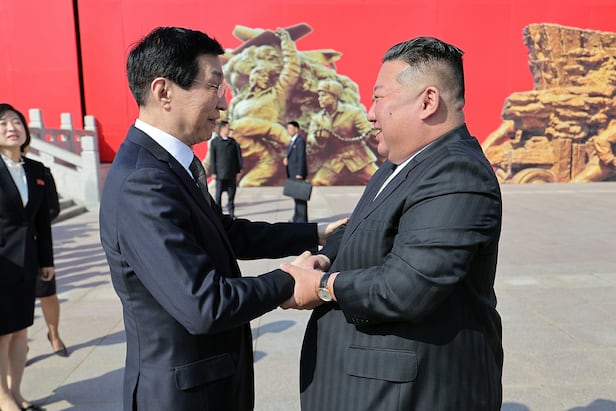

Analysts suggest Beijing's move balances North Korea ties with upcoming U.S. talks and internal party meetings
Published 2026.10.26. 00:45
North Korean leader Kim Jong-un’s visit to Beijing marked his sixth trip to the country, but it was the first time he did not meet with Chinese President Xi Jinping. It has been suggested that Xi Jinping avoided a summit with Kim Jong-un due to upcoming major political schedules for the Communist Party of China and considerations ahead of the U.S.-China summit next month.
However, as Wang Huning, the fourth-highest-ranking official and chairman of the National Committee of the Chinese People’s Political Consultative Conference, conveyed Xi Jinping’s regards and hosted a banquet, analysts argue that this was a compromise diplomacy aimed at reaffirming North Korea-China relations without a summit, rather than a deliberate snub by Beijing.
Wang Huning is noted as a key ideologist who served under three generations of leaders—Jiang Zemin, Hu Jintao, and Xi Jinping—and is credited with designing Xi Jinping’s governance philosophy. If the primary purpose had been economic cooperation, Chinese Premier Li Qiang, who oversees economic policies, might have taken the lead. However, Beijing chose a core figure in political and ideological affairs to engage with Kim Jong-un, implying that this visit aimed not only to strengthen economic collaboration but also to solidify political solidarity between the two nations.
Xi Jinping’s decision not to meet Kim Jong-un appears to stem from both political scheduling and diplomatic calculations. Beijing is set to host the fifth plenary session of the 20th Central Committee of the Communist Party from October 26–29 to discuss high-level personnel reshuffles ahead of next year’s party congress, making it difficult for Xi Jinping to leave the capital. Additionally, with a scheduled meeting with U.S. President Donald Trump during the Asia-Pacific Economic Cooperation (APEC) summit in Shenzhen on November 18–19, Beijing may have been reluctant to highlight strategic solidarity with North Korea through a summit.
A Beijing diplomatic source said on the 25th, “Amid efforts to manage U.S.-China relations, Beijing may have sought to avoid amplifying the influence of the ‘North Korea’ variable.” There are also observations that retaining the diplomatic card of a North Korea-China summit could provide Beijing with more leverage in future negotiations with the U.S.


No comments:
Post a Comment