But only a few GOP senators will admit it

November 10
(Photo illustration by Bill Kuchman/The Bulwark)
(Photos: Getty, Shutterstock)
Run this townAs I was finishing this newsletter, word came from House Republicans that they settled on Rep. Jim Jordan of Ohio to be their new leader as they move into the minority in January. With Speaker Mike Johnson saying he didn’t want the job, the choice came down to Jordan, the in-your-face chairman of the Judiciary Committee and Freedom Caucus cofounder, and the widely liked and relatively milder-mannered Steve Scalise, who has spent nearly four years as majority leader after about a decade as the Republican whip. Jordan and Scalise previously faced off in 2023, clashing over who would succeed Speaker Kevin McCarthy; ultimately, neither had enough support, and the job went instead to Johnson.
I just shot a quick video on this:Empire state of mind
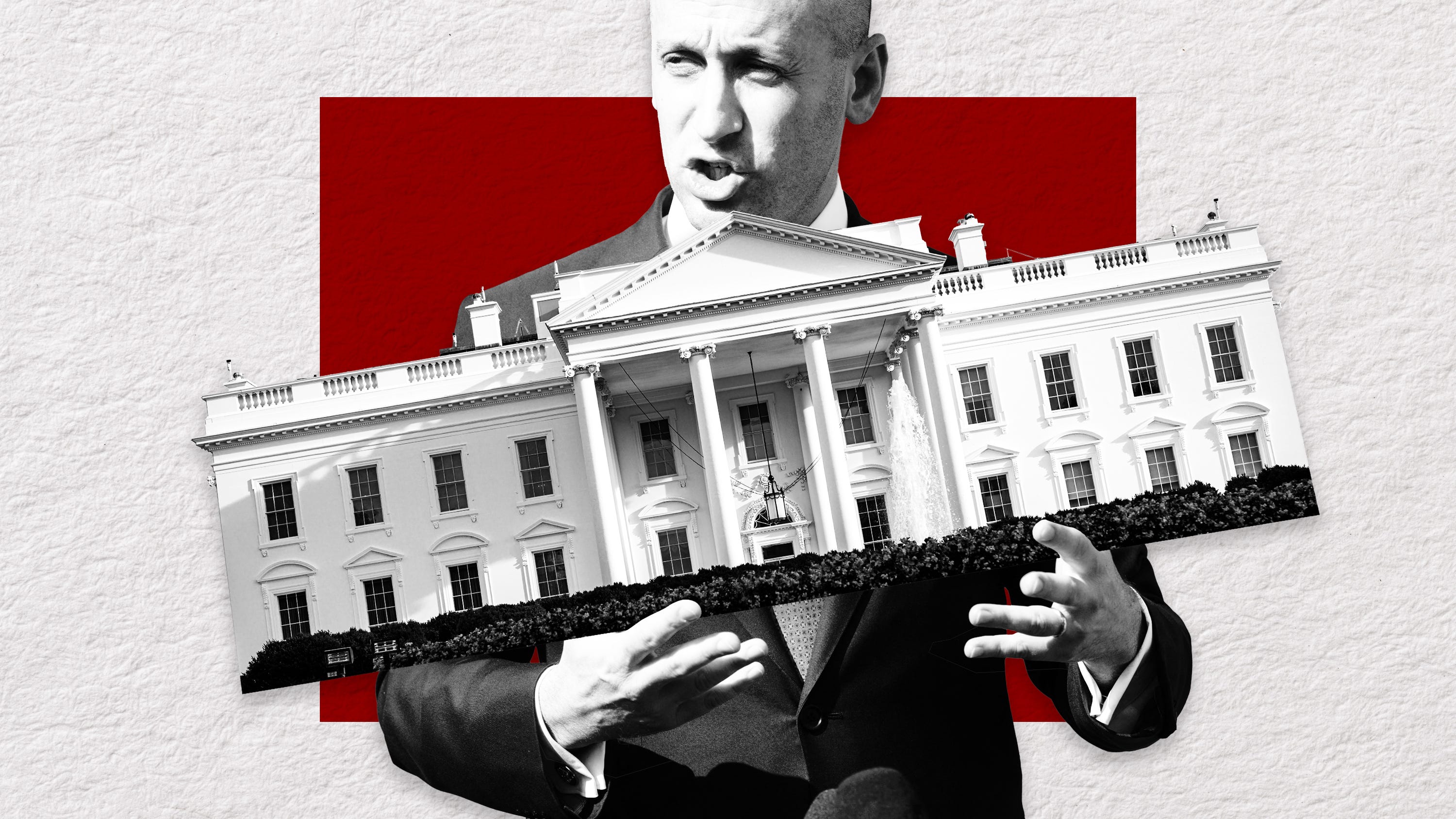
Donald Trump’s decision last week to name Stephen Miller as his new White House chief of staff gives the impression that instead of learning from and correcting the policy mistakes of the past two years, the president intends to double down on them. Miller has been unapologetically racist, and his prejudices and hatreds have fueled much of the Trump administration’s nativist agenda, especially in the area of immigration enforcement. He will now hold even more power over the administration’s policy direction.
Naturally I wanted to ask Republican senators, newly returned to Capitol Hill on their first day back in session, for their thoughts on Miller’s promotion.
First, I sought out two of the Republicans leaving Congress at the end of the term. I hoped they would offer some unvarnished honesty, and they did not disappoint.
“I think it’s the worst possible thing that could have happened this week,” Sen. Thom Tillis (R-N.C.) told me. “Look, this guy was deputy White House chief of staff and senior policy advisor and homeland security advisor. Tell me, what in Homeland Security before Markwayne Mullin got there was going well for this administration?”
“So, for a year, this guy is helping advise on homeland security where we lost the immigration reform and border security issue, right? And then you take a look at some of the missteps with Greenland and a number of other things,” Tillis added. “[Miller is] the last person who should be trying to settle things down.”
Sen. John Cornyn (R-Texas) was only slightly more circumspect. When I asked him whether last week’s election results, a Republican calamity, warranted some reflection on the past two years of GOP policy—with Miller a leading voice developing it—Cornyn jokingly pointed at Tim Scott (R-S.C.) and said, “I’m gonna talk to the expert here and find out.” Scott, the National Republican Senatorial Committee chairman, has received a drubbing over the party’s extraordinary losses in the upper chamber.
What sort of White House will Miller manage? Based on the man’s character, rhetorical habits, and political priorities, it’s reasonable to assume he will lead in a combative and unapologetic direction, and in ways that may even surpass the already belligerent stance of the first two years of Trump’s second term. Miller has called critics of Trump’s tariffs “economically illiterate, historically illiterate, and probably functionally illiterate.” He has encouraged Fox News to fire its pollster, who showed that Trump’s tariffs were unpopular—and he did so during an appearance on Fox News. He has said Republicans should ignore the “panicans” who were worried about the Iran war. He has called Democrats the “jihad party.” And he called one senator’s criticisms of ICE’s brutality “unimaginably stupid,” all while proclaiming that the world is governed only by power.
Encouraged by the departing lawmakers’ honesty about Miller’s appointment, I also asked Republicans whose Senate careers are still in the safe category if they were comfortable with the man Trump was placing at the wheel. The answers they gave me varied: Some seemed to be in denial, some refused to see the appointment as their concern, and others defended Miller’s character and record, even to a point of outright sycophancy.
Sen. Mike Rounds (R-S.D.), who just secured another six years in the Senate, told me bluntly, “The president decides who he wants as his chief of staff, and he does not ask us for permission.”
Sen. James Lankford (R-Okla.) coauthored a bipartisan immigration reform bill in 2024 that Miller harshly condemned as a secret vehicle for “amnesty”; Lankford’s Republican colleagues ultimately tanked the legislation at Trump’s urging. Even so, the senior senator from Oklahoma dismissed the idea that Miller’s xenophobia presents a full picture of his personality and policy priorities, telling me, “Stephen is smart and tough, and he has the trust of the president.”
“I think people should sit down and talk to him,” Lankford added. “Quite frankly, I find a lot of people unwilling to actually have a conversation with him. And people that can sit down and have a conversation with him will find a very different person.”
Sen. Bernie Moreno (R-Ohio), who’s made a name for himself as an unshakeable Trump loyalist, said Miller’s appointment is a signal that the administration is ready for war.
“It is definitely a period of reflection,” Moreno said. “We got our asses kicked. There’s no question about that, and there’s no candy-coating that. None of us should try to dance around that very fact.”
“The president appointing Stephen Miller is pretty straightforward. It’s I think what Senator [John] Thune said today, which is if Democrats want to actually advance an affordability agenda and actually get things going for the American people and help the lives of working Americans and grow our middle class, I think Republicans are all in to help that,” Moreno added. “And if they wanna be idiots and put some of these crazy, socialist mantras in place and go back to Biden-era ridiculousness, then we need to go into the arena like gladiators. And that’s where Stephen Miller comes in.”
Miller has steadily climbed the Trump ladder over the past decade while many of his fellow travelers have fallen into the political abyss from positions several rungs above him. His influence with the president has grown to a point that he has successfully pushed for multiple policies that have directly damaged the economy and sent Trump’s approval ratings through the floor. He’s now in a better position than ever to keep pushing.
99 problems
About a decade after it was founded, the Problem Solvers Caucus is on life support. The bipartisan centrist group’s Republican members suffered such devastating losses in the midterm elections that it is not clear how it will continue to function in the next Congress without a heavy recruiting push.
Prior to the elections, the group’s roster boasted 43 members, with roughly equal proportions of Republicans and Democrats. After the once-in-a-generation Democratic wave crashed across the country last week, a dozen of the caucus’s Republican members have lost or are on track to lose when the final totals are announced. That means that just seven Republicans in the Problem Solvers Caucus will retain their seats in the 120th Congress, compared to nineteen Democrats.1 (Democratic exits from the caucus were purely the result of retirements; each Democratic caucus member who ran for re-election won.)
“There’s churn on both sides, but certainly a lot more churn on the Republican side right now,” problem-solving Rep. Josh Harder (D-Calif.) told me Monday evening. “But as you know, in a divided government, there’s always members that are willing to work together, and I think there’s especially going to be an incentive for folks that are currently—or going to be—in the minority to find opportunities to build some bridges.”
Unfortunately, the Problem Solvers will not be in a position to solve any problems until they figure out how to make up their losses heading into the new year. Any path forward for the caucus will need to include both a recruitment drive and a new strategic vision for how they might actually influence the House agenda.
Harder noted, “I think there’s going to be a good recruiting push for sure on Problem Solvers and for those of us on [the Build America Caucus],2 as well.”
“Time will tell, but I think we have to reconstitute,” Rep. Salud Carbajal (D-Calif.) told me. “A number of Republicans have to see the Problem Solvers as having value—as something that they wanna participate with and commit to because the mission of the Problem Solvers is something that they have to understand and commit to.”
“Certainly, I think there’s hope,” the Democratic problem-solver added. “It’s just a matter of reconstituting and seeing how it plays out.”
“That’s kind of the way that works, right?” said Rep. Blake Moore (R-Utah), one of the few Republicans in the caucus to survive the midterm elections with his career intact. “I mean, when the Dems lose the majority, they lose members of that committee, as well. It’s not unexpected.”
Moore sounded a bit more defeated than his Democratic counterparts in the group, hinting that there will be little enthusiasm for their work from the GOP side.
The Problem Solvers Caucus took its current form in 2017, growing out of earlier negotiations and organizing by the centrist organization No Labels.3 The caucus gains power to help steer the congressional agenda when partisan squabbling reaches critical levels, especially in the context of small margins between the majority and minority parties. But when House Democrats assume power in January, the size of their majority—they will have something like eighty-five more seats than Republicans—means they will have few incentives to reach across the aisle to join hands with their diminished and defeated opponents, whether problem solvers or not.
Young forever
On Monday, Senator-elect Sherrod Brown (D-Ohio) celebrated his 74th birthday. He spent the day in freshman orientation alongside the several other Democrats who triumphed in last Tuesday’s wave elections.
Brown was a bit out of place during these proceedings. He has either run for public office or held it during every election cycle since 1974, when Gerald Ford was in office. That’s a fifty-two-year career in politics, almost two decades of which he has spent as a senator. Perhaps the facilitators threw in some special tips and tricks to help enliven his orientation for the familiar role.
I found the whole situation very amusing. I even posted that Brown must be feeling a bit like Billy Madison:When I caught up with the new-old senator later in the day on Monday, he told me that people kept sending him my post. As for what it’s like to be the big kid in class, Brown joked, “It’s kinda cool.”
1 I have included in the Republican tally a likely (but still uncalled) win by caucus member Maria Salazar (R-Fla.); she was leading at the time of writing.
2 The Build America Caucus is a newer group with a similar orientation to that of the Problem Solvers; it is also composed of centrist members of both parties. The midterm elections resulted in cuts to its Republican side, too.
3 No Labels is best known for its controversial and ultimately abortive campaign to recruit and run a third-party candidate for president in the 2024 election.



No comments:
Post a Comment