

Farm Policy | December 17, 2025
by Hannah Tremblay
America’s farmers have faced a year unlike any other, with a roller coaster of changing tariff and trade policies along with drastic cuts to federal funding and programs. These factors, along with the long-term effects of decades of agropolicies that favor large-scale, industrial operations and corporations, are wreaking havoc on farmers and communities.
Many advocates and policymakers have begun to warn that we are entering the next farm crisis, as farmers across the spectrum, from large commodity to smaller scale, diversified producers and ranchers struggle to make a living.
Here’s where things stand as we head into 2026:
- The U.S. farm economy is experiencing a sharp downturn from record high crop prices in 2022
- Many farmers are projected to operate at or below breakeven in 2025 due to both increasing costs of doing business and loss of markets, while at the same time experiencing increased costs of living and losses due to healthcare and SNAP cuts
- Many farmers have little in the way of a financial safety net and the ability to access farm loans is difficult for farmers in these hard times
- Natural disasters continued to unfold around the country, leaving many farmers financially devastated
- As economic conditions worsen for farmers, mental health crises and the need for farmer support increase
- Delays in passing a new farm bill is contributing to farmers’ uncertainty and economic challenges
- Farm Aid continues to support America’s family farmers and to advocate for a better food and farming system, as it did during the 1980s Farm Crisis
A growing economic crisis for farmers
The U.S. farm economy is experiencing a sharp downturn since record high crop prices peaked in 2022, with inflation-adjusted net cash farm income for corn and soybean farmers down by 45 percent, and overall net farm income excluding government payments down by 26 percent.1 Agricultural exports have declined from a record 196 billion dollars in 2022 to a projected 170 billion in 2025, contributing to a record trade deficit of nearly $46 billion. This year, farm debt is forecast to reach a new record high of $560 billion.2 In addition to threatening existing farm operations, these economic conditions make it harder for new and beginning farmers to succeed and for new farmers to move onto the land.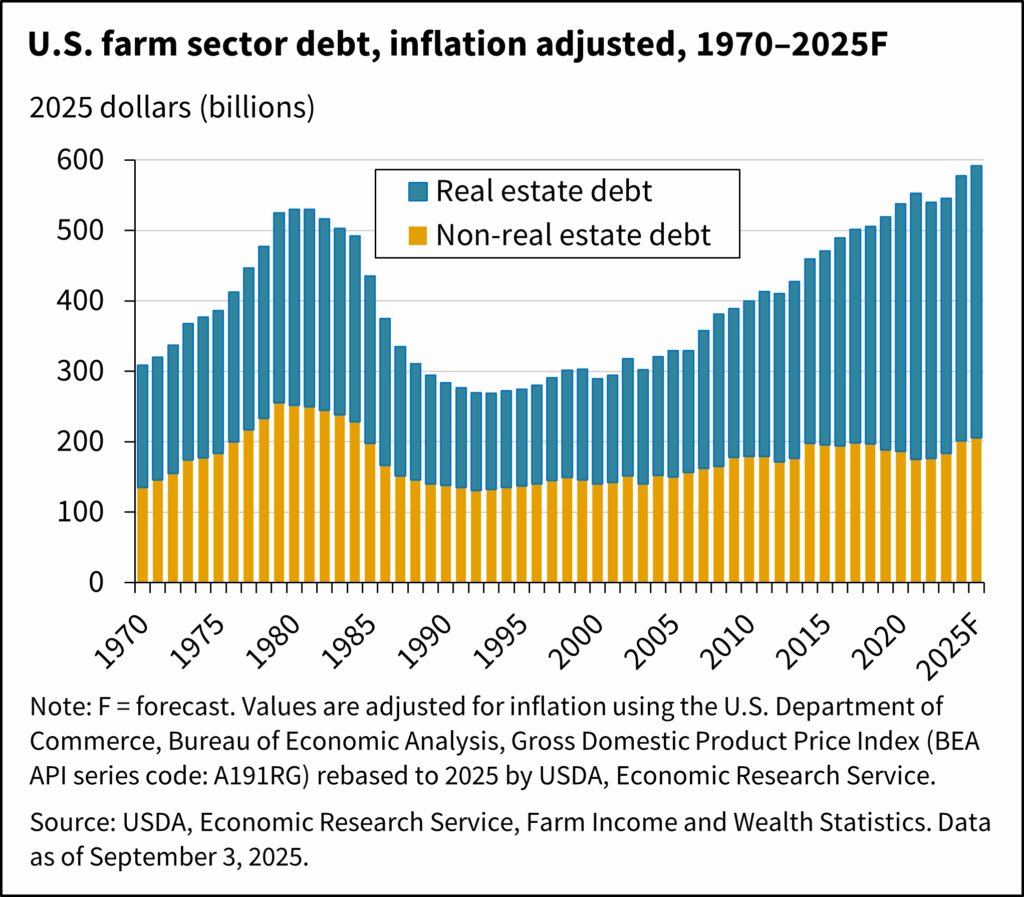
Some of these losses can be attributed to recent tariff policies. China usually purchases 52 percent of the U.S. soybean market,3 but in 2025, the U.S. lost $12.6 billion in soybean trade due to Chinese retaliation to U.S. tariffs. With the conflict still unresolved (despite a handshake agreement between China and the U.S.), farmers have had to find storage for their crops (and in some cases, alternative uses) in lieu of selling them, in the hopes that markets will return.
Farmers Underwater
Many farmers are still projected to operate at or below breakeven in 2025. Input costs remain historically high, and crop prices are forecast to continue declining, creating a third straight year of tight or negative margins. Despite the evidence that ad-hoc disaster programs are an unsustainable means of addressing financial and natural disasters, in December, Congress passed yet another relief package to address farmers’ losses due to the trade war with China. However, this aid is expected to cover only $12 billion of the estimated $35-43 billion in losses due to the tariffs and other economic factors and is a bandaid on the larger problem of the current financial farm crisis. Even with federal aid, expected revenue for major crops like corn, cotton and sorghum will fall significantly below the cost of production.While soybean farmers have been making news headlines because of the huge losses they’re experiencing as a result of tariffs, non-commodity farmers have also been impacted. Tariff rates during the growing season reached over 20 percent for some pesticides, close to 17 percent for some fertilizer, and 16 percent for tractors and other machinery.4 Despite recent rollbacks on tariffs,5 continued unpredictability around what trade policy will look like in coming weeks and months has upended farmers’ ability to plan for the future.6
Specialty crop producers have been particularly impacted by cancellations, funding cuts uncertainty around federal programs, for example, in March, USDA cancelled $1 billion in federal spending for local food purchasing programs,7 which provided funding for schools and governments to purchase food from local farms. The cancellation of these contracts resulted in major loss of markets for the more than 8,000 farmers participating in these programs, many of whom were new and beginning producers.8
These economic uncertainties have been exacerbated by barriers farmers face in accessing credit during these challenging times. Affordable credit is essential for farmers, who have to spend money to plant their crops and care for their animals months before they reap a financial benefit. While there have been many important improvements in farm credit policy at the federal level in recent years, there is still much work needed to ensure that farmers of all kinds can secure the credit they need to thrive on the land. Farmers take out loans before planting begins to cover costs for the season and pay these loans back after harvest, but business decisions like these are almost impossible given the uncertainty presented by tariffs and other policy changes – both for lenders as well as farmers, who don’t know what markets will look like for their crops months out.
Historically, there have been inequities in who can access agricultural financing. Beginning farmers, organic farmers or those engaged in diversified production or more local and regional markets have often struggled to secure credit or find loan packages that make sense for their farms. In addition, there is a long history of racial discrimination at USDA Farm Service Agency (FSA) offices, where Black, Latino, Native American and other socially disadvantaged farmers were denied the loans needed for their farms, ultimately leading to dispossession of their land.
The cuts made to FSA staff by the Trump administration (1,200 FSA staff have been cut since January and more than 18,000 have been cut across the USDA) will create more barriers to credit programs that were already challenging to access. FSA employees are responsible for running farmer financial support programs, including loans and disaster relief; these changes to USDA will hamper their ability to administer financial programs, combined with existing economic uncertainty, are further squeezing small and mid-sized, independently owned and operated farms.9 Meanwhile, financing from private banks is becoming harder for farmers to come by, a sign that banks recognize the difficulty that farm businesses have in turning a profit.
Farmers face cuts to healthcare and food assistance
In July, President Trump’s One Big Beautiful Bill Act made cuts to SNAP (formerly known as food stamps) and healthcare that directly impacted farmers’ markets and the wellbeing of rural communities. Farmers are both beneficiaries of SNAP and sell into markets that use SNAP dollars; 1 in 7 rural households rely on SNAP, including farming households and SNAP also bolsters local economies, with $1 of SNAP spent resulting in $1.50 of economic activity. Cuts to SNAP are creating critical gaps in the farm economy and are estimated to result in $30 billion of revenue loss for farmers, according to a House Agriculture Committee report.10The bill also made deep cuts to healthcare that will impact farmers by ending subsidies for plans administered through the Affordable Care Act (ACA). 17 percent of rural residents and 27 percent of farmers rely on the ACA for their health insurance. With cuts to ACA, healthcare premiums for rural residents are expected to rise 107 percent. Increased healthcare costs mean that many farmers will not be able to afford health insurance, something they can scarcely afford since farming is one of the most dangerous professions.11 As of 2022, nearly a quarter of farmers and ranchers were uninsured; this number is expected to rise as healthcare costs increase.12 And as more farmers and rural residents lose insurance, rural hospitals and healthcare systems risk collapsing.
Farmers are also being squeezed by other rising costs of living. Electricity and home heating costs are projected to rise this winter and to hit rural communities especially hard. Nationally, home heating costs are expected to rise over 7% this winter for all fuel types, with much larger increases in the South and Midwest.13 And like other Americans, farmers have seen residential electricity costs increase by 30% since 2021, driven by increased demand for electricity and more frequent weather events, which damage energy infrastructure.14
A changing climate, but still no reliable safety net
Climate change is impacting agriculture in multiple ways, including increased droughts, wildfires, soil erosion, decreased crop yields, increased pest and disease damage to crops, and heat stress on livestock. Climate change is also causing more frequent, severe weather events and the financial toll on farmers is real; in 2023, crop losses in the U.S. from major disasters were approximately $21.9 billion, $10 billion of which was not covered by crop insurance.15 Despite these ongoing disasters, there is no permanent federal disaster relief program for farmers. While large-scale, commodity farmers can enroll in crop insurance programs, these programs are not well-suited (or even available) for smaller scale, specialty crop or diversified producers. Consequently, when disasters strike, which is a more common occurrence as climate change worsens, many farmers are left without an easily accessible way to recover.Instead of a permanent federal disaster relief program, USDA has created many ad-hoc programs over the years to address disasters. These programs mostly leave out uninsured, specialty crop, diversified and dairy producers. In 2025, ad hoc disaster assistance payments are projected to reach $35.7 billion, marking a 720% increase from $4.35 billion in 2024, and USDA provided over $770 million in indemnities for hurricane-related losses in 2024.
Though the American Relief Act of 2025 provided ad hoc assistance, only a small fraction of the $16 billion aid package was intended for small and specialty crop producers, and this aid is still in the process of being distributed to farmers, nearly two years after the disasters it was supposed to address occurred. Consequently, federal assistance to address farmers’ losses has reached only a fraction of farmers who are struggling from climate disasters.
No new farm bill in sight
The last farm bill was passed in 2018 and expired in 2023. Though Congress keeps extending the 2018 farm bill, the lack of a new comprehensive slate of food and farm policies is contributing to farmers’ uncertainty and economic challenges. Farmers depend on farm bill programs to compensate them for protecting soil and water, increase opportunity and access to farming and strengthen rural economies, among many other important functions.Farm bill programs provide critical economic returns, supporting over 46,000 jobs nationwide and generating $3.45 billion in added value annually, or about $1.58 dollars generated per federal dollar invested.16 Without a farm bill, these programs face funding cuts and uncertainty, making it harder for producers to maintain their livelihoods and care for the land.
Agricultural labor shortage persists and worsens
Adding to farmers’ economic pressure are rising labor costs due to a labor shortage which has worsened this year as a result of the Trump administration’s immigration and deportation policies. According to Pew Research center, 750,000 immigrants left the labor force between January and August 2025, an acute issue for the agricultural sector because the majority of agricultural laborers are immigrants.17 Meanwhile, no viable alternative has been presented to make up for lost workers or reform our immigration system; H2A visas are not an adequate solution to the problem. Labor is the highest expense for specialty crop farmers, and cutting the available labor force only increases this cost.18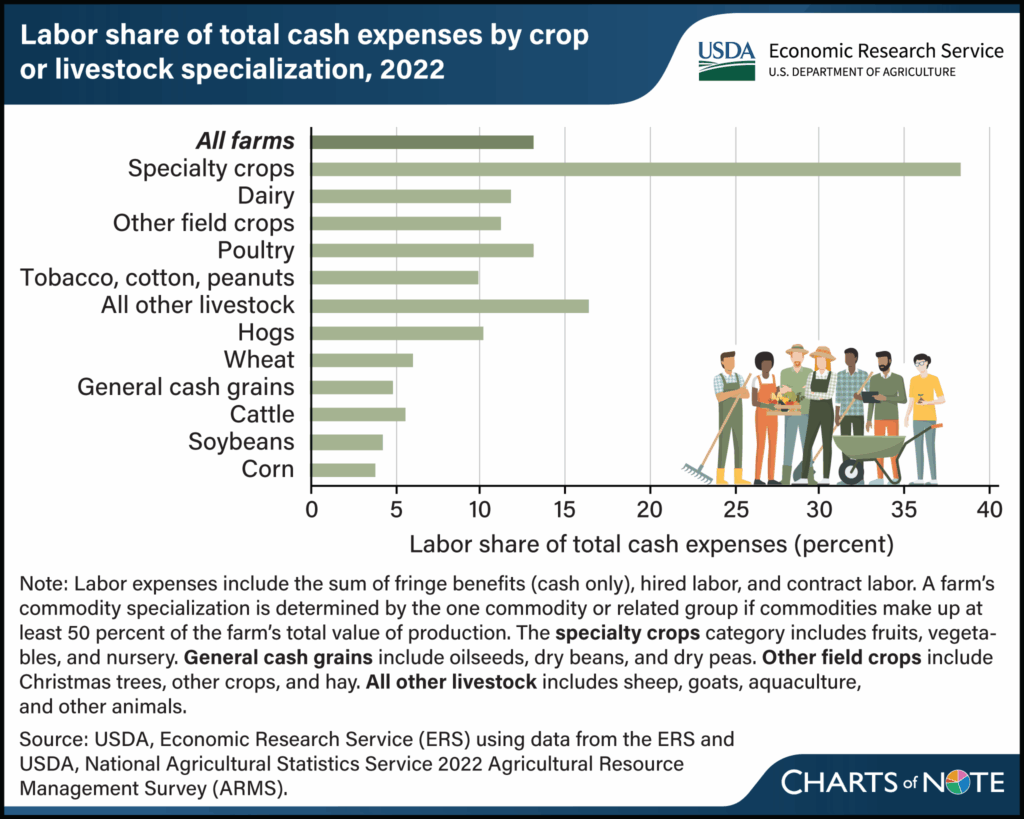
The lower availability of labor has had a variety of negative impacts on farmers; some farmers have had to shut down their farms due to lack of workers, while in California’s Oxnard region, intensified ICE activity has slashed agricultural labor by 20-40%, leading to $3-7 billion in crop losses.19 During labor shortages, large, industrial operations have options to explore mechanization and can afford expensive work visas, while smaller operations can be left without a workforce.20
What’s the impact on farmers and rural communities?
All of these factors, along with decades of agriculture policy that heavily favor large, industrial operations and corporations, have created the perfect storm, causing farmers to go out of business. Between 2017 and 2022, more than 140,000 farms were shuttered; advocates worry this trend is expected to continue. When farms go out of business, farmland is developed out of farming or farmland is bought by larger farms and corporate investors; consequently, we’re seeing fewer but larger farms, which further contributes to the consolidation of our farming and food system.As a result of this dire economic environment, organizations that support farmers are seeing a rise in mental health problems and stress within the agricultural community. In 2024, Farm Aid’s hotline saw an increase of 39% in disaster-related calls, with callers seeking emergency assistance due to events like Hurricanes Helene and Milton. Emergency Grant requests (which are given to farmers experiencing acute financial crises) increased by 29% compared with the previous year, which were primarily in response to natural disasters. In 2025, farm stress calls have been up an additional 4% and crisis calls are up 2%. Farm Aid is on track to exceed its distributed emergency grants from 2024. More than half of farmers who contact the Farm Aid Hotline are experiencing financial stress.
How can we fix these problems?
America’s family farmers are up against unprecedented economic challenges, many of which can be addressed by an ambitious and equitable farm bill. Several policy solutions that could help turn things around for America’s farmers include:- Federal aid that serves all farmers and support to farmers facing financial hardship. It’s essential that this aid be revenue-based, rather than crop or acreage based, so that farms of all types and sizes can access assistance.
- Strengthening the farm safety net, creating a permanent, accessible disaster relief program that serves specialty and diversified small and mid-sized producers in the wake of natural disasters.
- Flexible loan programs for farmers that allow access to capital in order to withstand economic downturns.
- Bolstering markets for local food producers by passing the Strengthening Local Food Security Act.
- Reining in corporate control, a force that is driving consolidation in our food system, raising prices for farmers and eaters and threatening family farmers. Congress must enforce the Packers and Stockyards Act , an important tool that can address corporate consolidation in our food system.
What Farm Aid is doing
The bottom line is that farmers and Americans deserve a food and farm system that serves all producers, no matter their size or what they grow, and that prioritizes the needs of communities over corporations. We advocate alongside farmers and our partners on Capitol Hill and across the country, demanding policies that level the playing field for family farmers and support a sustainable food system.Farm Aid is collecting farmer stories as part of this advocacy work. If you’re a farmer with a story to tell right now about the challenges you’re facing, please fill out our form.
With proceeds from our annual music festival, Farm Aid supports organizations around the country who are also advocating for a better farm and food system and who directly support farmers in their communities.
Finally, we work to educate our audience about these and other issues via our website and social media (like Instagram, Bluesky, Threads, Facebook and X).
Sources
- https://www.fb.org/market-intel/disaster-assistance-fuels-2025s-farm-income-rebound
- https://ers.usda.gov/data-products/chart-gallery/chart-detail?chartId=82246
- https://www.nytimes.com/2025/09/25/business/china-soybean-sales-farmers.html
- https://farmpolicynews.illinois.edu/2025/08/farmers-feel-fertilizer-price-squeeze-as-tariffs-hit-ag-sector/
- https://civileats.com/2025/11/04/farmers-struggle-with-tariffs-despite-china-deal-to-buy-us-soybeans/
- https://subscriber.politicopro.com/article/eenews/2025/12/15/trump-tariff-exemptions-us-imports-data-ee-00685168
- https://www.politico.com/news/2025/03/10/usda-cancels-local-food-purchasing-for-schools-food-banks-00222796
- https://www.baldwin.senate.gov/download/usda-local-food-programs-letter
- https://sustainableagriculture.net/blog/usda-staffing-crisis-farm-service-agency-staff-losses-put-farm-safety-net-at-risk/
- https://democrats-agriculture.house.gov/uploadedfiles/250409_-_ag_dems_-_snap_facts.pdf
- https://www.bls.gov/charts/census-of-fatal-occupational-injuries/civilian-occupations-with-high-fatal-work-injury-rates.htm
- https://www.census.gov/library/stories/2025/09/health-coverage-by-occupation.html
- https://neada.org/wp-content/uploads/2025/09/winteroutlook25-26.pdf
- https://powerlines.org/wp-content/uploads/2025/04/PowerLines_Utility-Bills-Are-Rising_2025-1.pdf
- https://www.fb.org/market-intel/major-disasters-and-severe-weather-caused-over-21-billion-in-crop-losses-in-2023
- https://www.nature.org/content/dam/tnc/nature/en/documents/National_FarmBillConservationPrograms.pdf
- https://www.pewresearch.org/short-reads/2025/08/21/key-findings-about-us-immigrants/
- https://www.ers.usda.gov/data-products/charts-of-note/chart-detail?chartId=110172
- https://grocerynerd.substack.com/p/grocery-update-117-making-food-affordable
- https://sentientmedia.org/trumps-deportations-are-causing-farm-labor-issues/


No comments:
Post a Comment