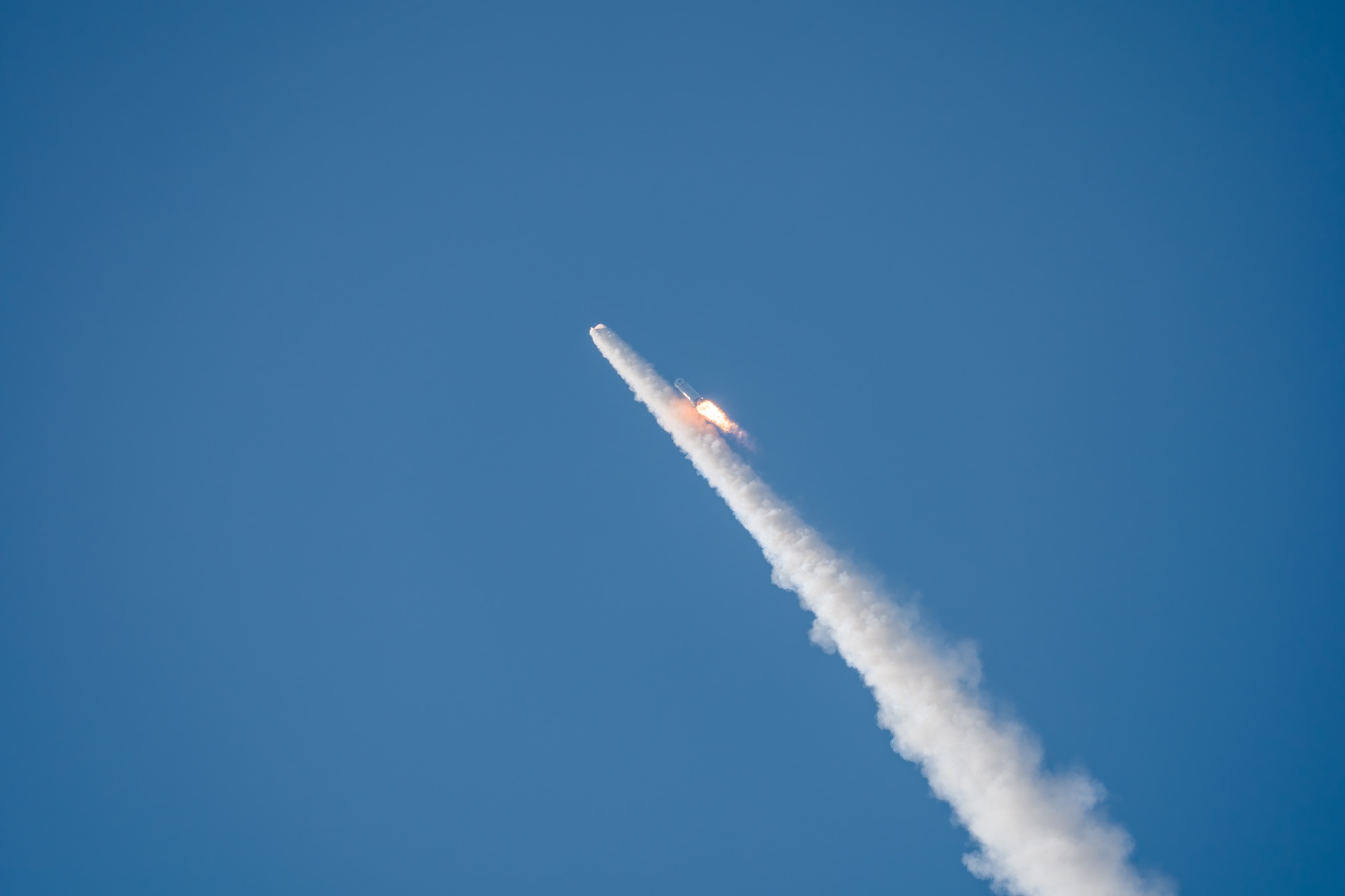

The test marks a significant step in China’s push to land humans on the Moon by 2030.
China’s space program, striving to land astronauts on the Moon by 2030, carried out a test flight of a new reusable booster and crew capsule late Tuesday (US time), and the results were spectacular.
The demonstration “marks a significant breakthrough in the development of [China’s] manned lunar exploration program,” the China Manned Space Agency (CMSA) said in a statement. China and the United States are racing to accomplish the next human landing on the Moon in a competition for national prestige and lunar resources. The Long March 10 rocket and Mengzhou spacecraft, both tested Tuesday, are core elements of China’s lunar architecture.
The launch of a subscale version of the Long March 10 rocket, still in development, provided engineers with an opportunity to verify the performance of an important part of the new Mengzhou capsule’s safety system. The test began with liftoff of the Long March 10 booster from a new launch pad at Wenchang Space Launch Site on Hainan Island, China’s southernmost province, at 10 pm EST Tuesday (03:00 UTC or 11 am Beijing time Wednesday).
A test version of the Mengzhou spacecraft, flying without anyone onboard, climbed into the stratosphere on top of the Long March booster before activating its launch abort motors a little more than a minute into the flight as the rocket reached the moment of maximum aerodynamic pressure, known as Max-Q. The abort motors pulled the capsule away from the booster, simulating an in-flight escape that might be necessary to whisk crews away from a failing rocket. The Mengzhou spacecraft later deployed parachutes and splashed down offshore from Hainan Island.
NASA and SpaceX performed similar in-flight abort tests before flying astronauts on the Orion and Dragon spacecraft. The test boosters on the Orion and Dragon abort tests were expended, but the Long March 10 rocket wasn’t finished after the Mengzhou abort command. Remarkably, the booster continued its ascent without the crew capsule, soaring into space on the power of its kerosene-fueled YF-100 engines before reentering the atmosphere, reigniting its engines, and nailing a propulsive landing in the South China Sea, right next to a recovery barge waiting to bring it back to shore.
“The rocket’s first stage and the spacecraft’s return capsule were safely splashed down in the designated sea area according to procedures,” CMSA said.
A recap video released by Chinese state television shows highlights from the test flight.
One test, two goals
In a matter of minutes, Chinese engineers moved closer to human-rating the Mengzhou crew capsule and achieved the country’s most successful test of a reusable rocket.
“The test successfully verified the functional performance of the rocket’s first stage ascent and recovery phases, as well as the maximum dynamic pressure escape and recovery of the spacecraft,” CMSA said. “It also verified the compatibility of relevant interfaces across various engineering systems, accumulating valuable flight data and engineering experience for subsequent manned lunar exploration missions.”
The low-altitude demonstration of the Mengzhou launch abort system follows a ground-level abort test last year that verified the spacecraft’s ability to escape an emergency on the launch pad. The Long March 10 booster also completed two test-firings on the launch pad prior to the in-flight abort test. At the same time, Chinese engineers have run a prototype lunar lander through a series of ground tests.
The Mengzhou spacecraft is the vehicle China will use to ferry astronauts from the Earth to the vicinity of the Moon, where crews will transfer into a lander to carry them to the lunar surface. After a short stay on the Moon, Chinese astronauts will take off and rendezvous with the Mengzhou capsule to bring them home.
Chinese officials say the Mengzhou spacecraft will also service the country’s space station in low-Earth orbit, replacing the Shenzhou capsule in use since the 1990s. The Mengzhou capsule has the capability for “multiple reuses,” according to CMSA. Mengzhou flights to low-Earth orbit will carry crews of up to seven astronauts, with smaller crews for lunar missions.
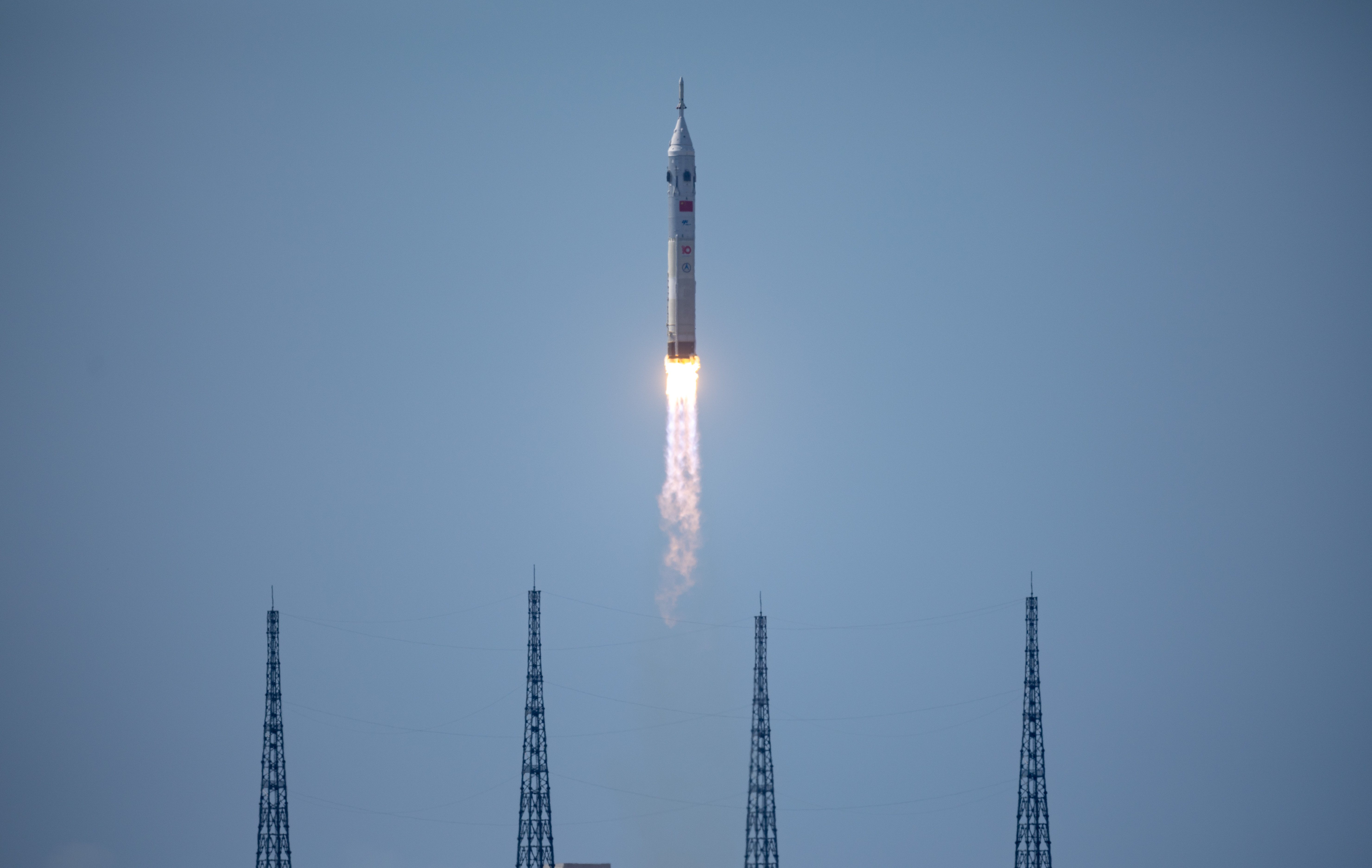
Mengzhou, which means “dream vessel” in Chinese, is scheduled for its first orbital test flight later this year. The spacecraft will launch on a Long March 10A rocket and dock with China’s Tiangong space station in low-Earth orbit. The Long March 10A, optimized for low-Earth orbit flights, will consist of a single reusable first-stage booster flying in combination with an upper stage. The full-size Long March 10, with 21 engines on three first-stage boosters connected together, will have the power to place payloads up to 70 metric tons into low-Earth orbit, and enough energy to propel the 26-metric-ton Mengzhou spacecraft to the Moon.
China’s leading state-owned space industry contractor, the China Aerospace and Science Technology Corporation (CASC), said the recovery of the Long March 10 booster after the in-flight abort test lays the foundation for “subsequent full-profile flight tests” and marks a “significant step” for China in “mastering reusable rocket technology.”
“The flight test further evaluated several key technologies, including the reliability of multiple engine restarts and high-altitude ignition during the rocket’s reentry phase, adaptability to complex force and thermal environments, and high-precision navigation control during the reentry phase.”
CASC oversees a sprawling industry of rocket and spacecraft manufacturers, including those responsible for designing and building the Mengzhou spacecraft and Long March 10 rocket.

The successful splashdown and recovery of the Long March 10 booster continues a busy period for China’s reusable rocket initiatives. No fewer than 10 Chinese companies are working on reusable rockets at different levels of maturity, all seeking to match the success of SpaceX’s reusable rocket program in the United States.
In December, two Chinese launch providers debuted new rockets—the Zhuque-3 and Long March 12A—with recoverable and reusable boosters. The rockets reached orbit, but their boosters missed their landings downrange from their launch pads.
Several Chinese companies have also completed high-altitude “hop tests” to evaluate vertical takeoff and vertical landing technologies ahead of launching their first orbital flights.
These advancements in China’s reusable rocket and lunar exploration programs come as NASA prepares to launch a crew of four astronauts on a loop around the far side of the Moon as soon as next month. A US-made lunar lander is likely still a few years away from being ready to transport crews to and from the lunar surface.



No comments:
Post a Comment