

Fuel shortages exacerbated by Trump’s pressure tactics are accelerating the island’s decline, which has already seen a sharp drop in visitors
EYANIR CHINEA
Mexico - FEB 11, 2026
For the government of Miguel Díaz-Canel, the political heir of Fidel and Raúl Castro, the situation is the result of an “economic war,” marked by the trade and financial embargo imposed by Washington since 1962 and exacerbated by decades of disagreements. For his detractors, however, it is the direct consequence of the iron grip of the state, which exerts control over up to 90% of the means of production, stifling the country’s economic development.
The continuous blackouts due to the energy crisis were expected to reach one of the most critical situations to date on Tuesday: up to 64% of the island was expected to be without power at the time of greatest energy demand, according to data from the Cuban state network itself, the Electric Union, collected by Efe.
The strangulation of Cuba’s already ailing economy is progressing rapidly. In early January, the U.S. military operation in Caracas to capture Nicolás Maduro and cut off the flow of oil from Venezuela left Cuba without its main ally, and more dependent on humanitarian fuel shipments from Mexico. With that avenue now also closed, which Mexican President Claudia Sheinbaum is trying to reactivate, as she stated this Tuesday, the situation has been deteriorating day by day.
Trapped in an economic system largely controlled by the socialist government, the island has historically relied on tourism as a key source of foreign currency. However, amid the paralysis of trade, transportation, and electricity supply, which has affected the quality of hotels and restaurants, visitor arrivals, already significantly reduced since the Covid pandemic, have been declining year after year.
Canada has remained the top source country for visitors, so the cancellation of its flights is a particularly hard blow to an already weakened economy. In 2024, some 860,000 Canadians vacationed on the island. Air Canada is currently carrying out an operation to repatriate at least 3,000 tourists, as announced on Monday when it reported the suspension of flights to the island until May.
In 2024, the next countries to send the most tourists to Cuba were, at a considerable distance, Russia (185,816), the United States (142,450), Germany (65,487), Spain (65,054), and Mexico (62,839). Only Mexico and Russia have shown a recent increase in the number of travelers.
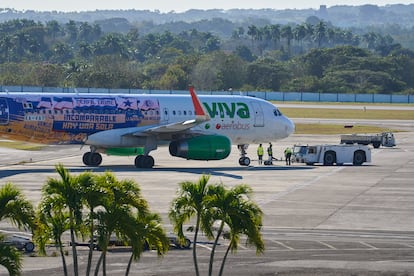 Mexican plane at José Martí International Airport in Havana on February 9.RAMON ESPINOSA (AP)
Las year ended with an official estimate of just $917 million in tourism revenue and 1.9 million visitors, 14% lower than the previous year and well below the 2.6 million projected by the Díaz-Canel administration, according to data from the National Office of Statistics and Information (ONEI) and public statements. This figure represents the lowest level of tourism in almost two decades, excluding the pandemic period.
For the Caribbean destination, the years of recovery that followed the “thaw” with the United States, driven by then-Presidents Barack Obama and Raúl Castro, which led to a record 4.6 million arrivals in 2018, are well behind.
The rest of the economy also revolves around tourism, as reflected in the import structure. In 2024, Cuba spent $369 million on poultry and $158 million on beer, essential products for supplying hotels and tourist resorts, according to figures compiled by the open data platform OEC.
Air Canada is the largest airline to announce the suspension of its flights to Cuba, citing unreliable refueling facilities at the country’s nine main airports. Other Canadian carriers, such as Sunwing, WestJet, and Air Transat, have also canceled or reduced operations and sent empty aircraft to repatriate passengers.
Mexican airlines, on the other hand, assert they have sufficient capacity to maintain their routes. The Federal Civil Aviation Agency (AFAC) reports that Aeroméxico and Viva transported 271,888 passengers to Cuba last year, a 5.2% increase. Viva, responsible for 63% of flights in 2025, explained that it can refuel at its base without depending on Cuba’s limited supply.
Other airlines, with longer routes, have begun to develop alternative plans to refuel in third countries. Air Europa, for example, announced it will make a technical stop in Santo Domingo, Dominican Republic. Iberia will maintain its flights, although it offered flexible fares for customers who wish to change their tickets.
Exports to China and Spain
With a small economy, the country is projected to have accumulated around $1 billion in exports by 2024, primarily tobacco and minerals, with China and Spain as its main destinations. Spain also has the largest number of foreign investment companies and trade offices on the island, according to ICEX data.
The European country is also Cuba’s second-largest supplier (13%), second only to China (16%), and had sold approximately €454 million worth of goods to the island by August 2025. According to ICEX, as of November, the average state salary was around €12 a month at the informal exchange rate, while the average private sector salary reached €54.
Without a secure energy source and with imports reduced by the drop in income, the economic situation of Cubans is becoming more precarious every day.
Mexico has sent 800 tons of humanitarian aid, primarily food such as powdered milk, on two ships expected to arrive in Cuba on Thursday, while the United States dispatched six million dollars worth of priority goods in an attempt to offer temporary relief. Trump, however, has warned that the Cuban government must negotiate “before it’s too late.” Faced with this pressure, the cornered Castro regime has opened a dialogue with the United States as the Cuban economy and daily life teeter on the brink of collapse.


No comments:
Post a Comment