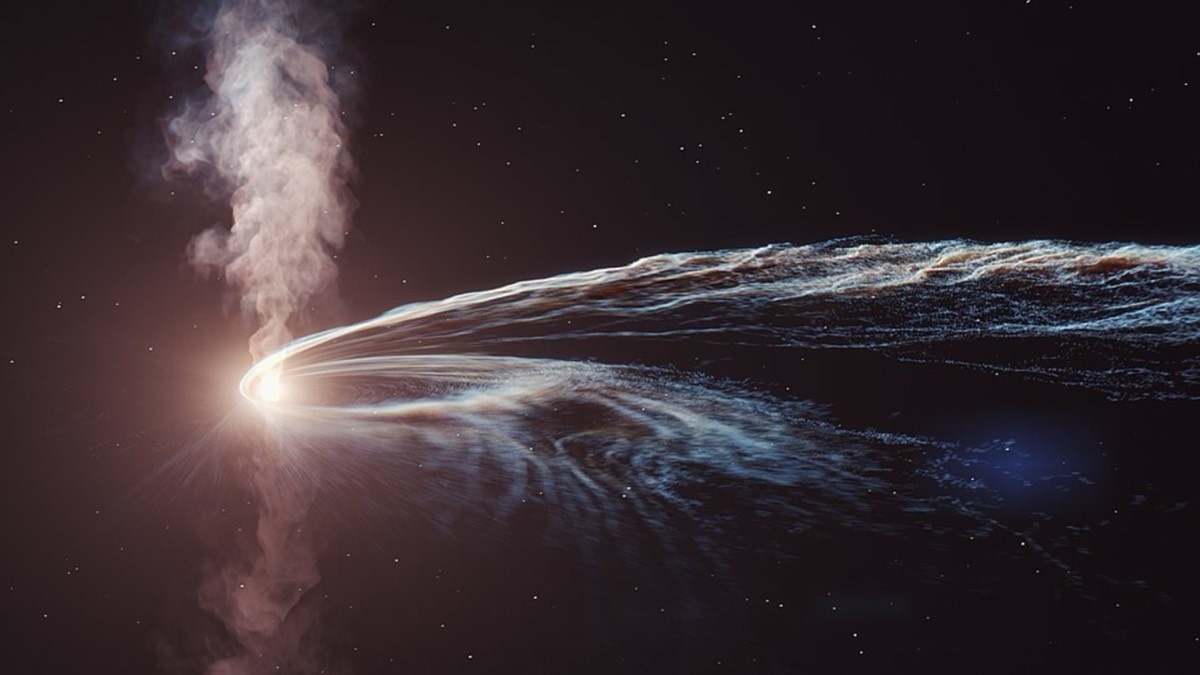

Dubbed “Jetty McJetface,” the tidal disruption event’s energy keeps getting brighter and should peak in 2027.
Jennifer Ouellette – Feb 5, 2026 Back in 2022, astronomers were puzzled by a so-called “tidal disruption event” (TDE), dubbed AT2018hyz, that had faded when it was first noticed three years earlier, only to unexpectedly reanimate and burp out extremely bright radio waves. University of Oregon astrophysicist Yvette Cendes, a co-author of that 2022 paper, dubbed the black hole “Jetty McJetface” (a nod to the 2016 online British competition to name a research vessel Boaty McBoatface).
Astronomers have continued to monitor it ever since. Far from fading again, the TDE has grown 50 times brighter, and that brightness continues to increase. The black hole’s energy emission might not peak until 2027, according to a new paper published in the Astrophysical Journal.
As we’ve previously discussed, it’s a popular misconception that black holes behave like cosmic vacuum cleaners, ravenously sucking up any matter in their surroundings. In reality, only stuff that passes beyond the event horizon—including light—is swallowed up and can’t escape, although black holes are also messy eaters. That means that part of an object’s matter is actually ejected out in a powerful jet.
In a TDE, a star is shredded (or “spaghettified”) by the powerful gravitational forces of a black hole outside the event horizon, and part of the star’s original mass is ejected violently outward. This, in turn, can form a rotating ring of matter (aka an accretion disk) around the black hole that emits powerful X-rays and visible light. The jets are one way astronomers can indirectly infer the presence of a black hole. Those outflow emissions typically occur soon after the TDE.
When AT2018hyz, aka “Jetty,” was first discovered, radio telescopes didn’t detect any signatures of an outflow emission of material within the first few months. According to Cendes, that’s true of some 80 percent of TDEs, so astronomers moved on, preferring to use precious telescope time for more potentially interesting objects. A few years later, radio data from the Very Large Array (VLA) showed that Jetty was lighting up the skies again, spewing out material at a whopping 1.4 millijansky at 5 GHz.
Since then, that brightness has kept increasing. Just how large is the increase? Well, people have estimated the fictional Death Star’s emitted energy in the Star Wars saga, and Jetty McJetface’s emissions are a trillion times more than that, perhaps as much as 100 trillion times the energy. As for why Jetty initially eluded detection, there seems to be a single jet emitting radiation in one direction that might not have been aimed at Earth. Astronomers should be able to confirm this once the energy peaks.
Cendes and her team are now scouring the skies for similar behavior in high-energy TDEs, since the existence of Jetty suggests that delayed outflow is more common than astronomers previously expected. It’s such an unprecedented phenomenon that astronomers haven’t really looked for them before. After all, “If you have an explosion, why would you expect there to be something years after the explosion happened when you didn’t see something before?” said Cendes.
DOI: Astrophysical Journal, 2026. 10.3847/1538-4357/ae286d (About DOIs).


No comments:
Post a Comment