
 While global core inflation is projected to be stable this year, regional divergences will likely come to the fore.
Inflation has remained resolutely above central bank targets, with global core CPI hovering at around 3% since 2024.
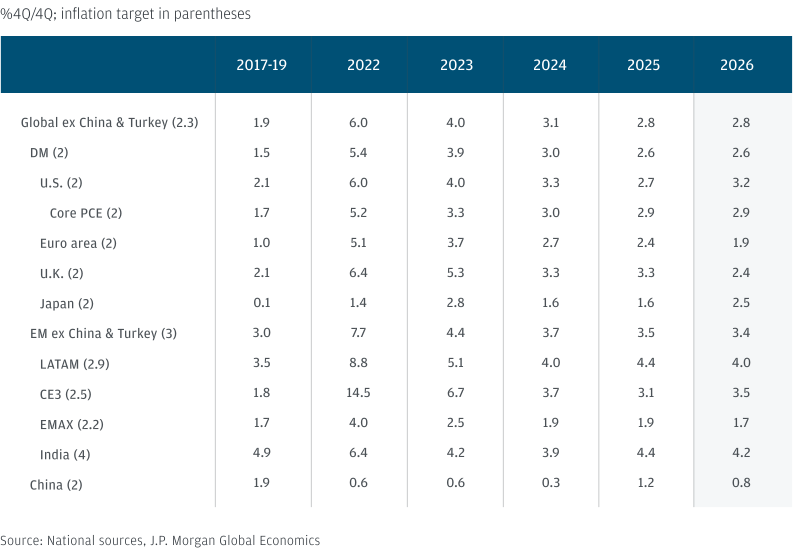
- Looking ahead, J.P. Morgan Global Research expects global core inflation to be stable at 2.8% in 2026.
- However, there will likely be disparate outcomes across regions, with inflation projected to accelerate in the U.S. and moderate in Europe.
February 17, 2026
Global inflation has remained elevated for the past two years, driven by rising goods prices and increasing labor costs. This stickiness has been broad-based, with core Consumer Price Index (CPI) prints proving persistently high in the U.S., Europe and LATAM.
However, the inflation outlook could soon change. “A phase of sticky inflation reflecting common global dynamics is ending,” said Bruce Kasman, chief global economist at J.P. Morgan. Against this evolving macro backdrop, what’s the global inflation forecast for 2026?
Global core CPI forecastsVIEW TEXT VERSION
Why has global inflation been so high?
Global goods prices soared post-pandemic on the back of supply chain disruptions, elevated commodity costs and fluctuations in demand. “These factors promoted a synchronized dynamic in which global goods price inflation spiked during 2021–2023, moderated and then subsequently firmed,” Kasman explained.
In addition, service prices and wage growth surged in the early stages of the post-COVID recovery. While there was some unwinding of the pandemic wage shock in 2023 and 2024, this was tempered by sustained service sector demand and tight labor markets, with unemployment rates reaching historic lows.
Together, these factors have kept inflation elevated above central bank targets, with global core CPI remaining stuck at around 3% since 2024.Is global inflation expected to fall in 2026?
Overall, J.P. Morgan Global Research sees global core inflation remaining stable at 2.8% in 2026. “However, the moderation of common elements and the rise of regional cross-currents reduces our conviction in this year’s global projection,” Kasman said.
On the goods prices front, common global impulses are fading as broad-based inflationary pressures related to supply chain disruptions and rising commodity prices have weakened. Instead, regional divergences are coming to the fore, rotating global goods price pressures toward the U.S. and Japan and away from Europe.
For starters, there were notable currency moves in 2025, with the U.S. dollar and Japanese yen down 6–7% in trade-weighted terms and the euro up by a similar percentage. Over in emerging markets (EM), LATAM and EMEA currencies appreciated while EMAX (Emerging Asia, excluding China and India) currencies weakened against a broadly stable Chinese yuan. “These moves explain a large portion of the variation in EM inflation dynamics, where FX pass-through tends to be stronger and goods account for a larger share of consumer baskets,” Kasman observed.
The U.S. trade war is also contributing to divergent goods prices inflation, as tariffs have boosted core goods prices in America but not elsewhere. In addition, the redirection of Chinese exports to other markets continues to generate downward pressure on import prices. “This impact varies by country, depending on FX moves as well as relative exposure to imported goods from China,” Kasman said.
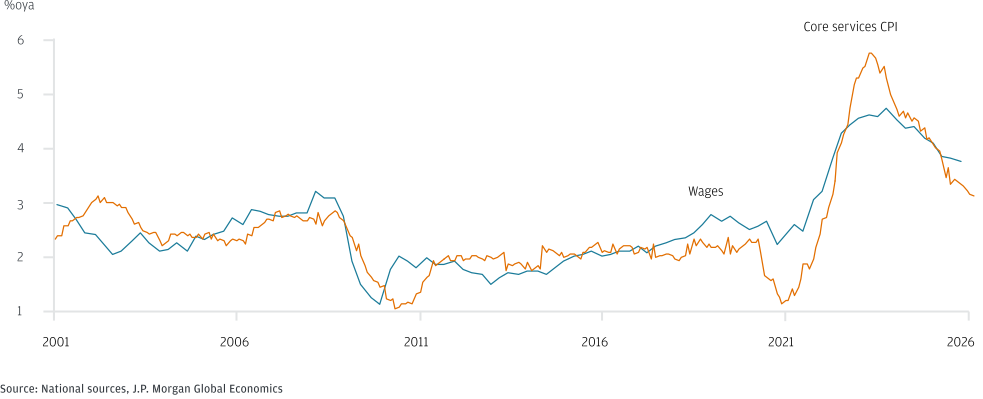
Looking at service price inflation, job growth has slowed and the unemployment rate in developed markets (DM) is about 0.5 percentage points above its 2024 low. But again, regional divergences are apparent. “The message from Western Europe is clear as wage inflation is moderating across the region. In Japan, wage inflation is clearly moving higher. However, U.S. measures are harder to read and, on balance, point to an interruption of the earlier downward trend,” Kasman shared.
All in all, these developments could translate into disparate inflation outcomes across the globe in 2026. “U.S. inflation is expected to accelerate above 3% oya (over a year ago) as an early-year rebound combines with persistent goods price pressures. Meanwhile, declining goods prices and moderating wage pressures should push inflation in Western Europe to 2% by mid-year,” Kasman said. “If right, the projected upswing in the U.S. alongside moderation in Europe is likely to open up a large inflation gap between the two regions over the first half of 2026.”
Wages and core services prices in DM are moderatingAre central banks expected to cut this year?
Disparate inflation outcomes will likely result in divergent monetary policy among global central banks in 2026. In light of inflationary pressures in the U.S., J.P. Morgan Global Research expects the Fed to remain on hold this year. Elsewhere, the European Central Bank (ECB) looks to have entered an extended pause while the Bank of England (BoE) is tilting dovish, signaling that a cut could be imminent due to labor market weakness.
“In Sweden, we expect the Riksbank to remain on hold due to strong growth, but the odds of a March cut have increased after another downside surprise left inflation running below its forecast,” Kasman noted. “And in Poland and Hungary, we pencil in just two more rate cuts this year.”
Over in EMAX, an inflation rate nearing 2% will likely keep the Bank of Korea (BoK) on a prolonged hold. “In the Philippines, we continue to expect three more 25 bp rate cuts through June as inflation remains below the Bangko Sentral ng Pilipinas’ (BSP) target midpoint, despite a January upside surprise,” Kasman added. “We expect the Monetary Authority of Singapore (MAS) will be the only one to tighten this year, but if growth remains strong, Malaysia’s Bank Negara (BNM) could follow later in the year.”



No comments:
Post a Comment