

- US naval forces continued to enforce the blockade on Iranian ports. US Central Command (CENTCOM) reported on April 15 that no vessels had breached the blockade on Iranian ports during the first 48 hours of enforcement.
- The United States has reportedly set two preconditions for another round of negotiations: first, Iran must fully “reopen” the Strait of Hormuz, and second, the Iranian negotiating delegation must have “full authority” to finalize a deal. The second precondition comes amid reports of intra-regime conflict and corroborates ISW-CTP’s assessment that the United States is negotiating with a divided council of hardliners and pragmatists rather than a singular, unified authority.
- Some Iranian officials have signaled different levels of willingness to compromise on Iran’s nuclear program in negotiations with the United States. These statements, at least to some extent, reflect internal disagreement over Iran’s negotiating position.
- Israeli Defense Minister Israel Katz stated on April 14 that the United States and Israel have decided that removing the enriched uranium from Iran is a “threshold condition” for ending the US-Israeli campaign.
- The US Treasury sanctioned 29 targets, including three individuals, 17 companies, and nine vessels on April 15, which are tied to Iranian oil smuggling and associated financing networks as part of the United States’ broader economic pressure campaign on Iran.
- Pakistan is reportedly pushing the United States and Iran to extend the ceasefire by 45 days. US President Donald Trump told ABC News on April 14 that he is not considering extending the ceasefire that ends on April 22.
- Iran is exploiting the current ceasefire to reorganize and regenerate its ballistic missile forces program on the tactical level by attempting to reopen tunnel entrances at missile bases.
- Iran reportedly utilized an advanced reconnaissance satellite purchased from the People’s Republic of China (PRC) in 2024 to target US military assets and bases across the Middle East during the war.
- The Israeli Security Cabinet reportedly held a meeting on April 15 to discuss a possible ceasefire in Lebanon, amid recent direct talks between Israel and Lebanon under US auspices. Israeli officials have not announced the outcome of the security cabinet meeting at the time of this writing, however.
US naval forces continued to enforce the blockade on Iranian ports. US Central Command (CENTCOM) reported on April 15 that no vessels had breached the blockade on Iranian ports during the first 48 hours of enforcement.[1] CENTCOM stated that nine vessels complied with the US direction to turn around and return to Iranian ports or coastal areas.[2] CENTCOM added that US forces have halted economic maritime trade to and from Iran and are prepared to act against any vessels attempting to violate the blockade.[3] Additional CENTCOM reporting indicates that the US forces redirected at least one Iranian-flagged cargo vessel after it departed Bandar Abbas, Hormozgan Province.[4]
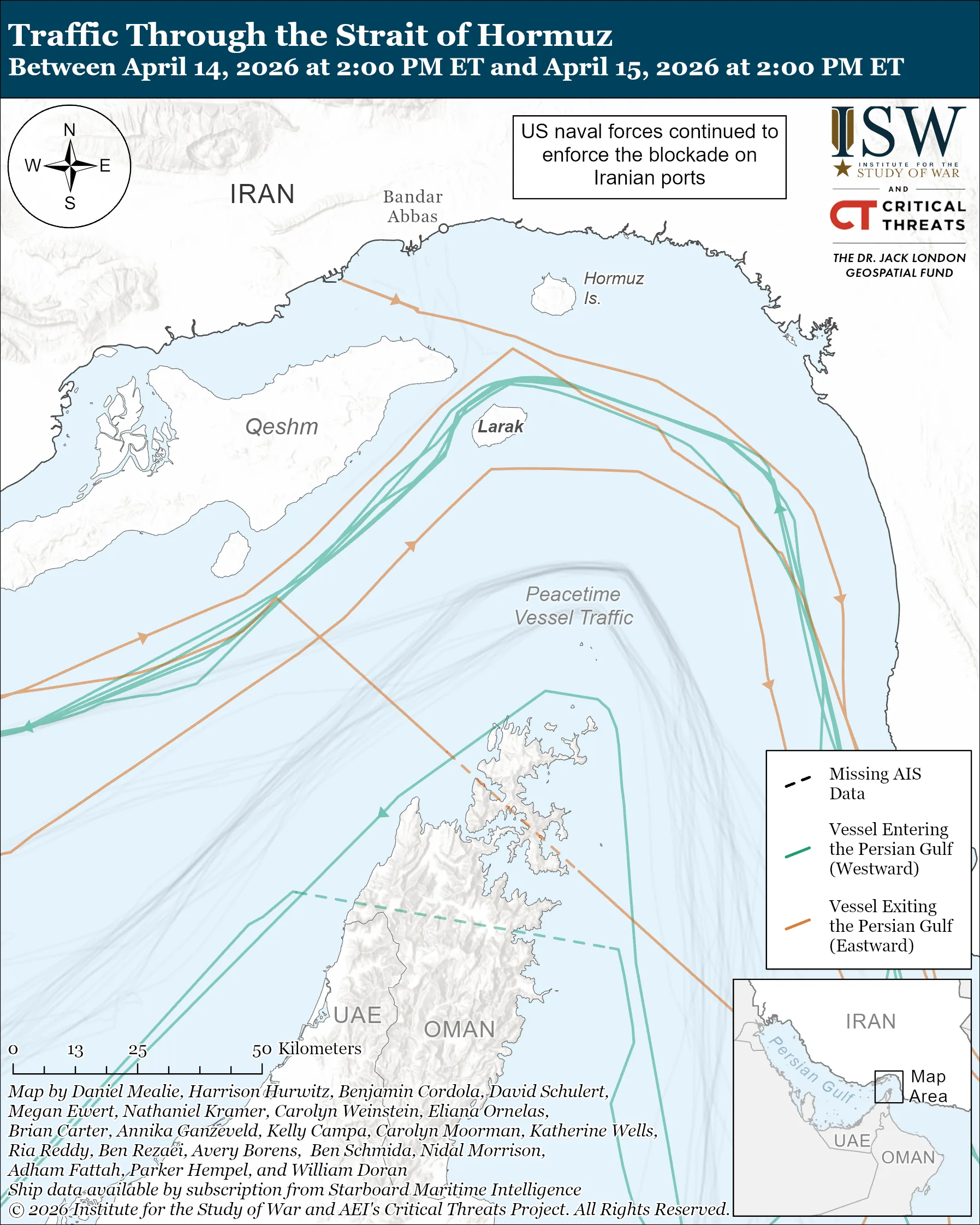
The United States has reportedly set two preconditions for another round of negotiations: first, Iran must fully “reopen” the Strait of Hormuz, and second, the Iranian negotiating delegation must have “full authority” to finalize a deal.[5] Iran has not conducted any kinetic activity targeting international shipping since April 7.[6] Iran does not need to conduct attacks against vessels to maintain the threat to international shipping, however. The decision for vessels to transit the strait is for the shipping companies, which will likely be hesitant to move vessels through the Strait until Iran provides reassurance that it does not pose a threat to their vessels and cargo.
The second precondition, which demands that Iran‘s delegation have “full authority“ from Iran’s senior leadership (including the Islamic Revolutionary Guards Corps (IRGC)) to finalize a deal, corroborates ISW-CTP’s assessment that the United States is negotiating with a divided council of hardliners and pragmatists rather than a singular, unified authority.[7] US Vice President JD Vance stated on April 14 that he believed that the Iranian negotiators in Islamabad wanted to make a deal, which implies that he assesses that the hardliners in Tehran were responsible for Iran’s reticence to make a deal.[8] Anti-regime media separately reported on April 14 that Iranian Supreme National Security Council (SNSC) Secretary General Mohammad Bagher Zolghadr was furious when Iranian Foreign Affairs Minister Abbas Araghchi allegedly appeared open to compromising on halting Iranian funding for the Axis of Resistance at the US-Iran negotiations in Islamabad on April 11.[9] Zolghadr then reportedly briefed Araghchi’s “deviation” to senior leadership, including by sending messages to IRGC officials and Supreme Leader Mojtaba Khamenei’s close affiliate Hossein Taeb, which resulted in the leadership ordering the delegation to leave after 21 hours of negotiations.[10] Zolghadr was one of the founding members of the IRGC Quds Force and helped establish some of the groups that now comprise the Axis of Resistance.[11] Unspecified mediators speaking to the Wall Street Journal on April 15 confirmed that Zolghadr has been “highly influential” in Iranian decision-making in US-Iran negotiations.[12] These reports follow previous anti-regime media reports on April 10 that IRGC Commander and key decisionmaker Major General Ahmad Vahidi pushed to get Zolghadr on the Iranian delegation to Islamabad, but the delegation leaders Araghchi and Parliament Speaker Mohammad Bagher Ghalibaf pushed back due to Zolghadr’s lack of diplomatic experience.[13] The senior leadership’s response to withdraw the delegation after Araghchi’s reported openness to discussing Iran’s support for the Axis of Resistance shows how unwilling the hardliners are to compromise on Iranian positions and how much sway they have over Iranian decision-making.
Some Iranian officials have signaled different levels of willingness to compromise on Iran’s nuclear program in negotiations with the United States. These statements, at least to some extent, reflect internal disagreement over Iran’s negotiating position. Iranian Deputy Parliament Speaker Ali Nikzad stated on April 15 that Iran will not negotiate its right to enrich uranium.[14] Former hardline President Mahmoud Ahmadinejad appointed Nikzad to several ministerial posts while he was president, and Nikzad later served as campaign chairman for former hardline President Ebrahim Raisi in the 2017 election.[15] His relationship with hardline figures suggests that Nikzad may similarly hold hardline, anti-Western views. Iranian Foreign Ministry spokesperson Esmail Baghaei adopted a slightly more flexible tone and stated on April 15 that Iran is willing to discuss “the level and type of enrichment.”[16] Baghaei emphasized that Iran must retain the ability to enrich uranium based on its ”needs,” however.[17] Foreign Minister Abbas Araghchi leads the foreign ministry and is more pragmatic than some Islamic Revolutionary Guard Corps (IRGC) officials involved in negotiations, which may make him more open to supporting limited concessions (see above). Two senior Iranian officials separately told the New York Times on April 13 that Iran told the United States that it is willing to pause enrichment for up to five years.[18] These differences likely reflect the presence of competing factions in Iran with divergent objectives in negotiations, which ISW-CTP previously assessed will likely complicate efforts to reach a negotiated agreement.[19]
Israeli Defense Minister Israel Katz stated on April 14 that the United States and Israel have decided that removing the enriched uranium from Iran is a “threshold condition” for ending the US-Israeli campaign.[20] Iran offered to downblend its highly enriched uranium instead of handing over its highly enriched uranium (HEU) stockpile during US-Iran talks on April 11 and 12.[21] ISW-CTP previously assessed that Iran presumably seeks to dilute rather than hand over its HEU stockpile so that it could re-enrich this stockpile at some point in the future.[22]
The US Treasury continues to sanction the Iranian oil trade as part of the broader US economic pressure campaign against Iran.[23] The US Treasury sanctioned 29 targets, including three individuals, 17 companies, and nine vessels on April 15, which are tied to Iranian oil smuggling and associated financing networks.[24] The US Treasury Department designated individuals and companies involved in shipping, logistics, and financial facilitation activities that support Iranian oil exports and sanctions evasion.[25] The Treasury stated that these networks operate within the broader shipping empire of Hossein Shamkhani and generate revenue for the Iranian regime and its regional proxies, including Hezbollah.[26] Hossein is the son of former Iranian Defense Council Secretary Ali Shamkhani.[27] The United States sanctioned Hossein and his multinational shipping network in July 2025 for generating tens of billions of dollars in revenue for the Shamkhani family and the Iranian regime.[28] The Treasury separately reported on April 14 that it is maintaining “maximum pressure” on Iran and is prepared to impose secondary sanctions on foreign financial institutions that continue to support Iranian activities.[29] The Treasury added that a short-term authorization permitting the sale of Iranian oil currently stranded at sea will expire in the coming days and “will not be renewed.”[30] The Trump administration has also sent warning letters to banks in Oman, the United Arab Emirates, Hong Kong, and the PRC, stating that financial institutions facilitating Iranian funds could face secondary sanctions and potential exclusion from the US financial system.[31]
Pakistan is reportedly pushing the United States and Iran to extend the ceasefire by 45 days.[32] US President Donald Trump told ABC News on April 14 that he is not considering extending the ceasefire.[33] The ceasefire is set to expire on April 22.
US and Israeli Air Campaign
Iran is exploiting the current ceasefire to reorganize and regenerate its ballistic missile forces on the tactical level. Satellite imagery observed by CNN on April 14 showed that Iran attempted to remove debris in front of the entrances to the Southwest Tabriz Missile Base in Tabriz, East Azerbaijan Province, and the Khomein Missile Base in Khomein, Markazi Province.[34] An Israeli geospatial analyst assessed that the internal structures of the Khomein and Tabriz missile bases “appear to still be intact” and that missile stockpiles are likely still there.[35] The combined force struck the Khomein Missile Base on February 28 and the Tabriz missile base on March 3.[36] The combined force struck the entrances of multiple Iranian missile bases over the course of the conflict, likely to degrade Iran’s ability to access missiles and missile launchers.[37] Iran is exploiting the lack of combined force strikes to move and use the construction equipment (such as bulldozers) necessary to access the missile launchers at Khomein and Tabriz. Unspecified sources told CNN on April 14 that US intelligence officials assessed that roughly half of Iran’s missile launchers are still operational.[38]
The combined force struck an Iranian defense industrial site and likely a makeshift internal security headquarters before the ceasefire. Satellite imagery from March 27 shows that the combined force struck the Ritaj Entertainment Complex in Ahvaz, Khuzestan Province.[39] An Iranian researcher stated on March 22 that IRGC Ground Forces commanders used the complex as a headquarters following the destruction of the IRGC Ground Forces Karbala Operational Division base.[40] Satellite imagery from April 15 shows that the combined force struck two facilities with the Ya Mahdi Industrial Research Complex between March 7 and 17.[41] Ya Mahdi Industrial Research Complex is a US-sanctioned company that is involved in the purchase of missile-related technology for the Iranian Aerospace Industries Organization and production of navigational equipment, radar systems, and high-pressure test instruments.[42]
Israeli media reported that senior Israel Defense Forces (IDF) officials are calling for the IDF to expand its “security zone” in southern Lebanon.[62] An Israeli Army Radio correspondent reported on April 15 that unspecified senior IDF officials are pushing for the IDF to expand the Israeli “security zone” in Lebanon beyond “second and third village lines” where the IDF units are currently operating.[63] The officials have also called for IDF units to conduct raids on Lebanese villages deeper within southern Lebanon.[64] IDF Chief of Staff Lieutenant General Eyal Zamir said on April 15 that he has ordered IDF units operating in southern Lebanon to make southern Lebanon up to the Litani River a “killing zone” for Hezbollah operatives.[65] Israeli Prime Minister Benjamin Netanyahu announced on April 11 that the IDF had created a “security zone” in southern Lebanon.[66] Netanyahu stated that the IDF security zone extends between eight and ten kilometers north of the Israel-Lebanon border.[67] Israeli Defense Minister Israel Katz previously called for the “security zone” to extend up to the Litani River.[68]
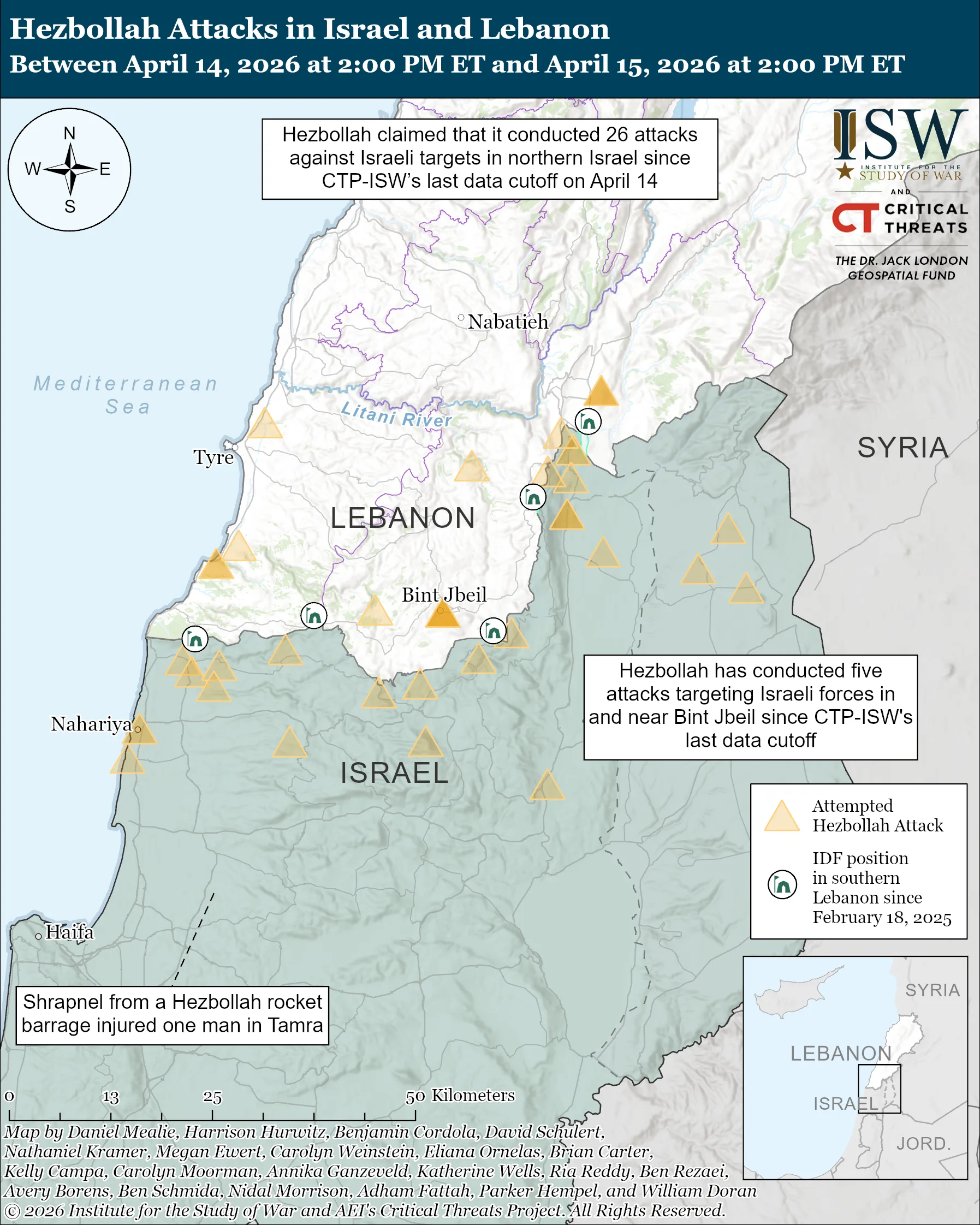
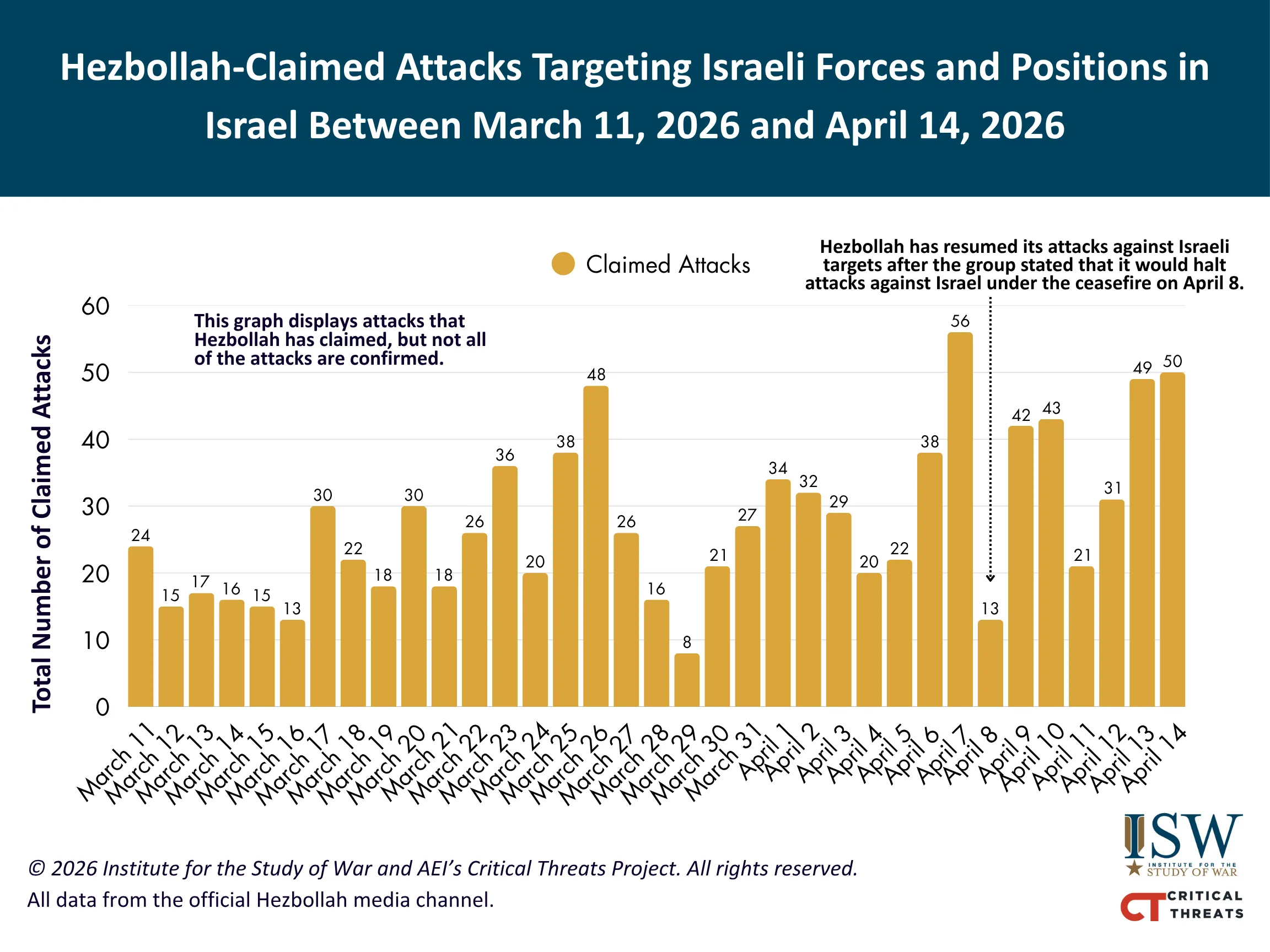
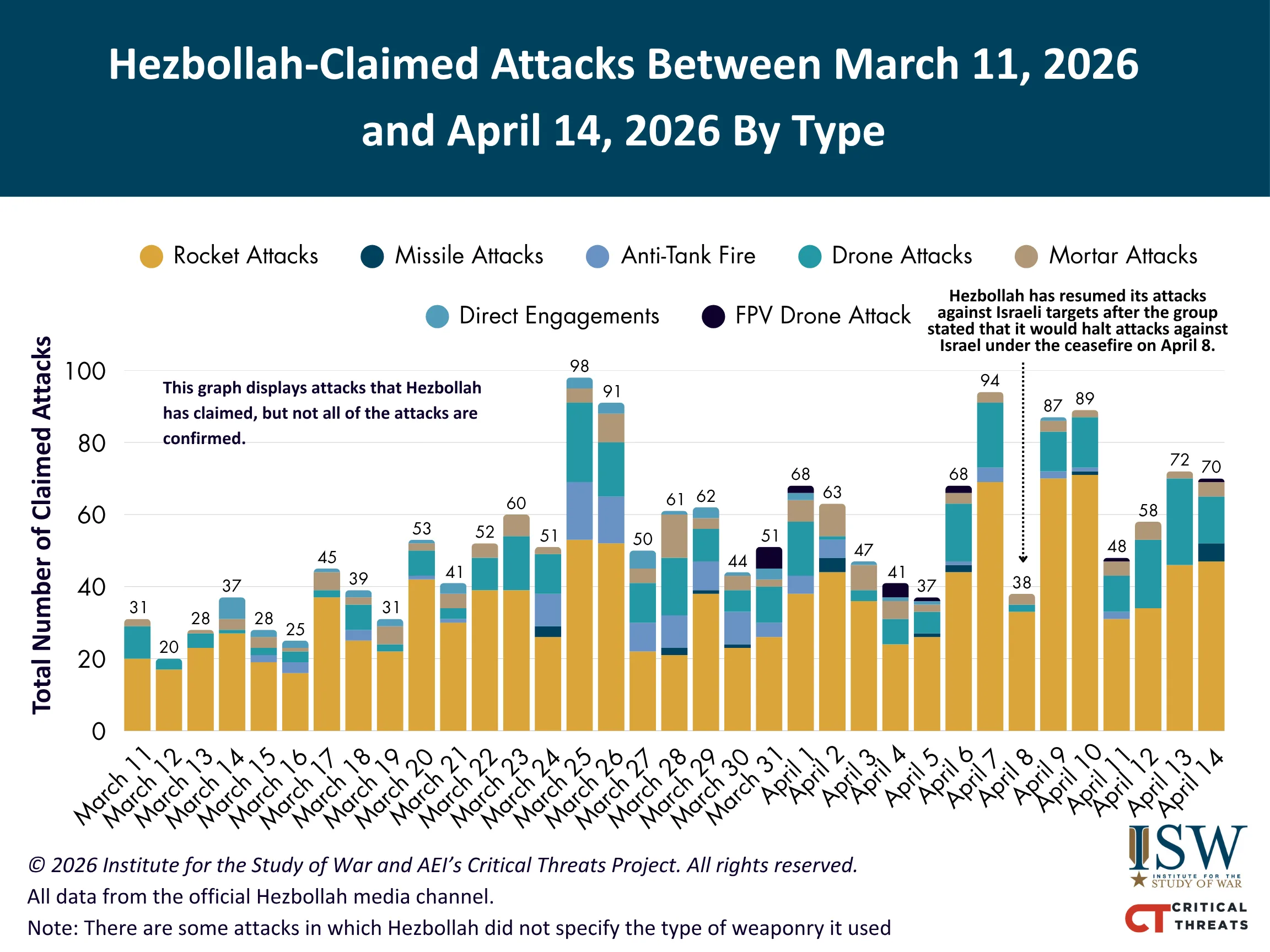
Hezbollah claimed that it conducted 26 attacks targeting IDF infrastructure and Israeli communities in northern Israel since ISW-CTP’s last data cutoff on April 14.[69] An Israeli Army Radio correspondent reported on April 15 that Hezbollah launched 70 to 80 percent of its rockets targeting northern Israel from positions north of the Litani River.[70] An Israeli military correspondent also reported on April 15 that Hezbollah fired about 40 rockets at northern Israel.[71] Shrapnel from Hezbollah rocket fire lightly wounded one man in Tamra, northern Israel.[72]
Hezbollah claimed that it conducted 20 attacks targeting Israeli forces in southern Lebanon since ISW-CTP’s last data cutoff on April 14.[73] Hezbollah claimed that it conducted four rocket attacks targeting IDF personnel in Beit Jbeil, southeastern Lebanon.[74] Hezbollah also claimed that it conducted a complex attack targeting an element of the IDF 101st Battalion, 35th Paratroopers Brigade (98th Division) in Bint Jbeil.[75] Hezbollah said that it used an improvised explosive device (IED) before engaging the patrol with small arms fire.[76]
Hezbollah fired a Paveh long-range cruise missile on April 14, targeting northern Israel.[77] The missile likely fell short and struck a civilian home in Ablah, Zahle District, Lebanon.[78] An unknown projectile — which a missile expert later identified as a Paveh based on the debris — struck a house in Ablah, according to a post from a Lebanese open-source intelligence (OSINT) account on April 15.[79] The Paveh has a range of around 1,650 kilometers and is part of the Soumar family of IRGC cruise missiles.[80]
The IDF has continued to conduct airstrikes targeting Hezbollah infrastructure and fighters across Lebanon. The IDF said it has struck more than 200 Hezbollah targets, including around 20 rocket launchers and an unspecified number of Hezbollah operatives and military structures, in southern Lebanon within the past 24 hours.[81] IDF Chief of Staff Eyal Zamir reported that the IDF has killed 1,700 Hezbollah operatives since the start of Israel’s campaign in Lebanon on March 2.[82] Lebanese media reported at least 36 airstrikes on southern Lebanese towns since ISW-CTP’s last data cutoff on April 14, including at least four separate airstrikes on Dibbine, Marjaayoun District, southeastern Lebanon.[83] The IDF also reiterated evacuation orders on April 15, calling for southern Lebanese residents to move north of the Zahrani River.[84] The IDF previously called for southern Lebanese residents to move north of the Zahrani River on March 12 and 17.[85] The Zahrani River is further north than the Litani River and is located approximately 56 kilometers north of the Israel-Lebanon border.[86]
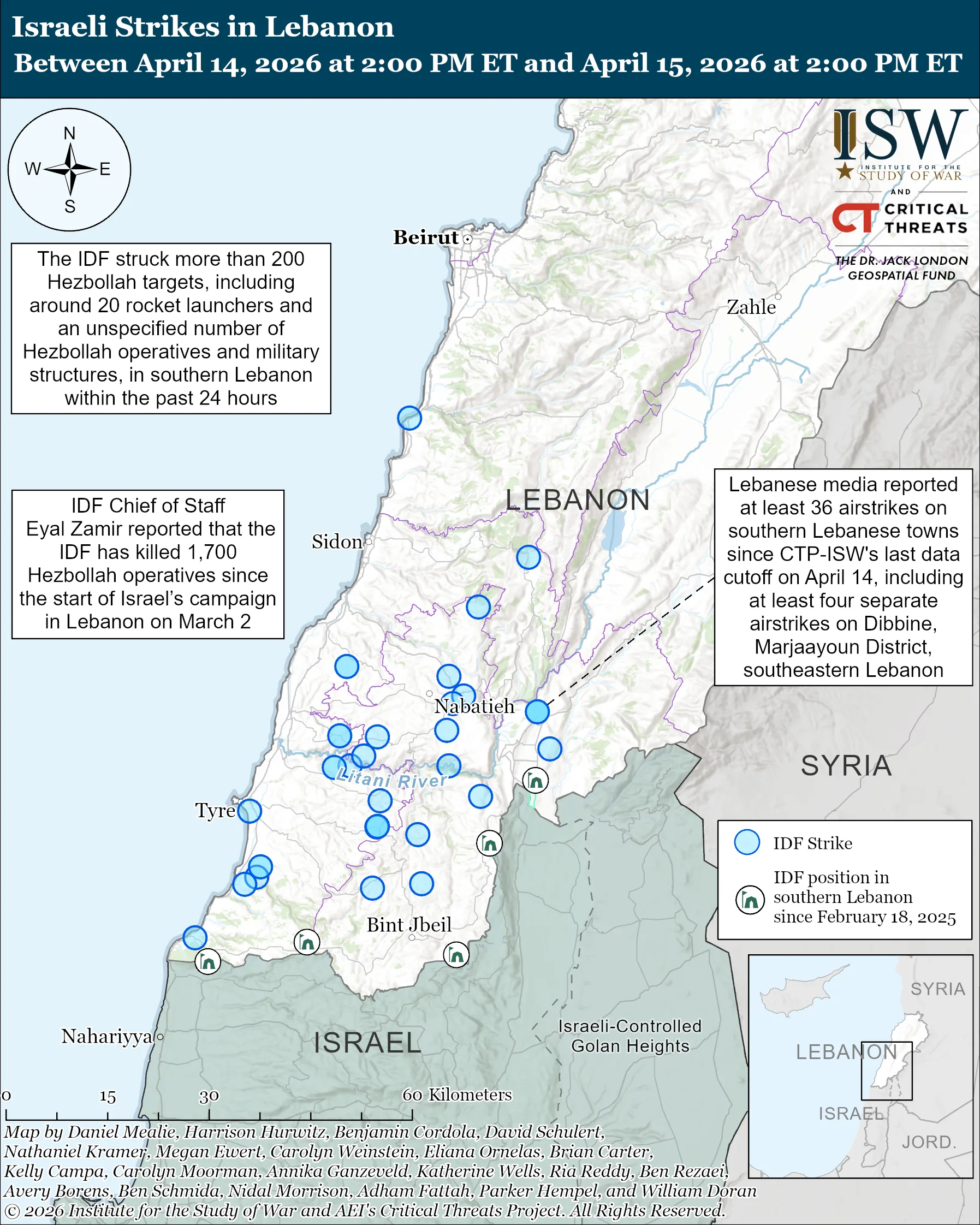
The IDF completed its “siege” of Bint Jbeil, southeastern Lebanon, on April 15.[87] Hezbollah wounded a 401st Armored Brigade (162nd Armored Division) battalion commander in Bint Jbeil, southeastern Lebanon, on April 14.[88] The IDF “completed” the “siege” of Bint Jbeil on April 15 after fighting in the town over the last few days.[89] Bint Jbeil is operationally significant for the IDF because it is located at the nexus of multiple main roads in southeastern Lebanon, including the Tebnine-Bint Jbeil road, that the IDF could use to advance north and link with Israeli forces advancing from other axes. Bint Jbeil is also symbolically significant to Hezbollah. Former Hezbollah Secretary General Hassan Nasrallah proclaimed “victory” from a stadium in Bint Jbeil after the Israeli withdrawal from Lebanon in 2000.[90]
The combined force struck an Iranian defense industrial site and likely a makeshift internal security headquarters before the ceasefire. Satellite imagery from March 27 shows that the combined force struck the Ritaj Entertainment Complex in Ahvaz, Khuzestan Province.[39] An Iranian researcher stated on March 22 that IRGC Ground Forces commanders used the complex as a headquarters following the destruction of the IRGC Ground Forces Karbala Operational Division base.[40] Satellite imagery from April 15 shows that the combined force struck two facilities with the Ya Mahdi Industrial Research Complex between March 7 and 17.[41] Ya Mahdi Industrial Research Complex is a US-sanctioned company that is involved in the purchase of missile-related technology for the Iranian Aerospace Industries Organization and production of navigational equipment, radar systems, and high-pressure test instruments.[42]
Iranian Response
Iran reportedly utilized an advanced reconnaissance satellite purchased from the People’s Republic of China (PRC) in 2024 to target US military assets and bases across the Middle East during the war.[43] Leaked Iranian military documents obtained by the Financial Times indicate that the IRGC Aerospace Force covertly purchased the Chinese Earth Eye TEE-01B reconnaissance satellite in 2024 for $36.6 million after its launch and transferred the satellite to the IRGC while in orbit.[44] The TEE-01B’s reported half-meter-per-pixel imagery resolution is comparable to Western models and enables the IRGC to identify aircraft, vehicles, and infrastructure changes, which likely supports Iranian battle damage assessments and targeting refinement.[45] The Financial Times reported that it obtained time-stamped coordinate lists, satellite imagery, and orbital analysis, which indicated that Iranian commanders tasked the satellite with monitoring key US military sites and captured images in March before and after drone and missile attacks on said locations.[46] China also granted the IRGC Aerospace Force access to Emposat’s commercial ground stations, a Beijing-based satellite control and data provider with a global network.[47] Empostat is reportedly closely linked to the People’s Liberation Army (PLA) Aerospace Force, including PLA personnel associated with key Empostat satellite launch command centers.[48] The combined force has repeatedly struck Iranian satellite ground stations during the 12-Day War and the current war in Iran, but by utilizing commercial ground stations outside of Iran, the IRGC prevented Israeli strikes.[49] The leaked data showed that the satellite captured imagery of Prince Sultan Air Base in Saudi Arabia from March 13 to 15.[50] This corresponded with Iranian ballistic missile attacks on Prince Sultan Air Base, which damaged five US KC-135 refueling tankers.[51] Other data showed that the satellite also conducted surveillance of the Muwaffaq Salti Air Base in Jordan and locations close to the US Fifth Fleet naval base in Manama, Bahrain, and Erbil airport, Iraq, contemporaneous with IRGC-claimed attacks on facilities in those areas.[52] The satellite also captured imagery of critical infrastructure that Iran struck in Gulf states, such as the Alba Aluminum facility in Bahrain, which Iran struck on March 29.[53] The Financial Times report on the IRGC’s utilization of Chinese intelligence assets for offensive capabilities follows a similar Washington Post report that Russia reportedly shared intelligence with Iran to support Iranian attacks against US forces in the Middle East in March.[54]Israeli Campaign Against Hezbollah and Hezbollah Response
The Israeli Security Cabinet reportedly held a meeting on April 15 to discuss a possible ceasefire in Lebanon, amid recent direct talks between Israel and Lebanon under US auspices.[55] Israeli officials have not announced the outcome of the security cabinet meeting at the time of this writing. Israeli officials told Israeli and Western media on April 15 that the Israeli Security Cabinet met to discuss a possible ceasefire in Lebanon.[56] Israeli Prime Minister Benjamin Netanyahu, in a statement after the meeting, did not specify whether the Israeli officials had made a decision about a ceasefire in Lebanon, according to an Israeli Army Radio correspondent.[57] A senior Israeli political source told Israeli media on April 15 that Israel’s assessment is that Israel will need to agree to a ceasefire in Lebanon in the next few days.[58] Israeli media reported that the US has put “heavy pressure” on Israel to accept “a temporary, symbolic ceasefire” in Lebanon.[59] The Israeli discussion of a possible ceasefire in Lebanon follows the first direct talks between Israeli and Lebanese officials in over 30 years in Washington, DC, on April 14.[60] The United States, Israel, and Lebanon issued a joint statement following their trilateral meeting on April 14 and stated that Lebanon, Israel, and the United States agreed to hold “direct negotiations” at an unspecified future date and location.[61]Israeli media reported that senior Israel Defense Forces (IDF) officials are calling for the IDF to expand its “security zone” in southern Lebanon.[62] An Israeli Army Radio correspondent reported on April 15 that unspecified senior IDF officials are pushing for the IDF to expand the Israeli “security zone” in Lebanon beyond “second and third village lines” where the IDF units are currently operating.[63] The officials have also called for IDF units to conduct raids on Lebanese villages deeper within southern Lebanon.[64] IDF Chief of Staff Lieutenant General Eyal Zamir said on April 15 that he has ordered IDF units operating in southern Lebanon to make southern Lebanon up to the Litani River a “killing zone” for Hezbollah operatives.[65] Israeli Prime Minister Benjamin Netanyahu announced on April 11 that the IDF had created a “security zone” in southern Lebanon.[66] Netanyahu stated that the IDF security zone extends between eight and ten kilometers north of the Israel-Lebanon border.[67] Israeli Defense Minister Israel Katz previously called for the “security zone” to extend up to the Litani River.[68]
Hezbollah claimed that it conducted 26 attacks targeting IDF infrastructure and Israeli communities in northern Israel since ISW-CTP’s last data cutoff on April 14.[69] An Israeli Army Radio correspondent reported on April 15 that Hezbollah launched 70 to 80 percent of its rockets targeting northern Israel from positions north of the Litani River.[70] An Israeli military correspondent also reported on April 15 that Hezbollah fired about 40 rockets at northern Israel.[71] Shrapnel from Hezbollah rocket fire lightly wounded one man in Tamra, northern Israel.[72]
Hezbollah claimed that it conducted 20 attacks targeting Israeli forces in southern Lebanon since ISW-CTP’s last data cutoff on April 14.[73] Hezbollah claimed that it conducted four rocket attacks targeting IDF personnel in Beit Jbeil, southeastern Lebanon.[74] Hezbollah also claimed that it conducted a complex attack targeting an element of the IDF 101st Battalion, 35th Paratroopers Brigade (98th Division) in Bint Jbeil.[75] Hezbollah said that it used an improvised explosive device (IED) before engaging the patrol with small arms fire.[76]
Hezbollah fired a Paveh long-range cruise missile on April 14, targeting northern Israel.[77] The missile likely fell short and struck a civilian home in Ablah, Zahle District, Lebanon.[78] An unknown projectile — which a missile expert later identified as a Paveh based on the debris — struck a house in Ablah, according to a post from a Lebanese open-source intelligence (OSINT) account on April 15.[79] The Paveh has a range of around 1,650 kilometers and is part of the Soumar family of IRGC cruise missiles.[80]
The IDF has continued to conduct airstrikes targeting Hezbollah infrastructure and fighters across Lebanon. The IDF said it has struck more than 200 Hezbollah targets, including around 20 rocket launchers and an unspecified number of Hezbollah operatives and military structures, in southern Lebanon within the past 24 hours.[81] IDF Chief of Staff Eyal Zamir reported that the IDF has killed 1,700 Hezbollah operatives since the start of Israel’s campaign in Lebanon on March 2.[82] Lebanese media reported at least 36 airstrikes on southern Lebanese towns since ISW-CTP’s last data cutoff on April 14, including at least four separate airstrikes on Dibbine, Marjaayoun District, southeastern Lebanon.[83] The IDF also reiterated evacuation orders on April 15, calling for southern Lebanese residents to move north of the Zahrani River.[84] The IDF previously called for southern Lebanese residents to move north of the Zahrani River on March 12 and 17.[85] The Zahrani River is further north than the Litani River and is located approximately 56 kilometers north of the Israel-Lebanon border.[86]
The IDF completed its “siege” of Bint Jbeil, southeastern Lebanon, on April 15.[87] Hezbollah wounded a 401st Armored Brigade (162nd Armored Division) battalion commander in Bint Jbeil, southeastern Lebanon, on April 14.[88] The IDF “completed” the “siege” of Bint Jbeil on April 15 after fighting in the town over the last few days.[89] Bint Jbeil is operationally significant for the IDF because it is located at the nexus of multiple main roads in southeastern Lebanon, including the Tebnine-Bint Jbeil road, that the IDF could use to advance north and link with Israeli forces advancing from other axes. Bint Jbeil is also symbolically significant to Hezbollah. Former Hezbollah Secretary General Hassan Nasrallah proclaimed “victory” from a stadium in Bint Jbeil after the Israeli withdrawal from Lebanon in 2000.[90]
Iranian Internal Security
Iranian media reported on April 15 that two improvised explosive device (IED) attacks targeted a Basij checkpoint on Imam Khamenei Street in Tehran City, injuring three people and causing material damage to nearby homes and vehicles.[91] An informed security source told a hardliner outlet that the incident caused “superficial” damage due to the incomplete explosion of both IEDs, but the attack did injure one Basij member and two other Iranians.[92] The security source noted that the Mojahedin-e Khalq has conducted similar attacks.[93] A reformist outlet separately quoted an IRGC statement that said that the attack originally included three IEDs, two of which exploded and one that Iranian authorities dismantled.[94] The IRGC statement also reportedly said that there are possibly two more IEDs remaining in the area.[95]Researchers
- Ria Reddy, Iran Analyst
- Ben Rezaei, Iran Analyst
- Benjamin Schmida, Middle East Researcher
- Parker Hempel, Middle East Researcher
- Nidal Morrison, Middle East Researcher
- Adham Fattah, Iran Analyst
- Carolyn Moorman, Middle East Researcher
- Katherine Wells, Iran Analyst
- Brian Carter, Research Manager


No comments:
Post a Comment