

You probably remember learning about Earth's internal layers when you were a kid in Earth Sciences class: a superhot, solid inner core, surrounded by a molten metal outer core (how metal!), and a solid-but-viscous mantle made of melted rocks.
On top of all this stuff sliding around is the thin, solid crust that makes up humanity's entire world.
That understanding of Earth's interior is only about 120 years old. When earthquakes were first tracked using seismometers, geologists were then able to measure the Primary or P waves (which can move through solids and liquids) and Secondary or S waves (which can only move through solids).
The changes in the P waves' signatures as they traveled indicated that they were moving through different kinds of material at different times, and when S waves failed to reach the opposite side of the planet, it was clear they must have hit fluid material.
Now, using data from a surprising source – underground nuclear tests conducted more than 30 years ago – researchers have some more detail about our planet's internal systems.
In a new study, geophysicist Ying Zhou of Virginia Tech analyzed seismic waves generated by underground nuclear explosions at Mururoa, a French Polynesian atoll, between 1977 and 1995.
Those waves traveled through Earth and were recorded at a seismic station in Kazakhstan, giving Zhou a set of repeated "snapshots" of what was happening inside the planet at different points in time.
Because the nuclear tests occurred at nearly the same location, the seismic waves followed remarkably similar paths through the planet.
Zhou found that seismic waves traveling through the outer core did not always take the same amount of time to make the journey. Compared with 1977, the waves were about 0.1 seconds faster in 1982 and 1983 and about 0.15 seconds faster between 1988 and 1990. But by 1995, they were roughly 0.15 to 0.2 seconds slower.
Those fractions of a second might sound trivial, but for a seismic wave traveling thousands of kilometers through the planet, however, they are meaningful. Like a more refined version of the original seismic tests that led to the discovery of P- and S waves, these results show that the waves are traveling through heterogeneous (mixed) materials.
And that material seemed to move around over the 30 years the seismic waves were recorded.
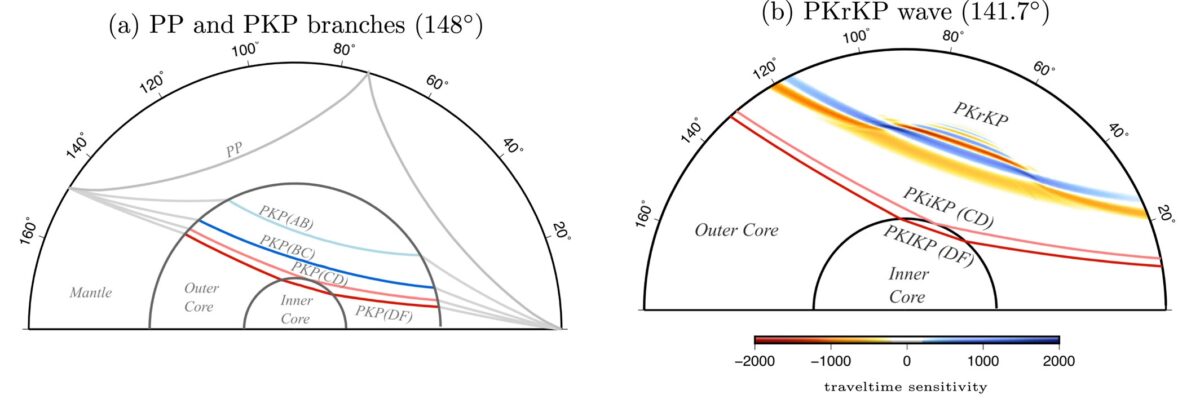
The study also identified a previously unrecognized type of seismic wave, which Zhou calls PKrKP. Unlike the more familiar seismic waves that travel through or reflect from the inner core, the PKrKP wave reflects within the middle of the outer core. This unusual behavior helped Zhou isolate the portion of the seismic journey that could reveal changes in the liquid outer core.
The researchers compared these outer-core waves with another type of seismic wave, called PP, that travels through the mantle rather than the outer core.
The analysis used 112 pairs of nuclear tests, with the explosions in each pair occurring less than 0.05 degrees apart.

So what could make these special waves traveling through the outer core speed up and slow down over just a few years?
The scale and speed of the changes suggest that the outer core is undergoing vigorous mixing. Zhou, writing in the study, estimates that a broad anomaly of some kind "with a lateral extent over 700 kilometers and a thickness of about 100 kilometers in the low-latitude southern Pacific can explain the observed 0.1- to 0.2-second PKP travel time anomalies."
Zhou proposes that this sizable anomaly is probably suspended solid material moving through the liquid outer core, like huge chunks of croutons floating in tomato soup.
These results make the case that it's likely that the outer core isn't simply a giant pool of purely liquid molten metal.
Giant anomalies changing how the outer core moves is fascinating on its own, but understanding this movement could also help geologists better understand what drives (or potentially changes) the processes responsible for Earth's magnetic field.
Previous research from the University of Southern California indicated that the outer core may be causing the inner core to change shape, which also may disturb Earth's magnetic field.
Related: Earth's Core May Be Wrapped in an Ancient, Unexpected Structure
What makes this study especially striking is the timescale. Previous attempts to detect changes in the outer core have often relied on seismic events separated by decades, and the signal can be difficult to distinguish from uncertainties in where those earthquakes actually occurred.
Here, the nuclear tests provided a much more controlled and time-limited set of repeated seismic sources.
These decades-old explosions – which have left incredibly destructive footprints in otherwise pristine ecosystems – have at least given scientists a way to listen in on Earth's deepest machinery.
Full study in the Journal of Geophysical Research.
This article was fact-checked by Michael Irving and edited by Michael Irving. While we pride ourselves on our process, we are only human. If you spot a mistake, please let us know.


No comments:
Post a Comment