
7 hours ago
Isabelle Gerretsen
The Odyssey was far more than entertainment to ancient Greeks. Archaeologists have unearthed evidence of a cult that revered the Homeric hero on his legendary home island of Ithaca.
Odysseus' perilous, decade-long journey home sees him trick a cyclops, outsmart a sorceress and survive countless disasters.
But Odysseus' legacy doesn't end there. There is one final, real-life twist in the adventures of this mythical king: Odysseus inspired a spiritual cult that lasted a thousand years. Evidence from archaeological excavations suggests worship of the Homeric hero began around the 9th Century BC, when his turbulent voyage was narrated in oral poems, and appears to have gained momentum after the Odyssey was written down in the late 8th Century BC.
Historical remains of this hero cult include a sanctuary dedicated to Odysseus on Ithaca, as well as recently unearthed coins and tiles bearing his name.
The discoveries shine a light on the fascinating interplay between real people, fictional heroes, and spirituality in the ancient world – and hold wider lessons on hero worship during this era.
From fandom to worship
In the Odyssey, as the Homeric hero is tossed around stormy seas, the thought of Ithaca keeps him going. "No country could be sweeter," he says in book nine of the epic poem.
Meanwhile, Odysseus' family and the Ithacan people desperately await his return. His wife Penelope describes Odysseus as "godlike" and a "noble, lionhearted husband, most talented and brave of all the Greeks".
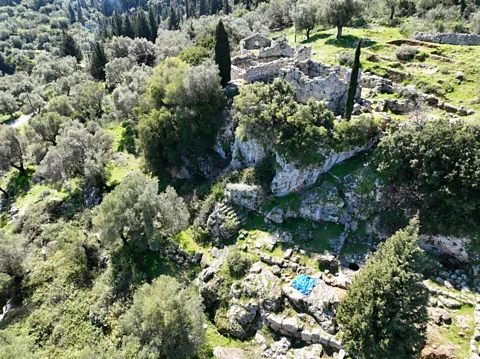 S Excavations have unearthed evidence of a sanctuary dedicated to Odysseus on Ithaca (Credit: S Dellaportas)
In real life, Odysseus also left a mark on Ithaca, a mountainous island that lies to the west of mainland Greece. Discoveries here and elsewhere paint a picture of a mythical character who played a central role in the religious and civic lives of ancient Greeks.
Excavations on the island started in the late 19th Century and have uncovered an array of Odysseus-themed artefacts, including a miniature bronze bust of the Homeric hero. A decree found in modern-day Turkey in the late 19th Century, in the ruins of an ancient Greek city, mentions a sanctuary dedicated to the worship of Odysseus, referred to as "Odysseion", on Ithaca. The decree, which dates back to 207BC and was issued by the city-state of Ithaca, also mentions an "Odysseia", a festival held in the Greek hero's honour.

In 2025, archaeologists from the University of Ioannina in Greece shed a clearer light on the previous finds. They revealed that they had found evidence of this Odysseion on Ithaca, following excavations in the ruins of a monumental complex known as the School of Homer.
Amid these ruins, which date to the Hellenistic period (4th to 1st Century BC), the archaeologists found a series of bronze coins, inscribed on one side with Odysseus's bearded head, "so familiar to us from innumerable works of Greek and Roman art", says Yannos Lolos, emeritus professor of prehistoric archaeology at the University of Ioannina, who led the research.
Myths were the threads that knitted different communities together – Joel Christensen
The archaeologists also unearthed fragments of three roof tiles inscribed with the name of the Greek hero. These finds identify the School of Homer with the Odysseion, says Christina Marabea, an archaeologist who carried out the excavations alongside Lolos. Two of these fragments are stamped with the words "of Odysseus" (ΟΔΥCCEOC, in ancient Greek), "clearly pointing to the existence of a shrine of the hero at the site", she says.

The format of the inscription "of Odysseus" is known from other sanctuaries dedicated to well-known gods in the ancient Greek world, Marabea explains. For example, in those other sanctuaries, roof tiles were found bearing inscriptions such as "of Poseidon" and "of Apollo" – meaning, the buildings were dedicated to those gods. The phrasing "of Odysseus" on the roof tiles in Ithaca therefore suggests this particular sanctuary was dedicated to the mythical hero, she says.
The third tile fragment reads like a dedication, "to Odysseus", and was likely left there by a pilgrim, according to Marabea. Leaving a variety of votives (such as clay or bronze objects and figurines inscribed with a simple dedication or prayer) is a "widespread ritual at many ancient sanctuaries", she says.
The archaeologists also unearthed fragments of three roof tiles inscribed with the name of the Greek hero. These finds identify the School of Homer with the Odysseion, says Christina Marabea, an archaeologist who carried out the excavations alongside Lolos. Two of these fragments are stamped with the words "of Odysseus" (ΟΔΥCCEOC, in ancient Greek), "clearly pointing to the existence of a shrine of the hero at the site", she says.
The format of the inscription "of Odysseus" is known from other sanctuaries dedicated to well-known gods in the ancient Greek world, Marabea explains. For example, in those other sanctuaries, roof tiles were found bearing inscriptions such as "of Poseidon" and "of Apollo" – meaning, the buildings were dedicated to those gods. The phrasing "of Odysseus" on the roof tiles in Ithaca therefore suggests this particular sanctuary was dedicated to the mythical hero, she says.
The third tile fragment reads like a dedication, "to Odysseus", and was likely left there by a pilgrim, according to Marabea. Leaving a variety of votives (such as clay or bronze objects and figurines inscribed with a simple dedication or prayer) is a "widespread ritual at many ancient sanctuaries", she says.
The sanctuary of Odysseus
Together, the finds reveal "new and decisive evidence" that the School of Homer acted as a public sanctuary and assembly point for local citizens "primarily intended for the worship of the Trojan War hero", Odysseus, during the Hellenistic era and early Roman period, says Lolos.
"The civic assembly met at the Odysseion, while the sanctuary of Odysseus, as evidenced primarily by the two roof tiles stamped with his name, might well have been the epicentre of worship, frequented by local and foreign pilgrims alike in veneration of the hero," says Marabea.
These new discoveries build on previous archaeological findings. During the 1930s, 12 bronze tripod cauldrons dating back to the 9th and 8th Centuries BC were discovered inside a "coastal cult cave" in northwestern Ithaca. These were likely "votives in honour of Odysseus," says Marabea.
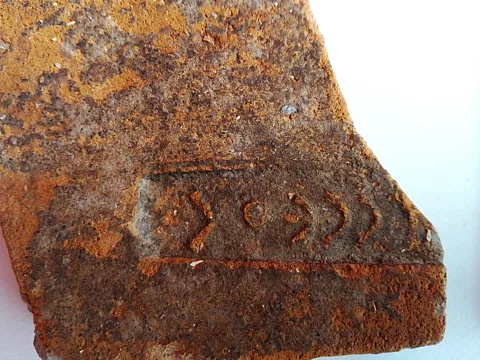 Archaeologists discovered tile fragments inscribed with the name of the Greek hero (Credit: Christina Marabea)
The decree found in modern-day Turkey reveals different aspects of the cult.
"It contains an invitation to the demos (people of Magnesia) for a privileged presidency at the Odysseia [festival]," says Marabea. "We cannot be exactly sure what took place at this festival but it probably involved athletic games and theatrical performances of epic poems."
At the Odysseia festival, there may have been events inspired by Odysseus' exploits in the Homeric poem, such as discus-throwing and archery, says Joel Christensen, professor of classics at The City University of New York. Animal sacrifices to the hero and Odysseus' divine patron Athena, the goddess of wisdom, are also likely to have taken place, he says.
Why ancient Greeks worshipped heroes

"As the Greeks were colonising and trading throughout the Mediterranean, they took their gods and heroes and stories with them, and mythical figures who travelled a lot became really important," says Christensen.
Mythical heroes such as Hercules, also known as Heracles, who ventured out to complete his 12 labours; and Jason, who set out on a quest to steal the Golden Fleece, "all show up at different cult sites", says Christensen. There was cult worship of Heracles in Rome as early as 600BC and a sanctuary dedicated to the hero on the Greek island of Thasos, he adds.
Was Odysseus a real person?
It is widely believed that Odysseus was a mythical character rather than a historical figure.
"We don't have any good evidence for him being real," says Christensen. However, there are geographical and historical elements in Homer's epic poems which suggest some correspondence with the past, such as the mention of palaces which recall those excavated in Mycenae and Pylos in Greece, says Marabea.


No comments:
Post a Comment