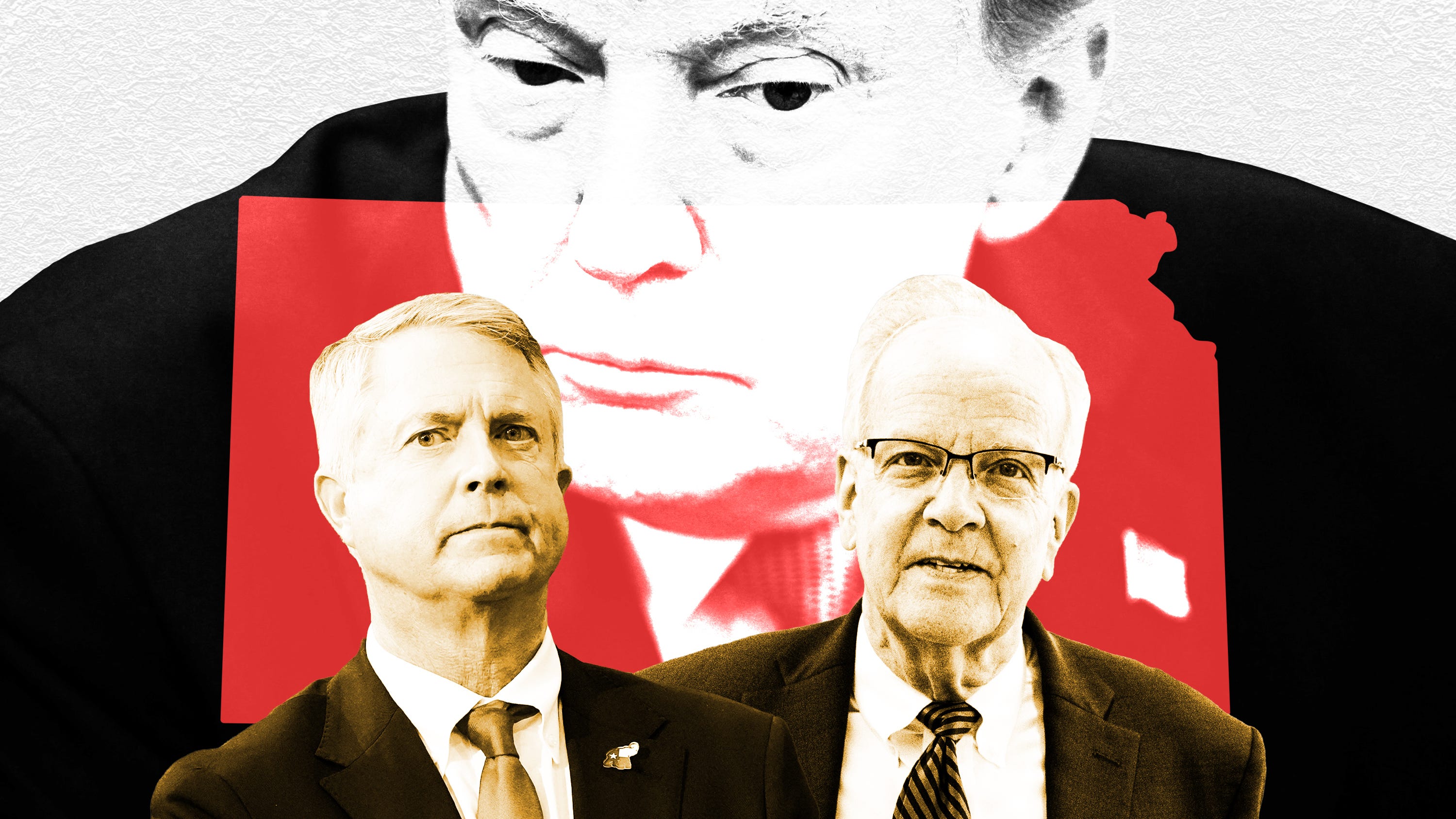
 They’re tied to Trump’s anchor
September 21
(Photo illustration by Bill Kuchman/The Bulwark
Photos: Getty, Shutterstock)
THE HOME OF DWIGHT EISENHOWER and Amelia Earhart is rarely part of the national conversation—but that could be about to change. It is becoming clear that the race for Senate this year could be a huge upset. In the nineteenth century, Kansas was the scene of violent clashes over slavery, which temporarily earned it the moniker “Bleeding Kansas,” and in the twentieth it was the birthplace of Brown v. Board of Education, the Supreme Court’s historic ruling finding racial segregation in public schools unconstitutional. But in recent decades, it’s been a backwater, mostly due to its size (a bit under 3 million people) and political lopsidedness. Kansas has voted Republican in every presidential contest since 1968 and hasn’t sent a Democrat to the Senate since 1932.
In light of that history, it would be foolish to get one’s hopes up too much about the Senate contest there this year. After all, the Republican incumbent, Roger Marshall, won his 2020 race by more than 11 points. But he isn’t sounding confident. At a recent debate, he bellowed over boos from the crowd, “What you’re going to get from me—you may not agree with me on everything—but you’re going to know exactly where I stand.” That sounds like someone who feels trapped and is making a virtue of necessity.
Marshall is trapped. Like nearly all Republicans, he has lashed himself to Donald Trump as Odysseus bound himself to the ship’s mast. He has bowed and scraped to MAGA with the best of them, even going so far as to praise Robert F. Kennedy Jr.’s cracked Make America Healthy Again agenda while measles deaths mount—and now he cannot escape.
Midterm elections are nearly always referenda on the sitting president. You can track the out party’s likely performance by knowing the popularity of the incumbent president. Though Kansans have a higher opinion of Trump than most of the country, his standing in the state has eroded. At the start of his second term, 60 percent of Kansans approved of Trump’s job performance; today, only 47 percent do. Among independents, 59 percent disapprove.
Like the rest of the country, Kansas has been burdened by high costs, but it’s been hit particularly hard by Trump’s trade and immigration policies. A Wichita State professor of international business estimates that Kansas is one of the most trade-dependent states in the country. One in six jobs in the state is directly tied to exports. Some tariffs might temporarily boost prices for some domestic products, like beef (which helps ranchers), but the chaotic implementation of the tariffs vitiated even that scant benefit. After imposing tariffs on imported beef, Trump repeatedly withdrew or weakened them, only to announce in August that the United States would temporarily lift tariffs on up to 660 million pounds of imported lean beef trimmings in an effort to reduce prices at the supermarket. As Americans have fully digested by now, tariffs are taxes that raise the prices of things we buy.
Agriculture Secretary Brooke Rollins, whose last foray into helping consumers was a recommendation that we all raise chickens in our backyards, seems unwilling to acknowledge the inevitable conflict between pandering to producers and pandering to consumers. She announced that the new policy would “protect the American rancher” and “the American consumer.” This was tough for both of Kansas’s Republican senators to swallow (as it were). Marshall said he was “frustrated” by the president’s actions, while Jerry Moran, apparently asleep for the past ten years as Trump has flattened every laissez-faire principle imaginable, urged the president to “let the free market work.”
Kansas’s beef with the administration goes beyond cattle. Kansas is the largest wheat-producing state in the union, and the twin blows of record-high diesel fuel prices and rising costs of fertilizer due to the closure of the Strait of Hormuz have been painful. This year, farmers are in doubt about how much to plant as export markets have been thrown into turmoil by Trump’s trade wars. Marshall bleats wanly that “the tariffs are working,” but tariffs on steel and aluminum have damaged the state’s large aviation industry, and as one small business owner observed sourly, her fertilizer bill had tripled this year and her diesel bill had doubled.
One of Kansas’s largest employers is the Canadian aviation firm Bombardier, which employs more than fifteen hundred people (and two thousand more in other states). While slapping around Canada, Trump has name-checked Bombardier, saying their products are not “good enough” and threatening to ban sales of their products in the United States. (If their products are so bad, why are people willingly buying them?) Employees at one of Bombardier’s Wichita plants were rattled. One told a Washington Post reporter, “This is ridiculous. We have thousands of Americans working here.” The Post delicately added that the employee used a profanity. Kansas’s two Republican senators are looking at their shoes and kicking sand, though Marshall did post that “I’m going to fight to keep Bombardier’s over 1,200 Kansas jobs. I’ve already taken that concern inside the Oval Office.”
How reassuring that must be.
Here’s another reason Marshall has cause to feel trapped: The Democrats have chosen a fantastically appropriate challenger. No DSA-adjacent progressive here. Instead, they nominated Adam Hamilton, pastor of the Church of the Resurrection, the largest Methodist congregation in the United States.
Hamilton is an articulate moderate, author of thirty books, who agrees that the border was out of control under Biden but notes that the indiscriminate meat-cleaver approach to immigration enforcement under Trump is damaging both economically and morally. “So right now, when you travel to southeast, southwest Kansas, you’re talking to people in the meatpacking industry, the cattle industry, and they’re saying, ‘Forty percent of our workforce are immigrants, and we need them, and we care about them.’” Later, he continued, “Stop demonizing them. Figure out a plan to bring immigrants in where it’s legal for them to be here, and where we can welcome them instead of [them] having to live in fear in our businesses or our communities.” Hamilton’s statistics are accurate, or perhaps a bit understated. Without those immigrant employees at meat processing facilities, prices of meat will climb even higher, to say nothing of the cruelty of uprooting families with long ties to the community and no criminal offenses of any kind.
Hamilton calls Trump’s tariffs “a disaster for everyone across the state of Kansas,” and hits the corruption theme hard. That’s exactly the kind of Democrat a Republican state demands.
Kansas is red, it’s true. But it has often chosen Democrats for governor, including incumbent Laura Kelly. So it isn’t as if Kansans’ fingers just can’t check off a Democratic box. After Hamilton won the primary, the Cook Political Report moved the race from “solid” to “likely” Republican. It is probably still Marshall’s race to lose, but the tailwind for Hamilton reflects just how badly Trump has betrayed his own base as well as the opportunities that open up when (A) there’s a wave building, and (B) the nominee matches the constituency.


No comments:
Post a Comment