
.png)
The eye of Hurricane Lala passed the southern tip of the Big Island as of Saturday evening, bringing a storm that blew fierce winds, caused gushing floods, knocked out power for some 60,000 people and contributed to the injuries of several people — at least one fatally.
The center of the eye did not cross over land, the National Weather Service said, so the storm did not technically make landfall. A hurricane has not made landfall on Hawaiʻi island in 155 years but Big Island Mayor Kimo Alameda noted that it was a close enough call that “we’re feeling the impacts.”
One person was killed in a head-on car collision Saturday afternoon at Hawaiian Ocean View Estates, and three others suffered traumatic injuries after a tree fell on them in Puna, according to the mayor. The injured were taken to Hilo Medical Center.
The storm forced the closure of more than 30 roads on the Big Island while winds ripped down power lines islandwide, and power was knocked out for more than 60,000 customers from Kohala to Nāʻālehu, according to Hawaiian Electric. Alameda said he was most concerned about the domino effect of that loss of power. It affects people who need home healthcare, including those who rely on oxygen tanks, as well as the island’s wastewater system, which was relying on backup energy as of Saturday evening.
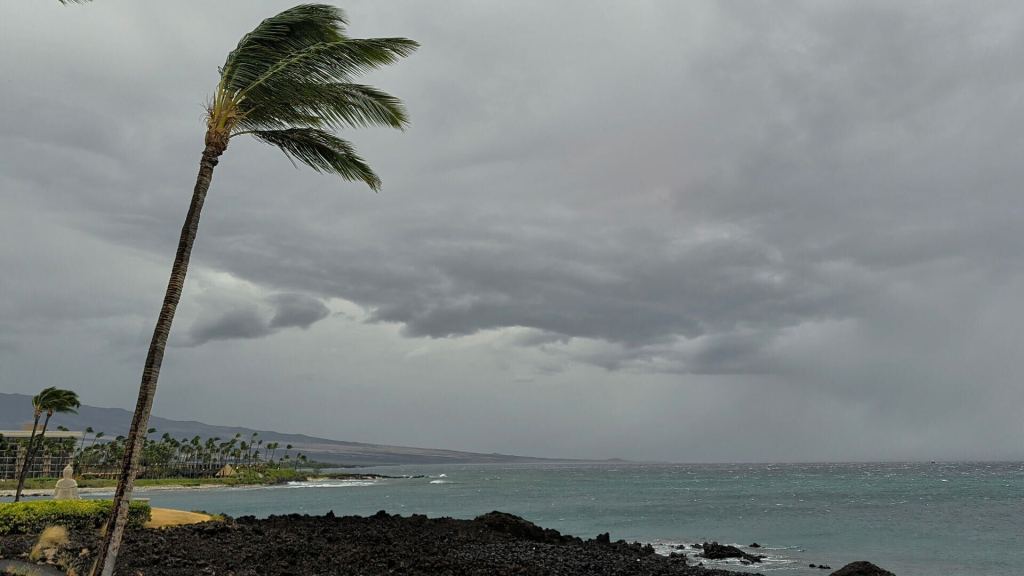 The sky above the golf course at Hilton Waikōloa Village during Hurricane Lala, shortly after 6:30 p.m. (Courtesy: Doug Cozloff)
HECO said crews are working around the clock to restore power but customers should prepare for the likelihood of extended outages, possibility overnight. Traffic lights were down across the island. In the early evening, Hawaiʻi County announced “a record number of widespread road closures and prolonged power outages.”
One reason for the extended problems was the danger the storm posed to workers sent out to make repairs.
“Conditions have degraded to a point that concern for the safety of our road and power personnel has resulted in crews being asked to fallback until conditions improve,” the Hawaiʻi Civil Defense Agency said just after 5 p.m.
Power was out or unstable for thousands of other residents across the other islands too even as it was being restored in some areas.
Damaging winds are expected to persist overnight on the Big Island and spread westward through Sunday. The National Hurricane Center warned winds would be most severe at higher elevations, and there is a risk for life-threatening flooding and mudslides, especially in areas with steep terrain. Storm surges and tides could flood coastlines by 1 to 3 feet on the Big Island.
The Hawaiʻi Department of Water Supply issued an Essential Needs Only Notice: Residents should use water only for drinking, cooking or personal hygiene.
Water levels in Big Island rivers and gulches had been rapidly rising all day. Wailuku River in Hilo surged from 3.4 feet at 7 p.m. on Friday to 16.2 feet by Saturday morning, according to the U.S. Geological Survey.
As the storm approached, Hawaiʻi island communities had prepared for impacts, and public and private services —from bus routes to flights — were canceled. Cancelations of some services began spreading to other islands later in the afternoon and evening as winds picked up.
More: Hurricane Lala Updates: Hawaiʻi Weather, Shelters, Map + More
 The water levels at the Wainaku Street Bridge were rising on Saturday. (Taylor Cozloff/Civil Beat/2026)
Power Out For Thousands
As of Saturday at 3 p.m., about 44,000 Hawaiian Electric customers statewide were without electricity. HECO said hundreds of personnel were working to address power outages but added that customers should prepare for possible prolonged periods without power, the company said.
Powerful winds have knocked down utility poles, and four of HECO’s independent power providers on Hawaiʻi island are disconnected from the grid because of storm damage. As a result, HECO warned that it might have to “load shed” — meaning temporarily shut off power for residents to maintain the stability of the system. Those shutoffs would only affect Hawaiʻi island, the company said and are not part of the company’s Public Safety Power Shutoff program.
 A postal worker delivers mail Saturday in Downtown Hilo. (Cody Yamaguchi/Civil Beat/2026)
At one point on Saturday, more than 30,000 customers were in the dark in Hilo, Kona, Kohala, Hāmākua, and Puna, according to HECO. A Civil Beat reporter on the Big Island who lost power was informed they would not have power back until Monday.
On Maui, approximately 3,300 customers had lost electricity in Upcountry Maui, Haʻikū, West and South Maui and Moloka‘i. On Oʻahu, roughly 8,400 customers had lost power in ʻAina Haina, Kaimukī, Kalihi, Mapunapuna, Mānoa and Nuʻuanu. In Kaimukī, some traffic signals had gone dark. In Waikīkī, power flickered in the afternoon but resumed.
HECO said its crews have been getting electricity back on as quickly as it is safe to do so. The numbers represented on the utility’s outage maps have fluctuated as power is lost and turned back on. Customers can call HECO to report downed power lines, which the company notes should be treated as “energized and dangerous.
- ”Hawaiʻi Island: 1-855-304-9191
- Maui County: 1-855-304-8181
- Oʻahu: 1-855-304-1212
Downed Trees, Road Closures
The Hawaiʻi County Civil Defense Agency reported a record number of road closures as the storm surged across the island. They included places where a landslide closed a lane of Hawaiʻi Belt Road in North Hilo at the 28-mile marker shortly before 8 a.m., and where a downed tree closed both lanes of Kohala Mountain Road near the 15-mile marker.
Sign Up For Emergency Alerts
Residents can sign up for Civil Defense emergency alerts here or by texting HAWAIIALERTS to 888777.Old Volcano Road also was closed because of downed power lines in Puna fronting the Keaʻau Urgent Care facility.
The Hawaiʻi Police Department advised drivers to avoid Plumeria Street between Hawaii Belt Road (Highway 19) and Lehua Street until late Saturday evening because of electric lines on road.
The county had warned on Friday that widespread rainfall of 5 to 10 inches was expected while the storm could drop more than 2 feet of rain on some areas. Officials expect peak impacts to hit on Saturday, but said hazardous conditions could drag on through Sunday.
Alameda, the Big Island mayor, said that by mid-morning Saturday, about 130 people had taken refuge in the dozen emergency shelters opened by the county, including many Puna residents who were alarmed by high winds and flooding. He said gusts of 70 mph had been reported in Kohala at that point.
“In the past hour, it already elevated our concerns,” he said at the time.
The county did not announce any mandatory evacuations, but Alameda said he believed the threat from Hurricane Lala was “only going to get worse. We haven’t felt the brunt of it yet, at least from what we’re hearing from the Weather Service.”
Indeed, as the hurricane passed the southern point of the island, gusts at the the highest elevations ranged above 100 mph late Saturday afternoon.
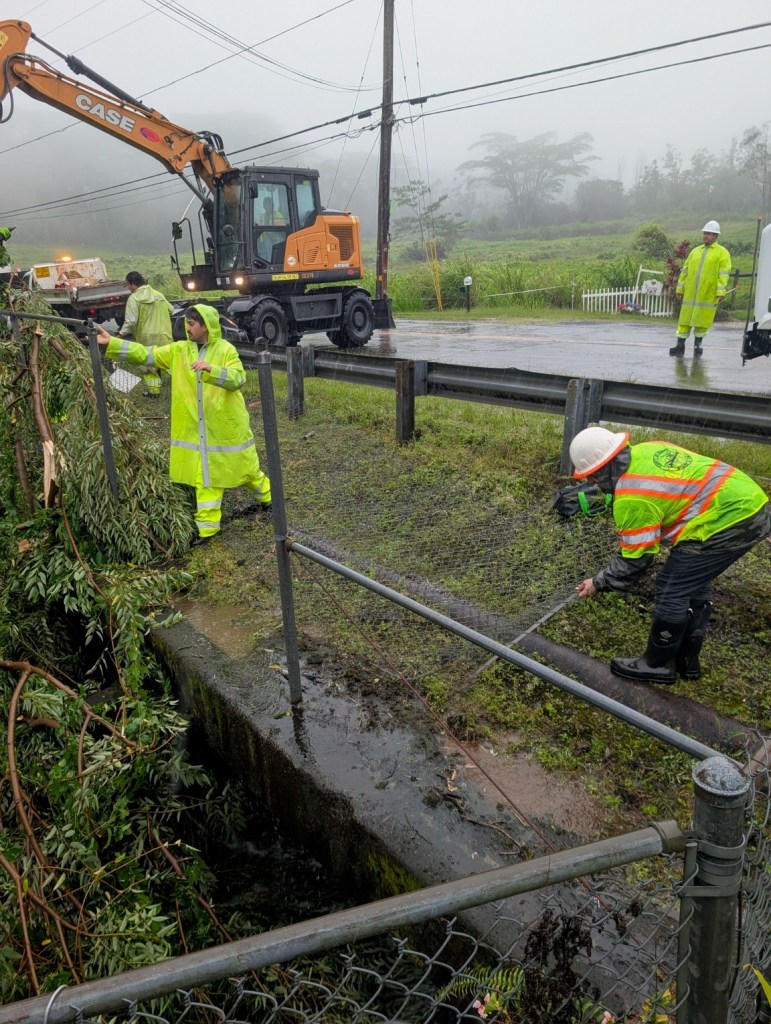 County workers clear debris from a fallen tree in Waiākea Uka in Hilo on Saturday. (Courtesy Hawaiʻi County/2026)
 Flooding on Hono’apu Road in Ka’u during Hurricane Lala. (Courtesy Hawaiʻi County/2026)
The county’s main concern Saturday morning had been the area from Kohala down to Ocean View in Kaʻū, the mayor said. Some people were reporting only modest impacts from the storm in other parts of the island, including North Kona, but Alameda said he told them, “Not for long. Not for long, man.”
“So, so they’re bracing themselves,” he said. “We’re really not out of the woods. I mean, I feel it. I can sense it. I’d say by 6 o’clock tonight, six to 12 o’clock tonight, we’re going to be hurting.”
He added: “I mean, I hope not. I pray not. But it looks like it’s projecting that way.”
Civil Defense received a report of one car that had hit a fallen tree on Hawaiʻi 19, but there were no injuries in that accident, according to county spokesman Tom Callis. Other toppled trees have caused problems.
“The storms barely even started, and we already had a big tree fall and hit the roof,” Cassidy Silva of Mountain View posted on Facebook on Saturday morning.
 Flooding along Mana Road in Waimea on Saturday. (Courtesy Hawaiʻi County/2026)
Alameda said closure of the Hilo and the Ellison Onizuka Kona International airports helped with the county’s emergency response because it meant fewer visitors circulating on the Big Island.
“A good, significant number of our rescues are the tourists because they’re not informed, they don’t have the app, they’re not signed up to our alerts,” he said, “so they just go right into the road closure or sometimes it’s flooding.”
The tourists who remained were told to shelter in place, he said.
The storm kept county highway crews busy all Friady night cutting trees, clearing roadways and closing roads where hazards were reported, Alameda said. The county announced shortly before noon Saturday that Highway 11 near Waiʻōhinu was blocked by fallen trees, and Highway 11 near Kāwā Flats was closed because of flooding. Kāwā is the site of regular flooding during heavy rains.
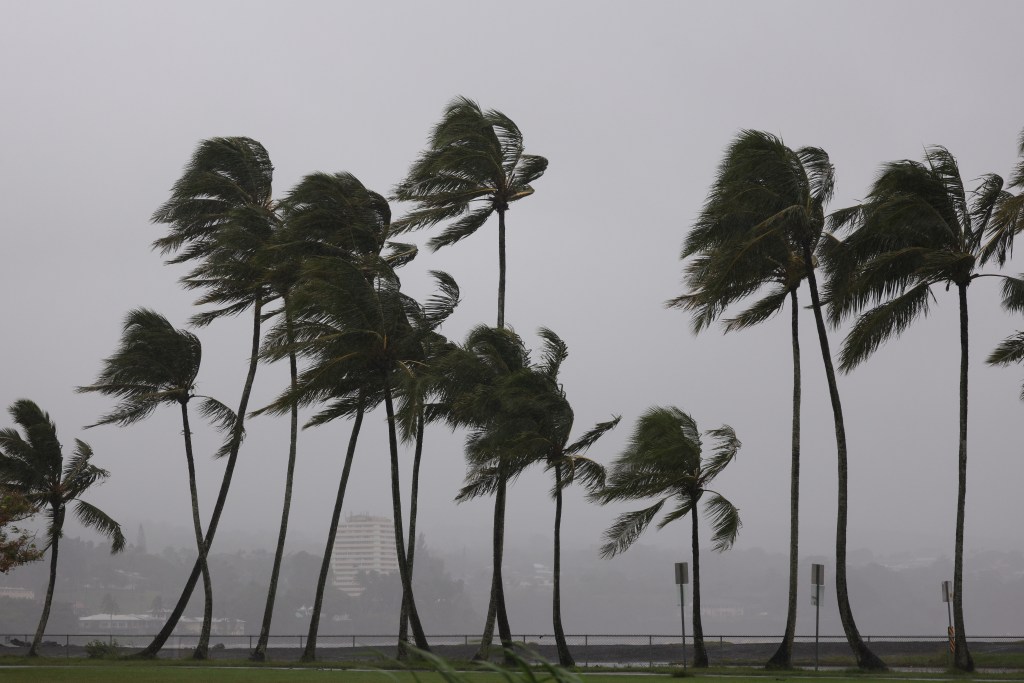 Hurricane Lala blew through palm trees in Hilo on Saturday. (Cody Yamaguchi/Civil Beat/2026)
On Saturday afternoon, the mayor issued a statement urging people to stay sheltered in place.
“We are receiving reports of downed trees and road closures across the island, and hazardous weather conditions will continue to intensify today,” he said.
“While road crews are working hard to clear debris as conditions allow, we need all residents and visitors to heed all warnings, move into safe shelter, and stay off the roadways. For your safety, and the safety of our first responders, we urge our community to continue to hunker down until this hurricane passes.”
Mayor: ‘All Hands On Deck’
The Hawaiʻi County Civil Defense headquarters had been fully activated by Friday morning to include state leaders and the National Guard, and “right now we’re basically monitoring,” Alameda said.
”We want to make sure that all of our culverts are clear, and our flood canals are also clear,” he had said on Friday.
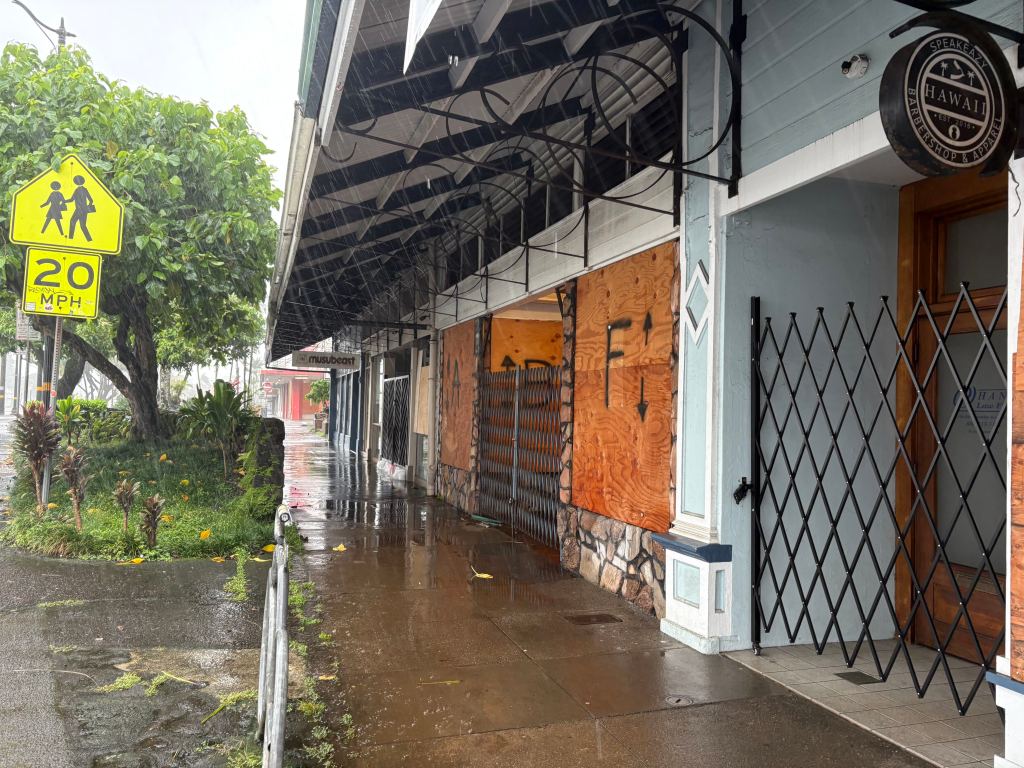 Bernie’s Barber Shop in downtown Hilo on Kamehameha Ave was boarded up on Saturday morning. (Taylor Cozloff/Civil Beat/2026)
The county has replaced culverts in South Kona and cleared drainage channels since floodwaters from the Kona low storms in March surged through South Kona.
“We’ve tried to better assess the flood patterns, which is kind of difficult because it didn’t go the way we thought it would during the Kona low,” Alameda said. “It went all kinds of different directions than we thought it would.”
“We brought out maps in South Kona, we brought out maps in Kaʻū and we kind of compared it with what happened in the Kona low and then we adjusted our flood canals accordingly,” Alameda said, “but we don’t know what we don’t know, so we did the best we can to prepare for that.”
More: How Is Climate Change Shaping Hurricane Lala?
Staff had started outreach to the homeless population on the island on Thursday, the mayor said, and the county had opened a dozen shelters across the island at 6 p.m. on Friday.
One area of particular concern is a “Safe Sleeping” tent shelter run by the Salvation Army in a vacant lot along Hilo’s Ponahawai Street. If that operation has to be evacuated, Alameda said about 70 of the homeless people who sleep there will be directed to an indoor shelter at Clem Akina Park in the Puʻu’eo neighborhood.
Residents are being reminded they need to bring their own supplies, and the county will supply cots.
“This is pretty much all hands on deck,” Alameda said. “Everybody’s concerned, and I appreciate the state and the federal government for helping us out.”
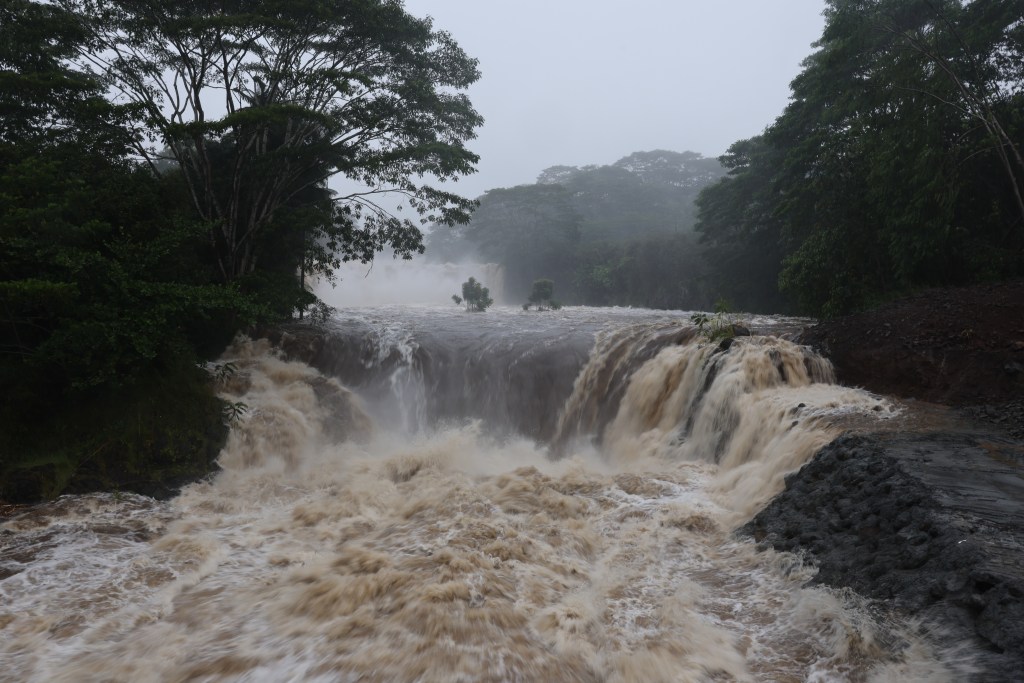 The Wailuku River surged Saturday in Hilo. (Cody Yamaguchi/Civil Beat/2026)
Hilo Streets Mostly Empty
Downtown Hilo was mostly a ghost town Saturday morning. Some shops were boarded up. Others just had sandbags in front of their doors, some of which looked homemade: Garbage bags with some miscellaneous items to weigh them down.
Puna Chocolate Company was one of the only stores with its lights on. Though it opened a few hours later than the posted hours, the plan was to close at the normal 11 p.m.
Hannah Ham and Hailey Zamudio were behind the counter, sipping coffee and watching the rain pour down outside.
 Extreme Exposure Art Gallery in downtown Hilo was bracing for the storm with sandbags on Saturday morning. (Taylor Cozloff/Civil Beat/2026)
 Homeless folks sat under an overhang on Kamehameha Avenue near the Anuenue On the Bay coffee shop. (Taylor Cozloff/Civil Beat/2026)
“I’ve lived in Hawaiʻi my whole life,” Ham said. “For me, it’s like, if it’s gonna hit, it’s gonna hit. Doesn’t matter where I am.”
They had just two customers by 9:30 a.m. Making some tips was worth braving the storm, they said, and their boss was regularly checking in.
Spencer Health and Fitness Center was briefly open in the morning, but staff were closing the doors by 10 a.m. The Sack N Save grocery on Haili Street closed its doors at 10 a.m.
There were numerous homeless people on Keawe Street and Kamehameha Avenue on Saturday morning. The mayor said the county had done outreach to direct them to shelters. One man Civil Beat spoke to, who declined to give his name, said he didn’t know about shelters.
 Hawaiʻi County Mayor Kimo Alameda said outreach workers directed the homeless who frequent downtown Hilo to a shelter at Clem Akina Park, but many remained on the street in the rain and wind. (Courtesy Hawaiʻi County/2026)
Falling Trees A Concern
Invasive trees in Puna pose a risk to humans, structures, and the electrical grid.
When Hurricane Iselle made landfall as a tropical storm in 2014, invasive albizias — which originate in Africa, extend as high as 100 feet, and grow up to 15 feet a year — caused an estimated 10s of millions in damage to roads, vehicles and residences.
The Big Island Invasive Species Committee calls them “one of the most notorious invasive trees in the state.”
Ironwood trees are slower growing but also prone to breaking and falling over in storms.
“These non-native trees are brittle and they come down easily in storms,” said Elliott Parsons, a specialist with the Pacific Regional Invasive Species and Climate Change Management Network at the University of Hawaiʻi.
Some residents rushed to remove albizias this week before the storm, but the cost of paying an arborist to scale the tall trees to remove them is prohibitive for most.
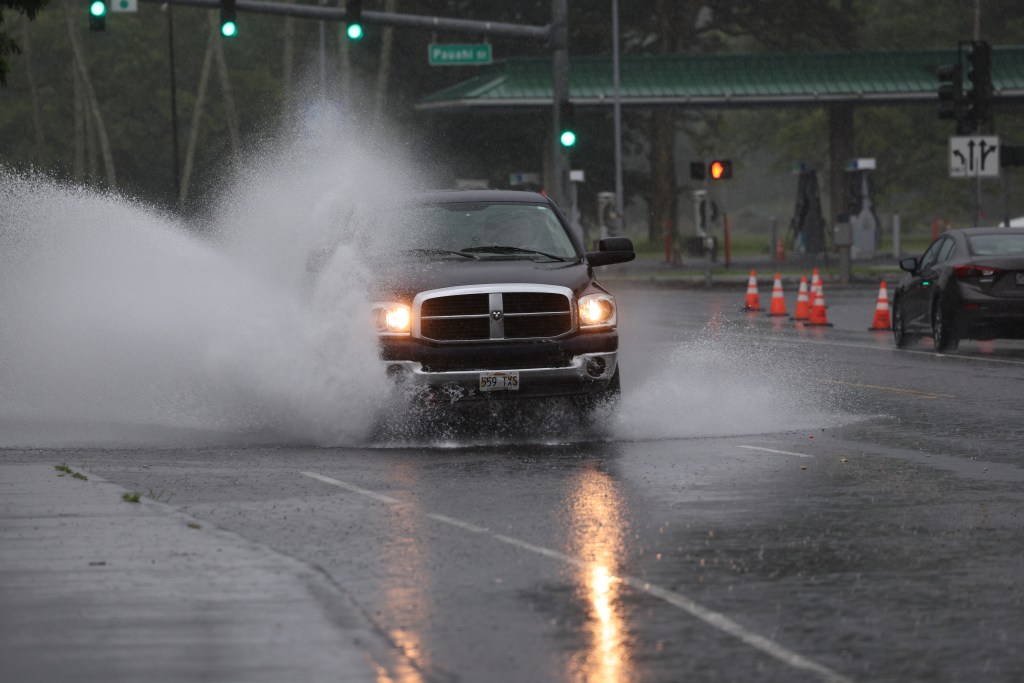 A vehicle drives along wet roads in downtown Hilo on Saturday. Kamehameha Avenue experienced some flooding in the afternoon. (Cody Yamaguchi/Civil Beat/2026)
Shelters Are Open
The county has shelters open at the locations below. Residents should bring their own food, water and any necessary medicine.
- Old Kohala Courthouse, 54-3900 ʻAkoni Pule Highway, Kapaʻau
- Waikoloa Elementary School cafeteria, 68-1730 Hoʻoko St., Waikoloa
- Kahilu Theater, 67-1186 Lindsey Road, Waimea
- Honokaʻa Gym, 45-541 Lehua St., Honokaʻa
- Laupāhoehoe Public Charter School Band Room, 35-2605 Mamalahoa Highway, Laupāhoehoe
- Waiākea High School Gym, 155 W. Kawili St., Hilo
- Keaʻau Armory, 16-512 Volcano Road, Keaʻau
- Pāhoa Neighborhood Facility, 15-2910 Kauhale St., Pāhoa
- Robert N. Herkes Gym, 96-1219 Kamani St., Pāhala
- Nāʻālehu Elementary School gym, 95-5545 Mamalahoa Highway, Nāʻālehu
- Kealakehe High School Gym, 74-5000 Puohulihuli St., Kailua-Kona
- Yano Hall, 82-6156 Māmalahoa Highway, Captain Cook


No comments:
Post a Comment